Understanding Functions Intuitively

A function is a rule that takes an input and gives back exactly one output. A vending machine is a function: you press B4, and you get the same snack every time. Press B4 again tomorrow, same snack. That predictability, one input mapping to one output, is the whole idea. This article builds the picture from the ground up, then shows why functions quietly sit underneath almost everything else in math.
Functions are everywhere in mathematics, but they are often introduced as abstract notation (f(x), domain, codomain) before students ever get a feel for what they are. The result is a lot of people who can compute f(3) without ever picturing what a function actually does.
Let us fix that.
A Function Is a Machine
The cleanest way to picture a function is as a machine with one input slot and one output slot. You drop something in, the machine processes it according to a fixed rule, and one result comes out.
Consider the rule "double it." Put in 3, get 6. Put in 10, get 20. Put in -2, get -4. The machine does not care about your mood or the time of day. Same input, same output, every time.
That reliability is the defining feature. The rule "give me a number between 1 and 10" is not a function, because the same input could produce different outputs. But "double it" always behaves. One input, one output.
We write this machine as f(x) = 2x. The f is the machine's name. The x is whatever you feed it. The 2x is the rule it applies. So f(3) = 6 is just shorthand for "run the doubling machine on the input 3."
Reading the Notation Without Fear
The notation f(x) trips up more students than the concept itself, mostly because it looks like multiplication. It is not. f(x) does not mean f times x. It means "the output of f when the input is x."
Think of the parentheses as the input slot on the machine:
- f(2) means run the rule on 2.
- f(a + 1) means run the rule on the quantity a + 1.
- f(anything) means run the rule on whatever sits inside.
If , then . You just drop 4 into every spot where x appears. That is the entire skill. Once the notation stops looking like multiplication and starts looking like a labeled input slot, most of the confusion disappears.
Domain and Range: What Goes In, What Comes Out
Every machine has limits on what it can accept. A vending machine takes coins, not seashells. Functions are the same.
The domain is the set of all inputs the function is allowed to take. The range is the set of all outputs it can actually produce.
For f(x) = 2x, you can double any real number, so the domain is all real numbers, and you can reach any real number as an output, so the range is all real numbers too.
But many functions have restrictions, and the restrictions are never arbitrary. They come from operations that break:
- cannot accept 0, because dividing by zero is undefined. Its domain is every real number except 0.
- f(x) = the square root of x cannot accept negative numbers (in the real numbers), so its domain is .
Finding a domain is really just asking: what inputs would make this machine jam? Exclude those, and you have your answer.
The Graph Is a Picture of the Machine
A graph is just a visual record of every input-output pair the machine produces. The horizontal axis holds the inputs, the vertical axis holds the outputs, and each point (x, y) says "when you feed in x, you get y."
This gives us a quick visual test for whether something even is a function. Since each input must produce exactly one output, no input can sit above two different output values. So:
The vertical line test: if any vertical line crosses the graph more than once, it is not a function.
A straight line passes. A parabola passes. A circle fails, because most vertical lines hit it twice, meaning one x-value would map to two y-values. The machine would not know which output to give, so a circle is not a function.
A Small Zoo of Common Functions
Once you see functions as machines, the named families stop being a list to memorize and start being characters with personalities:
- Linear (): changes at a constant rate. Its graph is a straight line. This is the function behind anything that grows steadily, like distance at constant speed.
- Quadratic (): rises, turns, and falls (or the reverse). Its graph is a parabola, the shape of a thrown ball's path.
- Exponential (): multiplies by the same factor each step, so it grows shockingly fast. This is the engine behind compound interest and population growth. (See understanding exponents.)
- Logarithmic: the inverse of exponential, growing fast at first then crawling. (See understanding logarithms.)
You do not need to memorize their formulas to recognize them. You need to know the shape each one makes and the kind of change it describes.
Combining and Reversing Machines
Two ideas turn functions from isolated rules into a toolkit.
Composition is feeding one machine's output into another. If g doubles a number and f adds 1, then f(g(3)) means double 3 to get 6, then add 1 to get 7. You chain the machines. This shows up constantly in calculus: the chain rule is precisely the rule for differentiating composed functions.
Inverse functions run the machine backward. If f doubles, its inverse halves. If f adds 10, its inverse subtracts 10. An inverse undoes whatever the original did, taking outputs back to the inputs that produced them. Not every function has an inverse, though: only ones where each output came from a single input (otherwise running backward would be ambiguous).
Why Functions Sit Underneath Everything
Here is the payoff. Almost every advanced topic in math is really a question about functions:
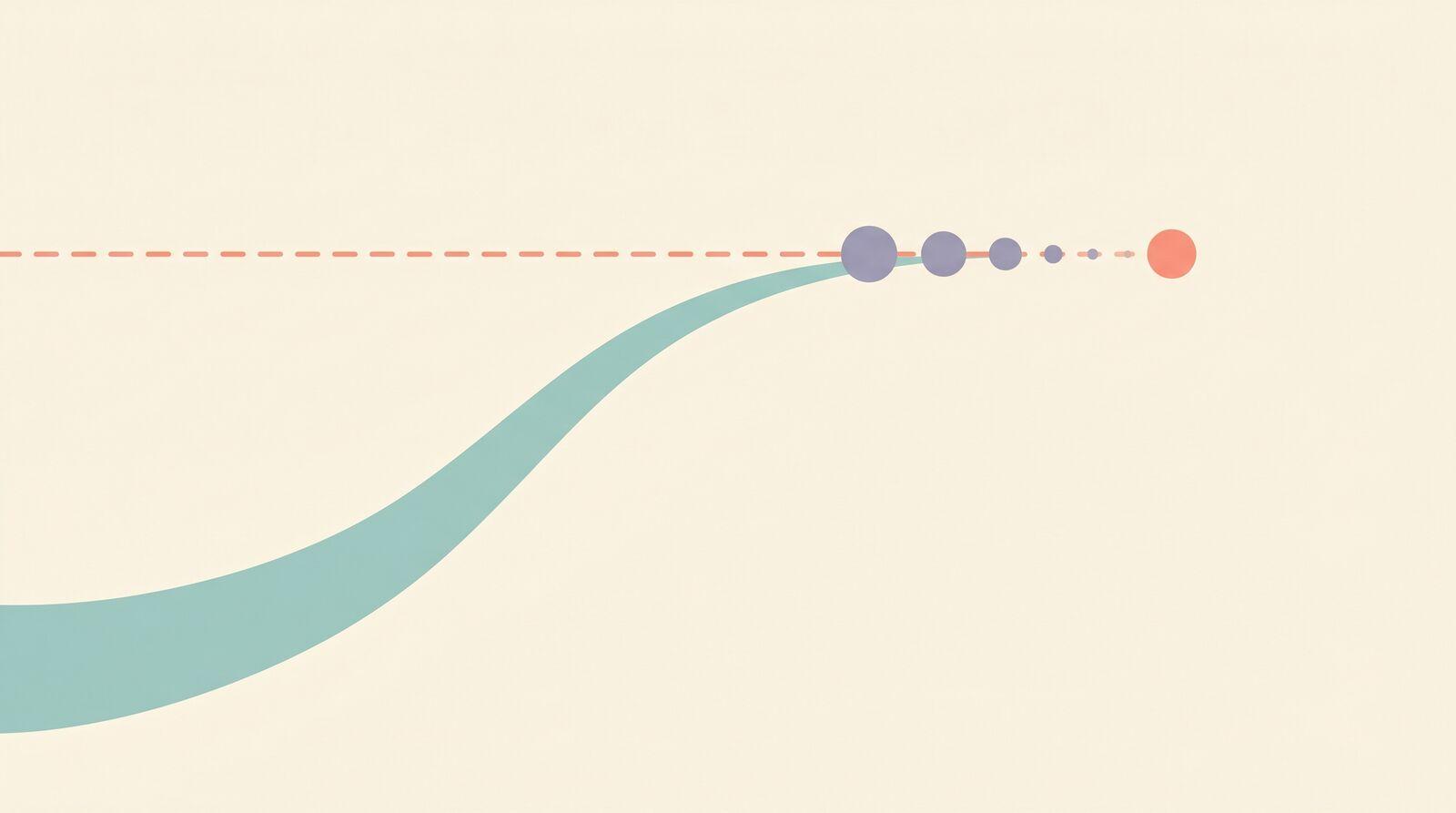
- A limit asks what output a function approaches as the input approaches some value.
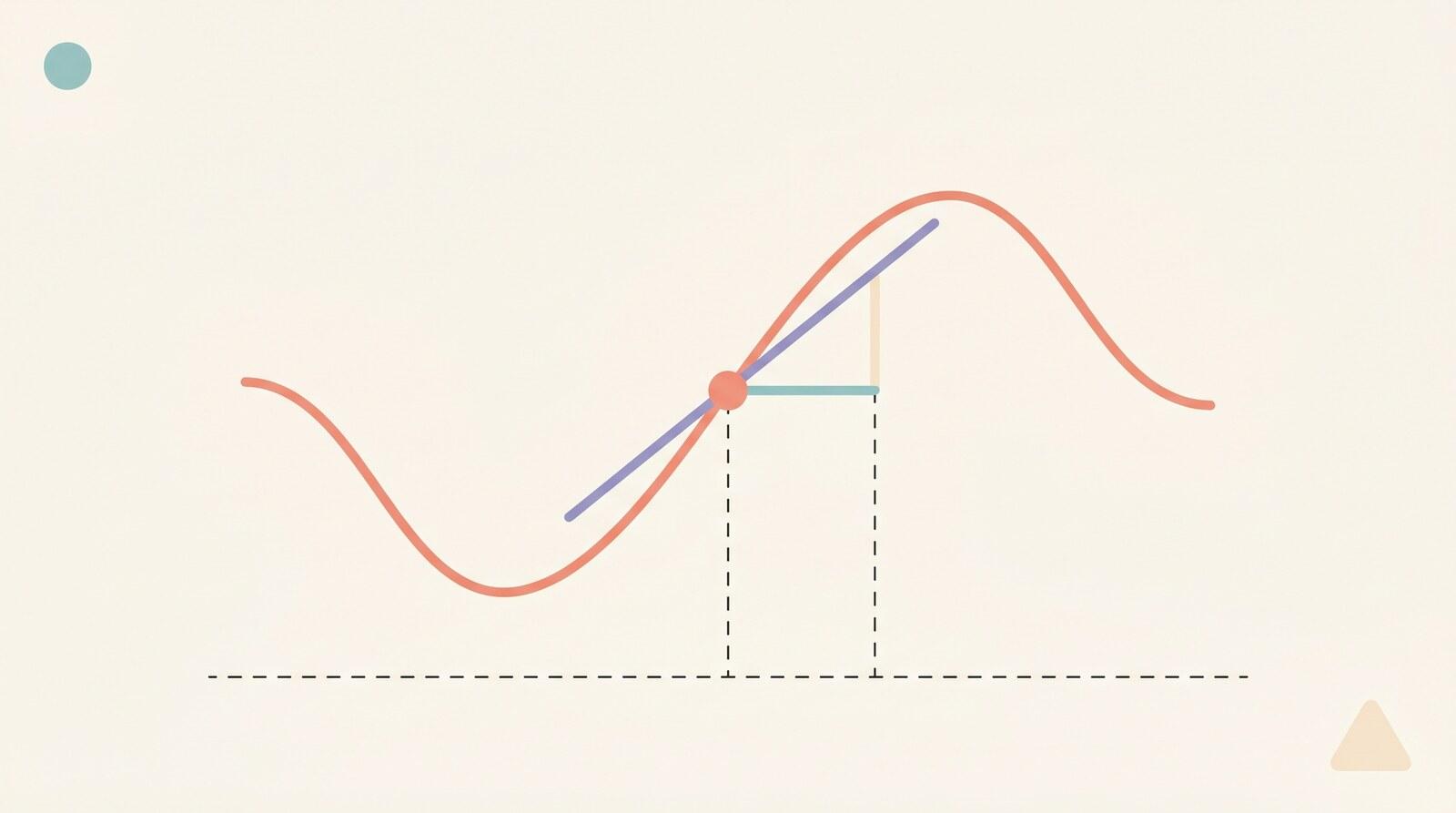
- A derivative measures how fast a function's output changes as its input changes.
- An integral adds up a function's output over a range of inputs.
If functions are shaky, all of calculus feels like fog. If functions are solid, calculus becomes a set of natural questions you can ask about a machine: where does it head, how fast does it change, how much does it accumulate.
Why This Matters for Learning
When you practice functions in Math Zen, you work through problems that build from evaluating f(x) and reading graphs up to domain and range, composition, and inverses, with difficulty that adapts to where you actually are.
Understanding the machine picture helps because:
- Evaluating f(a + 1) stops being scary once you see the parentheses as an input slot.
- Domain questions become "what would jam this machine?" instead of a rule to memorize.
- The same intuition carries directly into the spaced repetition you will use to keep these ideas fresh, and into every calculus topic that follows.
The Takeaway
A function is a reliable machine: one input, one output, every time. The notation f(x) is just a labeled input slot, the domain is what the machine accepts, the range is what it produces, and the graph is a picture of all its input-output pairs.
Next time you see f(x), do not think "scary algebra." Think: "what does this machine do to whatever I feed it?" That one shift makes functions, and everything built on top of them, far more intuitive.
Common Questions
- What is a function in simple terms?
- A function is a rule that takes an input and produces exactly one output. Put the same input in and you always get the same output back. A vending machine is a function: press B4 and you always get the same snack. The word "function" just names this reliable input-to-output relationship.
- What is the difference between domain and range?
- The domain is the set of all inputs the function is allowed to accept, and the range is the set of all outputs it can actually produce. For f(x) = the square root of x, the domain is all numbers zero or greater, because you cannot take the square root of a negative, and the range is also all numbers zero or greater.
- What does f(x) actually mean?
- It means "the output of the function f when the input is x." The f is the name of the rule, and whatever sits inside the parentheses is the input. f(2) means run the rule on the input 2. The notation is not multiplication: f(x) does not mean f times x.
- How do you know if a graph is a function?
- Use the vertical line test. If any vertical line crosses the graph more than once, the graph is not a function, because that single input would have two different outputs. A circle fails the test, a straight line passes it.
- What is the difference between a function and an equation?
- An equation states that two things are equal and may be true for only specific values. A function is a rule that assigns one output to every input in its domain. You can write a function using an equation, like y = 2x + 1, but the function is the machine that turns each x into its y, not the statement of equality itself.