Understanding Limits Intuitively (The Idea Behind Calculus)
The first chapter of every calculus textbook is about limits, and almost no student walks out of it feeling clear. The notation is dense, the examples often pick the strangest cases first, and the formal definition involves Greek letters that take an entire lecture to explain. By the time the textbook gets to the part where limits matter (derivatives, integrals, the entire rest of calculus), most readers have already decided to memorize procedures and hope for the best.
This article is not the formal definition. It is the picture of what a limit actually is, why we need the concept in the first place, and how it quietly powers every subsequent idea in calculus. Read it once, and the rest of the chapter will make sense.
Why Limits Sound Scarier Than They Are
If you ask a math student what a limit is, you usually get one of two answers: "the value a function approaches" or "I do not really get it." Both are honest. The first is correct but vague. The second is the sound of someone who was handed the formal definition before the intuition.
A limit is, in plain English, the answer to a single question: where is this function headed? You do not actually have to arrive there. You only have to look at where the function is going.
That is the whole concept. Everything else is bookkeeping for cases where the answer is unclear or surprising. If you can hold onto "where is it headed?" while you read the rest of the chapter, the formal machinery starts looking like a careful way of pinning down something you already understand.
The Simple Version: Where Is the Function Going?
Imagine the function f(x) equals x plus 1. What does it equal at x equals 3? Easy: 4. So the limit of f(x) as x approaches 3 is also 4, because as you slide x closer and closer to 3 from either side, f(x) slides closer and closer to 4. The limit and the actual value happen to match.
This is the first surprise: for most well-behaved functions, the limit is just the value. You can compute the limit of x plus 1 as x approaches 3 by literally plugging in 3 and reading off 4. No drama, no special technique. So why did anyone invent limits?
Because not every function is well-behaved at every point. Some have holes. Some have jumps. Some shoot off to infinity. And the most important functions in calculus involve a fraction with zero on the bottom, which is mathematically illegal as a value but completely well-defined as a limit. The concept exists for the cases where plugging in does not work.
Take . At x equals 1, the bottom is zero, so the function is undefined. But what about at x equals 0.99? At x equals 0.999? At x equals 1.0001? Plug those in, and you get values like 1.99, 1.999, and 2.0001. The function is heading toward 2, even though it never actually reaches 2 at the point we care about. The limit is 2.
That gap, between "where the function is heading" and "what the function equals at the point," is the whole reason limits exist. They let us talk about behavior near a point without requiring the point itself to be defined.
One-Sided Limits: Approaching from the Left or the Right
When you slide x toward some target value, you can come at it from below (smaller numbers) or from above (larger numbers). Most of the time, both approaches give the same answer. Sometimes they do not. When they disagree, mathematicians keep them separate.
The limit from the left is what the function approaches as x climbs up toward the target from below. The limit from the right is what the function approaches as x slides down toward the target from above. If both sides agree, the function has a regular limit at that point, equal to whatever they both say. If the two sides disagree, the limit at that point does not exist.
A clean example is the absolute value function divided by x. At x equals 0, the function is undefined. From the right, it equals 1, because positive numbers stay positive when you take the absolute value, and dividing by themselves gives 1. From the left, it equals minus 1, because negative numbers flip sign under absolute value, so you get a negative divided by a negative made positive again, which is minus 1. The two sides give different answers. There is no single limit at zero.
This is not a defect of the concept. It is a feature. The one-sided limits each tell you something specific about the function's behavior, and forcing them to agree would hide useful information. When a textbook draws an open circle on a graph and the function jumps to a different open circle, that is a place where the two one-sided limits disagree.
When the Limit Exists and When It Does Not
There are three things that can happen at a point.
The function is well-behaved. Both one-sided limits agree, and they match the function's value at the point. Plug in and you are done. Most calculus problems live here, even the scary-looking ones.
The function has a hole or a jump. Both one-sided limits exist as finite numbers, but they may or may not equal the function's value, and they may or may not equal each other. If they agree, the limit exists (and it might not equal the value, which is fine). If they disagree, the limit does not exist.
The function blows up to infinity. As x approaches the target, the function grows without bound, either positively or negatively. Mathematicians sometimes write that the limit is infinity, but that is shorthand for "the limit does not exist, and here is the direction it fails." Infinity is not a number you can land on.
Once you know which of these three behaviors a function has at a point, you have classified the limit. Most of a calculus chapter on limits is just teaching you how to recognize which case you are in.
Why We Need Limits at All
Here is the question that turns limits from a curiosity into the foundation of calculus: how fast is something changing right now?
If you drive 60 miles in one hour, your average speed is 60 miles per hour. That is a simple division. But your speedometer can show your speed at this exact instant, not over an hour. How does it know? You did not travel any distance in zero seconds, and you cannot divide by zero, so the obvious calculation breaks.
The fix is to look at smaller and smaller windows of time. Over the past minute, you went a certain distance, so your average speed in that minute was distance divided by minute. Over the past second, you went a smaller distance, and the average over that second was its own number. As the window shrinks toward zero, the average speed approaches a specific value, and that value is your instantaneous speed. The limit lets you talk about a "rate at an instant" without ever literally dividing by zero.
This same trick, taking a quantity that breaks at a single point and asking what it is heading toward, is how derivatives, integrals, infinite series, and continuity are all defined. Without limits, calculus does not exist. With limits, the whole field becomes a clean extension of what you already know about ordinary arithmetic.
The Zero-Over-Zero Problem
The most common puzzle in a limits chapter is a fraction that gives zero divided by zero when you plug in. Students see that and assume the function is broken. It is not broken. It is asking you to do a little algebra first.
Consider as x approaches 2. Plug in 2 and you get zero on top and zero on bottom. Useless. But factor the top: . Now the fraction simplifies to x plus 2 (after canceling the (x minus 2) factors), and plugging in 2 gives 4. The original function had a removable hole at x equals 2, and the limit fills the hole with the value the function would have had if the hole were not there.
The cancellation is not a magic trick. It is a reminder that fractions are, as we covered in the fractions intuition post, divisions waiting to happen, and the same algebraic moves you learned in middle school still apply. Zero over zero just means "more than one number could fit here; do the algebra to find out which."
This pattern (find the indeterminate form, simplify, then plug in) handles a huge fraction of the limit problems in a typical course. The trickier cases involve trigonometric or exponential functions, but the idea is the same: the function looks broken at the target, but it is actually heading somewhere specific, and the algebra reveals where.
From Limits to Derivatives
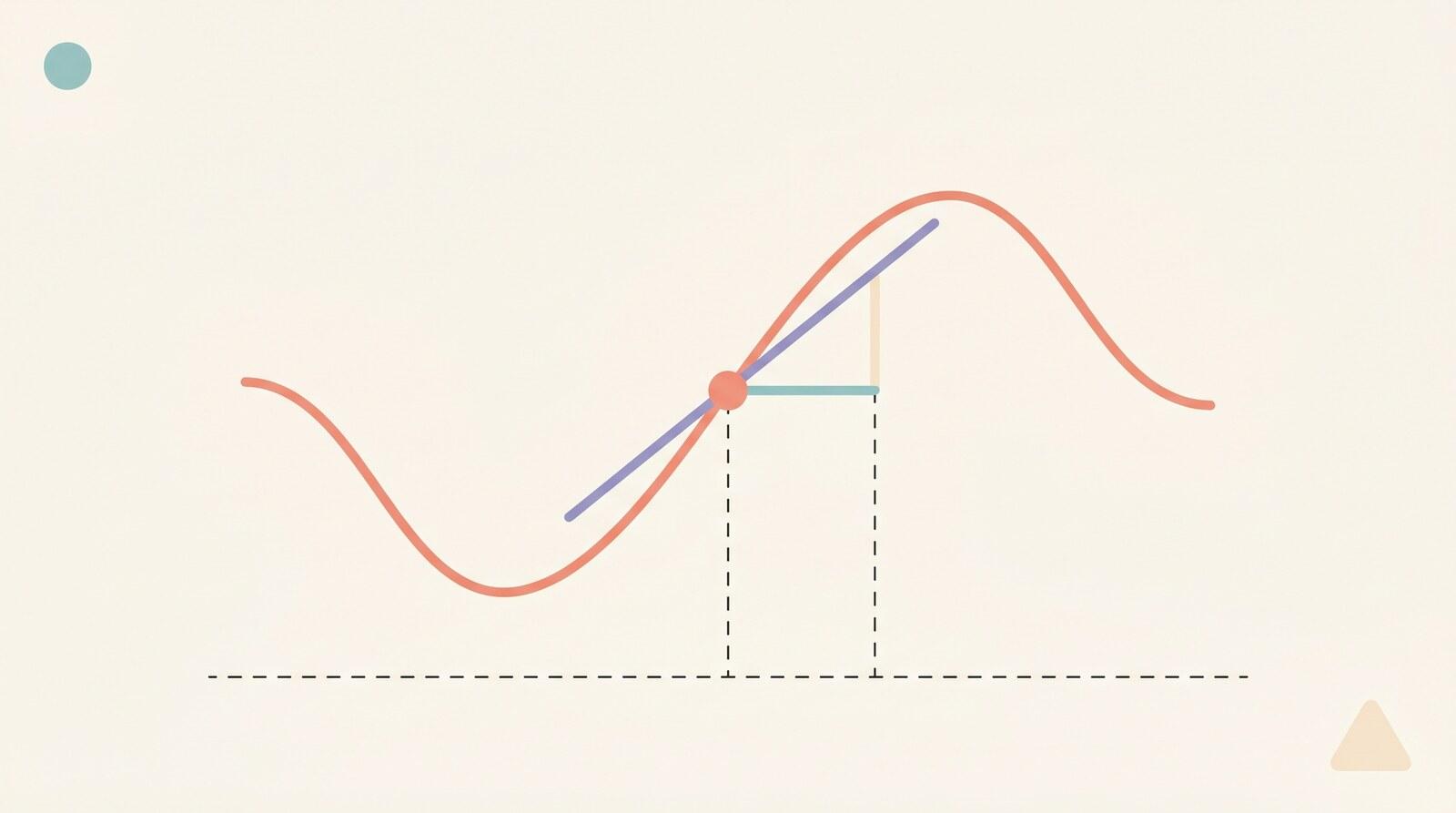
If you understand limits, derivatives are a one-line idea. The derivative of a function at a point is the slope of the function at that point, and "slope at a point" is exactly the kind of thing you cannot compute with ordinary arithmetic, because slope requires two points and a single point gives you nowhere to measure from.
The fix is the same fix that gave us instantaneous speed. Pick a second point a tiny distance h away from your point of interest, compute the slope of the line connecting the two, and then take the limit as h goes to zero. As the second point slides closer to the first, the line's slope approaches the slope of the curve at the original point. That limit is the derivative.
This is why the formal definition of the derivative looks like a fraction with h in it: it is the slope between two points, with h about to become arbitrarily small. We unpacked this in detail in our post on derivatives from scratch, where the limit machinery does the work of "zooming in until the curve looks straight."
If limits feel abstract, this is the moment they pay off. Every derivative rule you will memorize, the power rule, the chain rule, the product rule, is a consequence of this one limit, applied to specific kinds of functions. If you know limits, you can derive the rules. If you only know the rules, you are at their mercy.
Limits at Infinity and Asymptotes
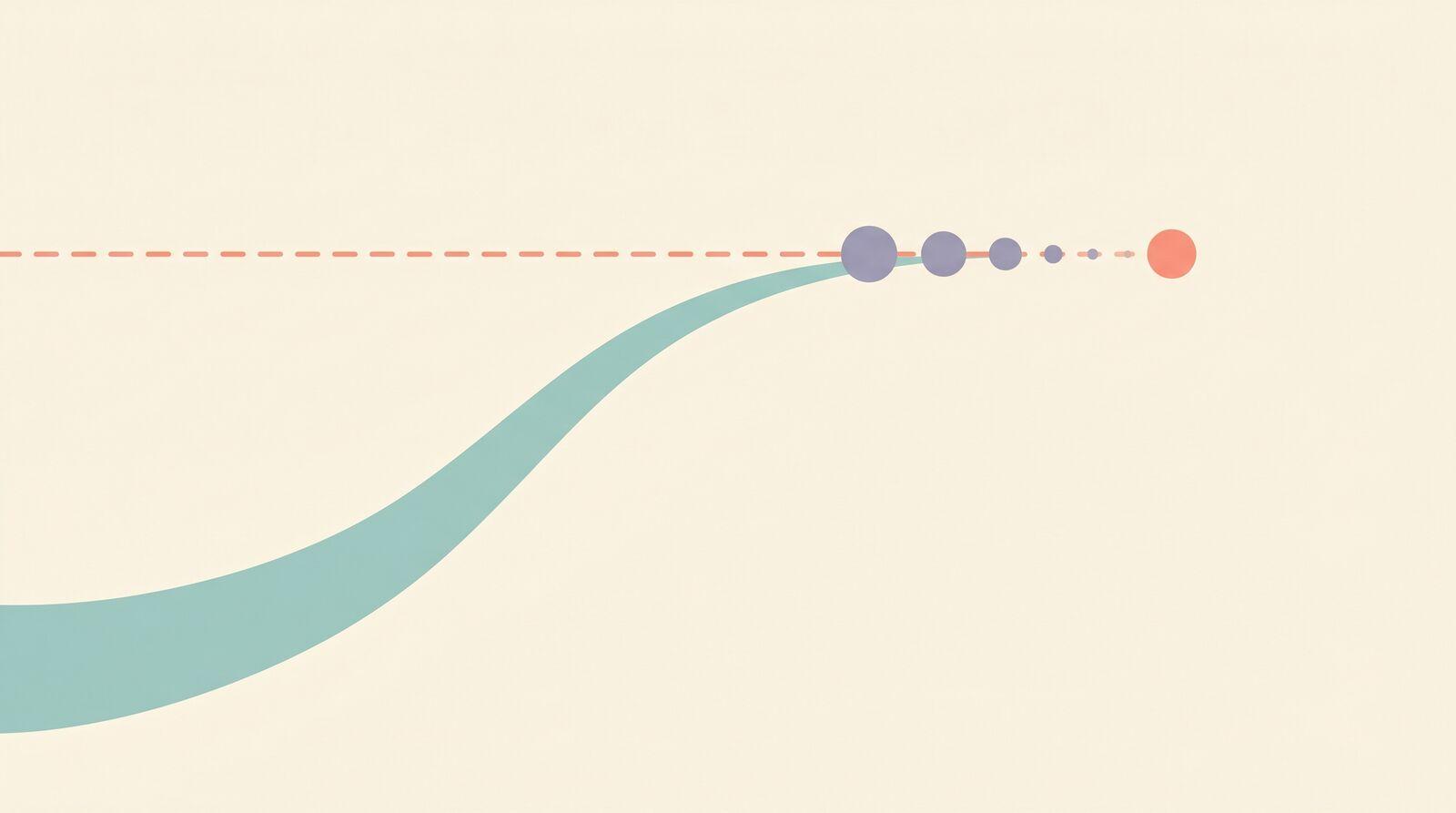
There is a second kind of limit that often shows up alongside the first. Instead of asking what happens as x approaches a finite number, you can ask what happens as x heads toward infinity. The function might level off at some value, in which case it has a horizontal asymptote. It might keep growing, in which case there is no finite limit. Or it might oscillate forever without settling, in which case the limit also does not exist.
Take f(x) equals 1 divided by x. As x grows larger and larger, the fraction gets smaller and smaller. The limit of 1/x as x approaches infinity is 0. The function never actually reaches 0, but it heads there as relentlessly as you like. The horizontal line y equals 0 is the asymptote.
The same idea handles "approaching negative infinity" by sliding x off to the left. And the same idea, in reverse, defines vertical asymptotes: a function has a vertical asymptote at x equals a if the limit as x approaches a is plus or minus infinity. Asymptotes are not separate concepts; they are limits dressed in different clothing.
This matters in real life because many natural quantities approach a limit without ever reaching it. Terminal velocity is the speed a falling object approaches as air resistance balances gravity, but never quite reaches in finite time. Compound interest under continuous compounding approaches a specific multiple of the principal as the compounding period shrinks to zero. Population models approach a carrying capacity without strictly hitting it. The math language for "approaches but never arrives" is the limit.
Why Limits Get Taught Badly
If limits are this useful, why do they so often feel like a wall? Three honest reasons.
First, the formal epsilon-delta definition is usually introduced before the intuition has settled. Epsilon-delta is a precise way of saying "no matter how close you want me to get, I can stay that close by getting close enough on the input side." The idea is simple. The notation is brutal. Most students learn the notation, get a passing grade on a couple of proofs, and never use it again.
Second, the example problems are skewed toward indeterminate forms (the zero-over-zero cases) because those are the only ones interesting enough to need limits at all. This makes the topic feel like a parade of trick questions. The truth is that most real limits are obvious by plug-in, and the tricky cases are a small subset that you learn to spot and handle.
Third, the connection to the rest of calculus is often deferred. Students see "lim" all over the place in derivative and integral chapters but are not always told that the entire setup is just the limit they spent two weeks on, applied in a specific way. When you see the connection, the calculus textbook stops feeling like five disconnected topics and becomes one continuous story.
Practicing Limits Without Burning Out
Reading once is not enough to make the topic automatic. The good news is that limits respond well to short, varied practice sessions, the same strategy that works for fractions and logarithms.
Plug in first, always. Most limits are well-behaved. Trying the direct substitution takes two seconds and tells you whether you need to do anything fancy. If you get a number, you are done.
Recognize the indeterminate forms. Zero divided by zero, infinity divided by infinity, infinity minus infinity, zero times infinity, and a few others mean "do not panic, do some algebra." Each form has a standard set of moves (factor, expand, conjugate, divide top and bottom by the highest power, and so on). Learning the moves is a small list.
Sketch the function when stuck. If the algebra is going nowhere, draw the graph. Limits are visual ideas, and a quick sketch of the function near the target value often makes the answer obvious in a way that pure manipulation does not.
Mix problem types. Do not drill twenty zero-over-zero problems in a row. Mix in plug-in problems, infinity limits, and one-sided limits. As we covered in the spaced repetition post, the brain learns to classify a problem only when it has to choose, which only happens during mixed practice.
Where Math Zen Fits In
Math Zen's bucket progression for limits starts with the easy plug-in cases, so you build the habit of trying the simplest thing first. The middle buckets cover one-sided limits and the standard indeterminate forms, with mixed problem sets that force you to identify which case you are in before reaching for a technique. The later buckets focus on limits at infinity and the connection to derivatives, where the topic stops being about limits per se and becomes the engine that powers everything that follows.
Because the practice sessions are short and the problems mix naturally, you build pattern recognition without the burnout that comes from a single-topic textbook drill. Most students who feel "stuck" on limits are not stuck on the concept. They are stuck on the algebra of the indeterminate cases, and a few weeks of mixed practice usually clears it.
The Bottom Line
A limit is the answer to "where is this function heading?" For well-behaved functions, the answer is just the value at the point. For functions with holes, jumps, or asymptotes, the limit captures the behavior near a point in a way that the value alone cannot. Limits exist so we can talk about rates and slopes and continuous behavior at a single instant, the things ordinary arithmetic cannot reach.
If a limit problem ever feels impossible, do not start with the formal definition. Ask the plain-English question: where is this function going as x slides toward the target? Try plugging in. If that fails, do enough algebra to make it succeed. Most of the chapter dissolves once you trust that the concept is exactly as simple as it sounds.