Understanding Derivatives Intuitively
A derivative is the rate at which something is changing at a single instant. When a speedometer reads 100 km/h, that is a derivative: it tells you how fast your position is changing right now, not over the whole trip. The derivative of any function works the same way. This article builds the picture from scratch, then shows where the familiar rules (power, chain, product) come from.
Derivatives are one of the most important ideas in all of mathematics. They show up in physics, economics, engineering, biology, and computer science. Yet many students learn them as a set of mechanical rules (power rule, chain rule, product rule) without ever building a clear picture of what a derivative actually is.
Let us fix that.
Start with Slope
You already understand derivatives. You just do not know it yet.
Imagine driving on a highway. Your speedometer reads 100 km/h. What does that number mean? It means your position is changing at a rate of 100 kilometers per hour. If you keep that speed, in one hour you will be 100 km further down the road.
Speed is a rate of change. And a rate of change is exactly what a derivative is.
Now think about a simpler example: a straight line on a graph. The line y = 2x + 1 goes up by 2 every time x increases by 1. The slope is 2, and it is the same everywhere on the line. The slope tells you the rate at which y changes as x changes.
For a straight line, the derivative is just the slope. Simple.
The Problem with Curves
But most interesting functions are not straight lines. Consider y = . At x = 1, the function equals 1. At x = 2, it equals 4. At x = 3, it equals 9. The function is not going up at a constant rate. It is accelerating.
So what is the "slope" at a specific point on a curve? The curve does not have a single slope. It is constantly changing.
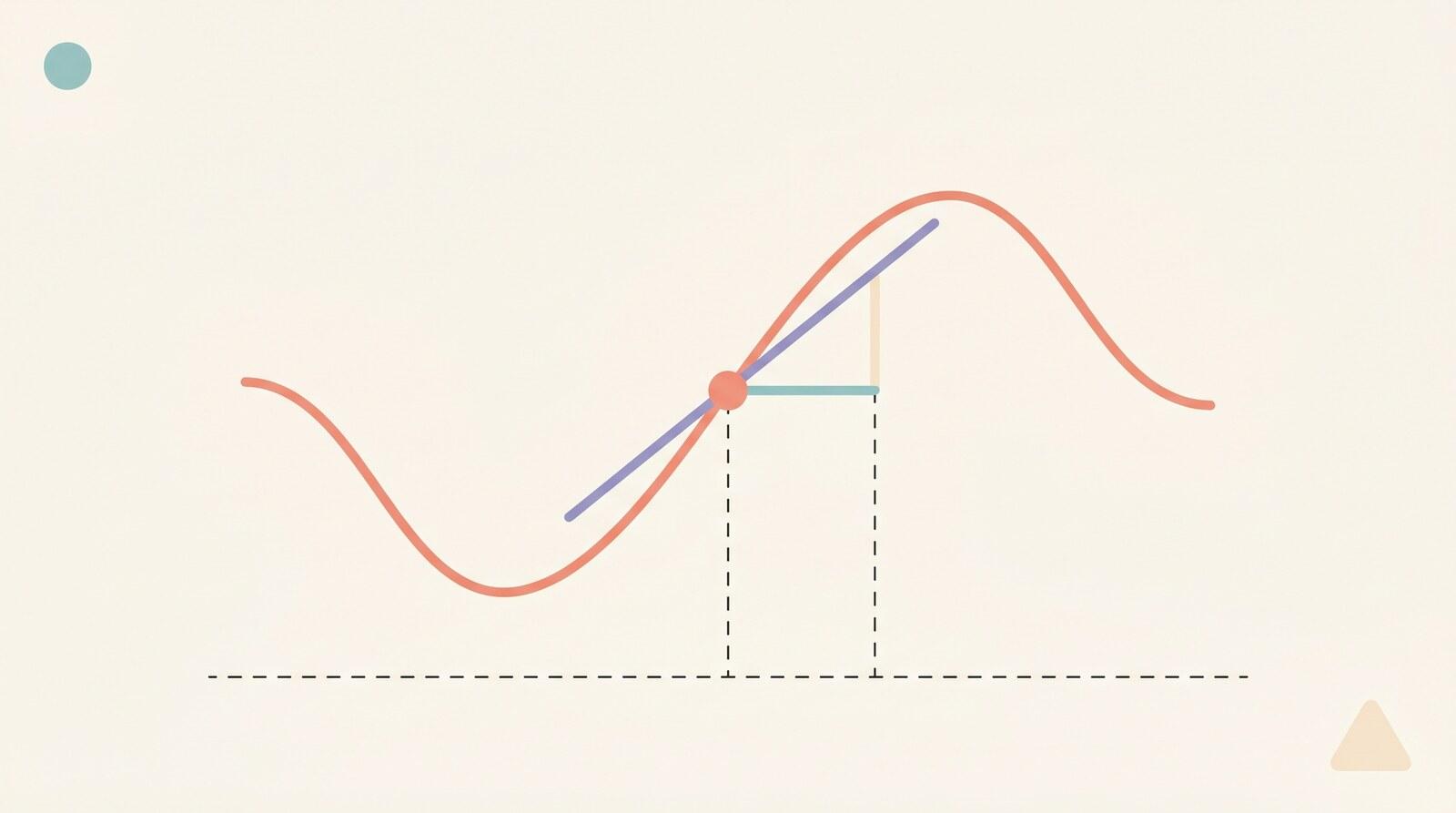
Here is the key idea: zoom in close enough to any smooth curve, and it starts to look like a straight line. Try it. If you zoom in on the graph of y = near the point (1, 1), the curve looks nearly straight. And that nearly-straight line has a slope.
The derivative at a point is the slope of the curve at that exact point, found by zooming in infinitely close.
Making It Precise
Mathematically, "zooming in" is captured by the concept of a limit. To find the slope at x = a, we pick a nearby point at x = a + h and compute the slope of the line connecting them:
This is called the difference quotient. It gives the average rate of change between x = a and x = a + h.
Now make h smaller and smaller. As h approaches zero, the average rate of change approaches the instantaneous rate of change. That limit is the derivative:
For , let us compute :
As h approaches 0, this equals 6. The derivative of at x = 3 is 6. The curve is rising at a rate of 6 units of y per unit of x at that exact point.
What the Rules Really Mean
Once you understand the core idea, the differentiation rules become shortcuts rather than mysteries:
Power rule ( of ^(n-1)): For , the derivative is 2x. At x = 3, that gives 6, matching our calculation above. The rule just packages the limit computation into a formula.
Chain rule: If one quantity depends on another, which depends on a third, the rates of change multiply. If y changes 3 times as fast as u, and u changes 2 times as fast as x, then y changes 6 times as fast as x.
Product rule: When two changing quantities are multiplied, both contribute to the rate of change. It is like asking: if both the length and width of a rectangle are growing, how fast is the area growing?
Derivatives in the Real World
Once you see derivatives as rates of change, they appear everywhere:
Velocity is the derivative of position. It tells you how fast your position is changing.
Acceleration is the derivative of velocity. It tells you how fast your speed is changing.
Marginal cost in economics is the derivative of total cost with respect to quantity. It tells you how much producing one more unit will cost.
Population growth rate is the derivative of population with respect to time.
In each case, the derivative answers the same question: how fast is this thing changing, right now?
Why This Matters for Learning
When you practice derivatives in Math Zen, you work through problems that progressively build from basic differentiation to chain rule, implicit differentiation, and applications like related rates and optimization.
Understanding the intuition helps because:
- You can sanity-check your answers. If the derivative of at x = 3 came out negative, you would know something is wrong, because the parabola is clearly increasing there.
- Related rates and optimization problems are much easier when you think "rate of change" instead of "apply the formula."
- The same intuition carries forward into integrals (which reverse the process) and differential equations (which describe how rates of change relate to each other).
The Takeaway
A derivative is the slope of a curve at a single point, found by zooming in until the curve looks straight. Everything else, the limit definition, the power rule, the chain rule, is machinery built around that one idea.
Next time you see f'(x), do not just think "the derivative." Think: "how fast is f changing at x?" That shift in perspective makes all of calculus more intuitive.
Common Questions
- What is a derivative in simple terms?
- A derivative is the rate of change of a function at a single instant. If your position function is f(t), the derivative f'(t) is your speed at time t. For any function, the derivative tells you how fast its output is changing relative to its input.
- What is the difference between a derivative and a slope?
- They are the same thing. The slope of a line is constant. The slope of a curve changes from point to point, and the derivative is the slope of the tangent line at any given point. Derivative just means slope at one location when the slope is not constant.
- Why is the derivative of x squared equal to 2x?
- It comes from the power rule, and the reason the power rule exists is geometric. Take a square with side length x and area x squared, and nudge x a little: the area grows by roughly two strips of width x, the two new edges. The rate of growth is 2x.
- What is the chain rule used for?
- The chain rule handles derivatives of nested functions, like sin(x squared) or (3x + 1) to the fifth. Differentiate the outer function while treating the inner one as a single variable, then multiply by the derivative of the inner function. Rates of change multiply when transformations chain.
- When does a derivative not exist?
- At sharp corners, vertical tangents, jumps, or discontinuities. The derivative requires a unique tangent line, so wherever the curve breaks, kinks, or stands straight up, the derivative is undefined at that point.