Spaced Repetition for Math Practice: Why Cramming Doesn't Work
You have probably experienced this: you study for hours the night before a math exam, perform decently, and then forget most of it within a week. This is not a failure of your memory. It is a failure of your study strategy.
The Problem with Cramming
Cramming packs a large volume of information into a short window. Your brain treats it as temporary, storing it in short-term memory. Research consistently shows that massed practice (studying one topic intensively, then moving on) produces weaker long-term retention than distributed practice.
For math, this is especially damaging. Math builds on itself. If you forget how to factor polynomials, you will struggle with integration by partial fractions later. Every gap in retention becomes a gap in understanding.
What Is Spaced Repetition?
Spaced repetition is a learning technique where you review material at increasing intervals over time. Instead of practicing derivatives for three hours on Monday and never again, you practice for 20 minutes on Monday, 15 minutes on Wednesday, 10 minutes on Friday, and then once the following week.
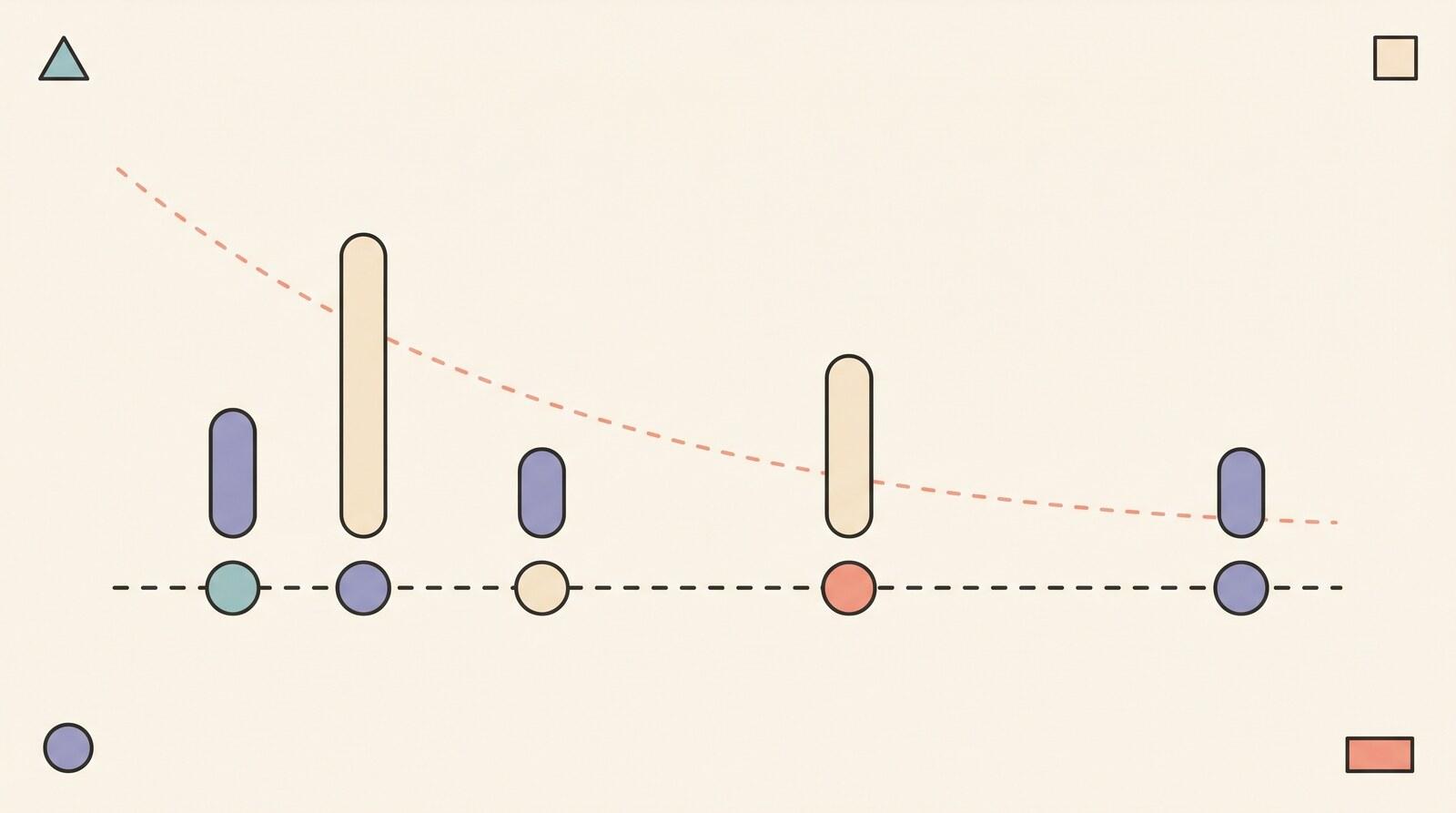
The idea comes from the "forgetting curve," first described by Hermann Ebbinghaus in the 1880s. Without reinforcement, you forget roughly 70% of new information within 24 hours. But each time you successfully recall something, the memory becomes stronger, and the interval before you need to review it again grows longer.
Why It Works for Math
Spaced repetition is particularly effective for math because:
Active recall strengthens procedural memory. Solving a problem from scratch forces your brain to reconstruct the solution process, not just recognize it. Each reconstruction strengthens the neural pathways involved.
Interleaving builds flexibility. When you practice different problem types in the same session (derivatives, then integrals, then factoring), you learn to identify which technique applies. Blocked practice (only derivatives for an hour) skips this critical skill.
Difficulty calibration prevents wasted time. If you already know basic addition, spending 30 minutes on it is not productive. Spaced repetition systems naturally move you past mastered material and focus your time on what you actually need to practice.
How Math Zen Implements This
Math Zen uses a bucket-based progression system that applies spaced repetition principles automatically. Here is how it works:
Each subtopic has 5 difficulty levels (buckets). When you start a new subtopic, you begin at bucket 1. To advance, you must solve a set number of problems correctly at your current level. Get problems wrong, and you receive a penalty that may move you back.
This design means:
- You cannot skip ahead. You must demonstrate mastery at each level before facing harder problems.
- Difficulty adapts to you. If a topic is easy, you progress quickly. If it is hard, you spend more time at the appropriate level.
- Returning to a topic after time away naturally provides the spacing effect. Your skill may have decayed slightly, giving you the productive challenge that strengthens retention.
Practical Tips
If you want to apply spaced repetition to your math practice, whether or not you use an app:
Practice daily in short sessions. 15 to 20 minutes of focused practice is more effective than a 2-hour weekend session. Consistency matters more than volume.
Mix topics. Do not spend your entire session on one topic. Practice derivatives for 5 minutes, switch to probability for 5 minutes, then try some algebra. This interleaving feels harder in the moment but produces better results.
Revisit old topics. Even after you feel confident with a topic, come back to it periodically. A quick 5-minute review every week or two keeps the knowledge fresh.
Track your accuracy. If you are getting everything right easily, the problems are too easy. If you are getting most problems wrong, they are too hard. The sweet spot is around 70 to 85% accuracy, where you are challenged but not overwhelmed.
The Research
A 2013 review by Dunlosky et al. rated distributed practice as one of the most effective learning strategies, alongside practice testing. Both strategies are core to how Math Zen works: you practice by solving problems (testing), and the bucket system distributes that practice over time and difficulty levels.
The key insight is that effective studying should feel slightly difficult. If it feels too easy, you are not learning. Spaced repetition ensures that every practice session sits in that productive zone of challenge.
Start Small
You do not need to overhaul your entire study routine overnight. Start with one change: instead of practicing one topic until you are bored, switch between two or three topics in a single session. Notice how it feels harder, and trust that the harder feeling means it is working.
Your future self, sitting down for an exam with the material genuinely retained, will thank you.