Understanding Logarithms Intuitively (Without Memorizing Rules)
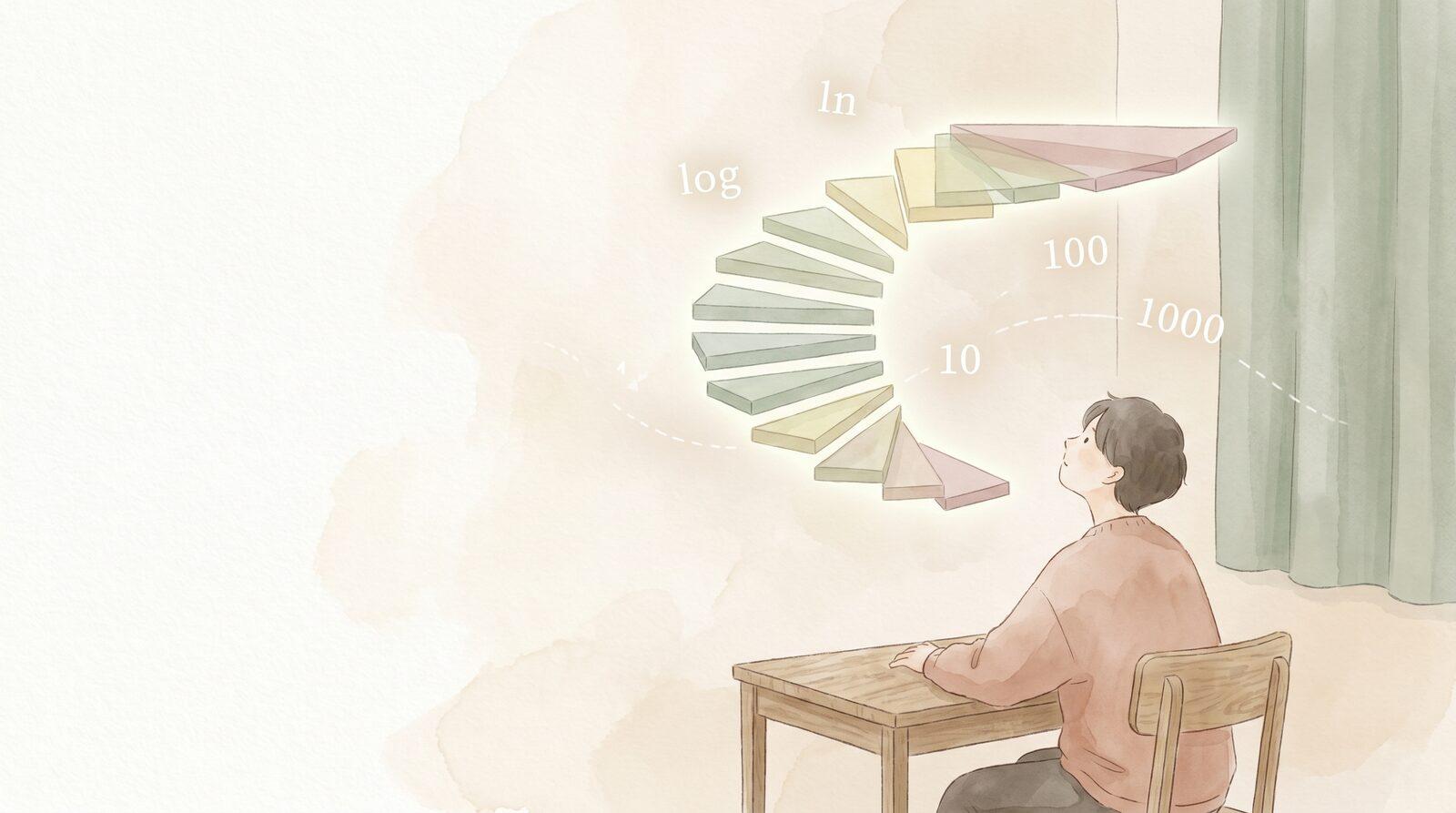
If you ask most adults what a logarithm is, they will either say "I forget" or "something with exponents." Neither answer is wrong. Neither is useful. And that is a shame, because the logarithm is one of the most elegant ideas in basic mathematics, and once you see what it really does, it stops being a topic you dread and becomes a tool you reach for.
This article is not a rules cheat sheet. It is a short walk through what logarithms actually are, why the rules look the way they do, and where they show up outside a math classroom. If you understand the why, the homework takes care of itself.
Start with the Question Logs Answer
Exponents ask a forward question: if I multiply 10 by itself 3 times, what do I get? Answer: 1000.
Logarithms ask the reverse: I have 1000. How many times did I multiply 10 by itself to get here? Answer: 3.
That is the whole concept. A logarithm is the inverse of an exponent. Where an exponent says "do the multiplication," a log says "count the multiplications." Everything else in the chapter is bookkeeping around that one idea.
Written out: , because . If you can translate back and forth between those two statements, you already understand logs. The rest is practice.
Logs as "How Many Digits"
Here is a way to feel what a log actually measures. Pick any whole number and count its digits.
- 7 has 1 digit.
- 42 has 2 digits.
- 1000 has 4 digits.
- 1,000,000 has 7 digits.
The log base 10 of a number is, roughly, one less than the number of digits. Log of 1000 is 3. Log of 1,000,000 is 6. For numbers in between, the log is a decimal that tells you "how far along you are" between one digit count and the next. Log of 500 is about 2.7, because 500 is much closer to 1000 (a four-digit number) than to 100 (a three-digit number).
This is not a coincidence or an approximation. The logarithm is literally measuring how many factors of ten fit inside a number, and the digit count is what you get when you count those factors.
So when someone says "that is a logarithmic scale," they mean: each step up corresponds to one more digit, not one more unit. The gap between 10 and 100 looks the same as the gap between 100 and 1000, because both are multiplied by 10.
Why the Base Matters
A logarithm always has a base. log base 10 counts how many times you multiplied by 10. log base 2 counts how many times you multiplied by 2. log base e (the natural log) counts how many times you multiplied by e, a specific number around 2.718 that shows up naturally in growth problems.
The base is not a mystery. It is just the building block you are counting with.
- , because 2 times 2 times 2 is 8.
- , because that is 2 to the 10.
- .
- , because you only multiplied e by itself once.
When computer scientists talk about "the log of n," they usually mean base 2. When scientists talk about natural log, they mean base e. When a calculator says "log" with no base written, it usually means base 10. Different fields pick the base that fits their problem, and you can always convert between them with one small formula.
The Product Rule Is Just Counting Multiplications
Textbooks present the logarithm rules as three isolated facts:
These look arbitrary. They are not. Each one falls out of the one-sentence definition we started with.
Remember: a log counts how many times you multiplied. If you multiply 100 by 1000, you are combining something you multiplied 2 times with something you multiplied 3 times. The result is 100,000, which is 10 multiplied 5 times. 2 plus 3 equals 5. That is the product rule. Nothing more.
Dividing is the reverse: 1000 divided by 100 means "I multiplied 10 three times, then removed two of those multiplications." 3 minus 2 is 1. That is 10 to the first power, which is 10. Check.
And raising a number to a power means doing the same multiplication again and again. If 100 is 10 multiplied 2 times, then 100 cubed is 10 multiplied 2 times, then 2 times, then 2 times. 2 plus 2 plus 2 is 6. That is the exponent rule.
Once you see all three rules as "counting multiplications and combining the counts," you never have to memorize them separately again.
Natural Log, Briefly
The one piece that often trips people up is the natural logarithm, written ln. It uses the strange base e, approximately 2.71828.
Why a weird number? Because when you study continuous growth (populations, money compounding constantly, radioactive decay, chemical reactions), the equations simplify dramatically when you use base e. The rate of change of e to the x is e to the x itself, which is a shortcut that makes calculus much cleaner. You do not need to understand this fully right now. You just need to trust that e is not arbitrary. It is the base that nature keeps handing back to mathematicians.
If you want a bit more on why rates of change matter and why mathematicians keep reaching for them, our post on derivatives from scratch walks through the same "zoom in" intuition that leads to e.
For most homework problems, treat ln exactly like log base 10. All the rules are the same. The base is just different.
Where Logs Show Up in Real Life
Logarithmic scales are everywhere, because the world has a habit of producing quantities that span many orders of magnitude. When numbers range from 1 to 10,000,000, a linear chart is useless. A log scale turns that range into a manageable line.
Decibels measure sound intensity on a log scale. A 60 decibel conversation is not twice as loud as a 30 decibel whisper. It is a thousand times more intense. The log scale hides the huge multiplicative difference behind small, friendly numbers.
The Richter scale for earthquakes does the same thing. A magnitude 7 earthquake releases about 32 times more energy than a magnitude 6 one. The numbers look close. The physical realities do not.
pH in chemistry is a log scale for hydrogen ion concentration. A liquid at pH 4 has 10 times more hydrogen ions than one at pH 5, and 100 times more than one at pH 6. Every unit is a factor of ten.
Star brightness (the magnitude system astronomers use) is logarithmic, and so is the way our ears and eyes perceive loudness and brightness. Evolution seems to have built us with logarithmic senses, probably because the world we evolved in was full of exponentially varying stimuli.
When you meet a weird scale in a science class and wonder "why is the spacing so odd?", the answer is almost always: it is a log scale, because the raw numbers would span too many orders of magnitude to fit on the page.
Why Math Class Teaches This Badly
Many students meet logarithms in a unit about solving exponential equations, two months after they stopped caring about exponents. The rules appear before the meaning, the meaning appears in a single sentence buried in paragraph three, and the homework is mostly algebraic manipulation.
If that is how you learned them, and you now feel like logs "never clicked," it is not because you are bad at math. It is because the order was inverted. The definition is the whole story. The rules are consequences. If you anchor yourself in "a log counts multiplications," every problem becomes a translation exercise between two equivalent ways of writing the same idea.
This is the same reframing that works for so many topics in math. The rules feel mysterious until you can tell the story in plain English, and then they feel inevitable. That is also why active explanation as a study technique is so effective for math: you cannot talk yourself through a log problem if you do not know what a log is, and the act of trying to explain it exposes exactly where your understanding breaks down.
Practicing Until It Feels Natural
Reading this once will give you the concept. Making it automatic is another matter, and that takes short, deliberate practice. A few suggestions:
Drill the translation. Spend five minutes a day converting between exponential and logarithmic forms. 2 to the 5 is 32. Therefore, log base 2 of 32 is 5. Do twenty of these. It feels trivial. It is exactly the fluency you need.
Sketch log scales by hand. Draw a number line from 1 to 10,000 on a log scale. Where does 100 go? Where does 500 go? This is one of the most underrated ways to internalize what a log actually measures.
Do mixed practice. Do not drill log problems for an hour straight. Mix them with the other topics you are studying. Interleaving is what actually builds long-term retention, and it keeps you in the habit of asking "which tool applies here?" rather than "what did we just learn in Chapter 8?".
Where Math Zen Fits In
Math Zen's bucket progression is well suited to logs because the topic rewards short, mixed practice sessions over cramming. The early buckets focus on translation between exponential and log forms, the middle buckets drill the product, quotient, and power rules with small numbers, and the later buckets work on change-of-base and solving exponential equations. Because the app mixes logarithm problems with related algebra and exponent problems, you build the pattern recognition that lets you spot when a log is the right tool, which is most of the actual skill.
If you find yourself reaching for the rules before you think about the meaning, slow down and translate the problem back into the "how many times did we multiply?" frame. That is almost always the shortcut.
The Bottom Line
A logarithm is not a separate thing from an exponent. It is the same relationship read in reverse. When you see log base b of x equals y, the whole content is: b multiplied by itself y times equals x. Everything else, the rules, the natural log, the scales in science, the graphs that look weird, is just consequences of that one reversal.
If you get stuck on a log problem, do not go straight to the rules. Go back to the definition. Ask "how many times did we multiply?" and let the answer tell you what the log equals. Do that for a week of short practice sessions, and the topic stops being a wall and becomes a lens.