math-concepts

Understanding Exponents Intuitively (Why x² Is Just Repeated Multiplication, Until It Isn't)

May 12, 202612 min read

Understanding Exponents Intuitively (Why x² Is Just Repeated Multiplication, Until It Isn't)

Exponents are usually a student's first real encounter with mathematical notation that looks bigger than it is. A small number sits up next to a bigger one, and suddenly there is a page of rules: add the exponents when you multiply, subtract them when you divide, anything to the zero is one, a negative exponent flips the fraction, a fractional exponent means a root. The whole list looks arbitrary, and most students treat it as a memorization exercise.

It is not. There is one idea at the bottom of exponents, and every rule on that list is what happens when you push that idea hard enough. Once the idea is clear, you can derive every rule in under a minute, which is much faster than memorizing them and worrying that you got the signs backwards.

This article is the idea. It is not a substitute for practice, and you will still need to drill the rules until they are automatic. But the meaning comes first. Without the meaning, the practice is just shuffling symbols.

The One Idea: Counting Copies

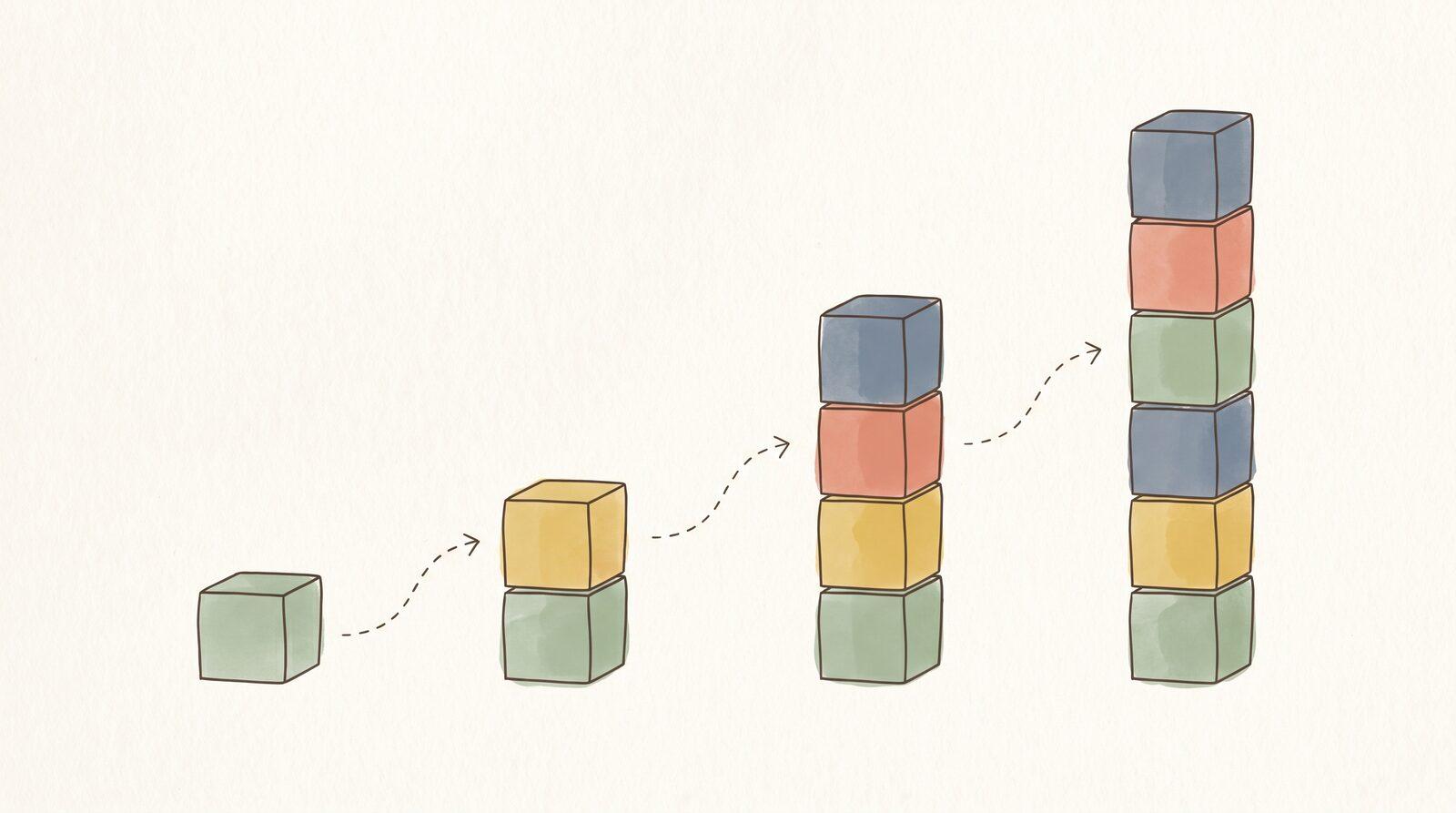
When you write x², you mean x times x. When you write x³, you mean x times x times x. The little number on top is just shorthand for "how many copies of x are you multiplying together."

That is the entire starting point. For whole-number exponents, x^n means a stack of n copies of x, all multiplied. Five squared is two copies of five multiplied together, which is twenty-five. Two cubed is three copies of two multiplied together, which is eight. There is nothing else going on.

Almost every rule you have ever been asked to memorize is a consequence of that single picture.

Why the Rules Are Not Rules

Take the rule x^a times x^b equals x^(a + b). This looks like something you have to remember. It is not. It is just counting.

If x^3 is three copies of x and x^4 is four copies of x, then x^3 times x^4 is three copies plus four copies all multiplied together, which is seven copies. That is x^7. The exponents added because you concatenated two lists of copies into one list. The rule is not a rule. It is what happens when you put two stacks of x's next to each other.

Division works the same way. x^7 divided by x^4 is seven copies of x with four copies of x in the denominator. Cancel pairs of x's top and bottom, and three copies remain, which is x^3. Exponents subtract because you are removing copies, not adding them.

Power of a power, (x^a)^b equals x^(a · b), is the same trick at one level higher. (x^3)^4 means four copies of x^3 multiplied together. Each x^3 is three copies of x, and there are four of those, so the total is twelve copies of x, which is x^12. The exponents multiply because you are stacking groups inside groups.

Once you see exponents as "how many copies," the rules stop looking like a list and start looking like bookkeeping for a single picture.

The Leap: What About Zero, Negative, and Fractional?

The "count the copies" picture works perfectly when the exponent is a positive whole number. But what is x^0? You cannot multiply x by itself zero times in any literal way. And x^(-2)? Multiplying x by itself negative two times is gibberish. x^(1/2)? Half a copy of x is not a thing.

This is where most students hit a wall, because the textbook just announces that x^0 is one, x^(-n) is one over x^n, and x^(1/n) is the n-th root, with no explanation of why.

There is a better way to think about it. Mathematicians did not arrive at these values by decree. They arrived at them by asking one question: what definition of x^0, x^(-n), and x^(1/n) would let the rules we already have keep working?

That single question forces every value, and once you see why, the "leap" stops feeling like a leap.

Why x^0 = 1

Look at the pattern of powers of 2 going down:

  • 2^4 = 16
  • 2^3 = 8
  • 2^2 = 4
  • 2^1 = 2
  • 2^0 = ?

Every time you drop the exponent by one, you divide by two. Sixteen divided by two is eight. Eight divided by two is four. Four divided by two is two. The pattern says the next value should be two divided by two, which is one.

Or use the division rule: x^a divided by x^a equals x^(a - a) equals x^0. But anything divided by itself is one. So x^0 has to be one, otherwise the division rule breaks.

This is not a definition imposed from outside. It is the only value that keeps everything else consistent. Anyone who had used exponents for a few weeks would arrive at it independently, because anything else would make the rules contradict themselves.

The one exception people argue about is 0^0, which is a separate conversation and depends on context. For every nonzero base, x^0 is one, and the reason is mechanical.

Why Negative Exponents Flip

Continue the pattern. After 2^0 = 1, the next step down divides by two again:

  • 2^0 = 1
  • 2^(-1) = 1/2
  • 2^(-2) = 1/4
  • 2^(-3) = 1/8

A negative exponent is a positive exponent in the denominator. x^(-n) is one over x^n. The minus sign is not subtraction. It is a flip.

Same conclusion from the division rule. x^3 divided by x^5 is x^(3 - 5) which is x^(-2). But x^3 divided by x^5, by counting copies, is one over x^2. So x^(-2) has to equal one over x^2. The rule and the counting agree, which is the entire point.

Why Fractional Exponents Are Roots

This is the leap that confuses the most people, because there is no "counting copies" picture for half an exponent. But the algebra still works the same way.

Suppose x^(1/2) is some number we have not pinned down yet. Use the power of a power rule: (x^(1/2))^2 equals x^(1/2 · 2) equals x^1 equals x. So whatever x^(1/2) is, when you square it you get x. That is the definition of the square root. So x^(1/2) must equal √x.

The same trick works for any fraction. x^(1/3) cubed is x, so x^(1/3) is the cube root. x^(2/3) is (x^(1/3))^2, which is the cube root squared. The fractional exponent is just a compact way to write a root, and the n in the denominator tells you which root.

This is not magic. It is the only value that lets the rules you already have stay consistent. The notation extends because we insist that it should.

The Connection to Logarithms

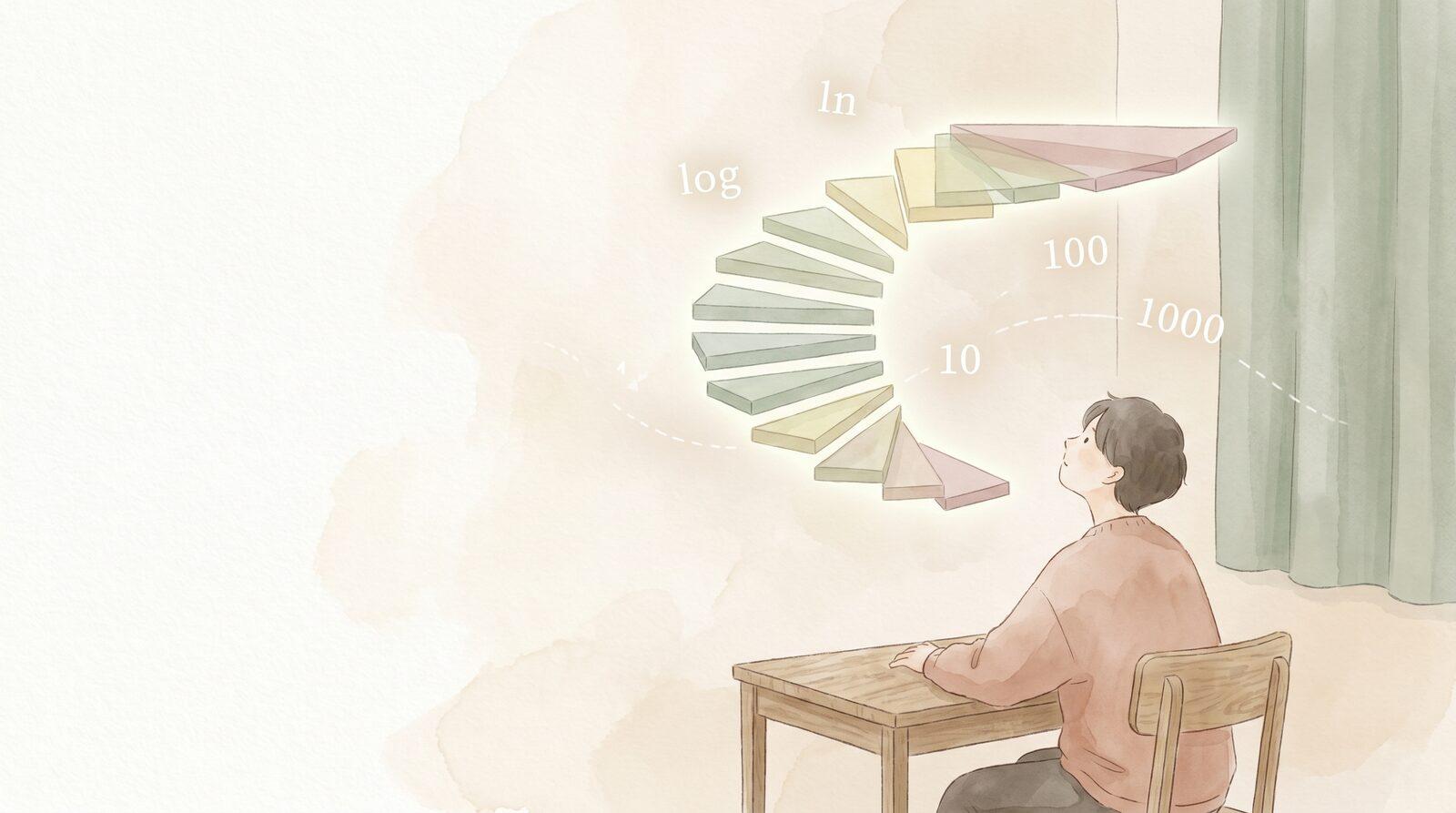
Once you see exponents as counting copies, logarithms stop being mysterious. A logarithm is the inverse: it asks "how many copies." If 2^5 is 32, then log base 2 of 32 is 5. The exponent answers "what do I get." The logarithm answers "how many copies did it take."

Every exponent rule has a matching logarithm rule, and they are mirror images. Multiplying exponentials adds the exponents, so taking logs of a product adds the logs. Raising to a power multiplies the exponents, so taking the log of a power multiplies by that power. They are the same picture, viewed from opposite sides.

Where Exponents Actually Show Up

Exponents are the language of anything that grows or shrinks by a fixed factor each step.

Compound interest. Money in a savings account at 5% per year multiplies by 1.05 each year. After ten years, it has multiplied by 1.05^10, which is roughly 1.63. After thirty years, 1.05^30, which is more than four times the original. The compounding is exactly an exponent, and the difference between linear and exponential growth is the whole reason early saving matters so much.

Population, viruses, viral content. Anything where each member produces a similar number of next-generation copies grows exponentially. So do cells dividing, rumors spreading, and content reposting. The relevant exponent is small, but it is on top, and small numbers on top compound fast.

Radioactive decay, drug half-lives, cooling. Anything that loses a fixed fraction each step is exponential decay. After one half-life, half the material is left. After two half-lives, one-quarter. After three, one-eighth. The factor each step is one-half, and the exponent is the number of half-lives that have passed.

Computer memory and file sizes. A kilobyte is roughly 10^3 bytes. A megabyte is 10^6. A gigabyte is 10^9. Computer hardware doubles roughly every two years (Moore's law), which is itself an exponential.

Scientific notation. The mass of the sun is about 2 × 10^30 kilograms. The radius of a hydrogen atom is about 5 × 10^(-11) meters. The vocabulary of very large and very small numbers is exponents, because no one writes thirty zeros by hand.

Anywhere a quantity multiplies by a fixed factor at each step, exponents are the right tool. The list of such situations is long, which is why this topic shows up in chemistry, biology, economics, finance, computer science, physics, and most of pre-calculus.

Why Exponents Are Often Taught Badly

If exponents are this clean, why do so many students hit a wall on them?

First, the leap from whole-number exponents to zero, negative, and fractional exponents is usually presented as a list of new rules, with no explanation of why they have to be those particular values. Students treat the new rules as arbitrary, which makes them easy to forget and easy to mix up.

Second, the rules themselves are taught in isolation rather than as consequences of counting copies. Students memorize "add the exponents when multiplying" and then panic when they see (x^a)^b and have to decide whether to add or multiply. The picture would tell them in two seconds, but the picture is missing.

Third, fractional exponents and roots are taught as different chapters. They are the same idea. A student who sees x^(1/2) and √x as two unrelated objects has to memorize twice as much, and gets confused twice as often.

The fix is to spend an hour with the "counting copies" picture, derive the rules instead of memorizing them, and then drill them until they are automatic. The drilling is necessary. Most of the suffering is not.

Practicing Until It Is Automatic

Reading this article once gives you the picture. Making exponents fluent is a separate task.

Derive each rule once, by hand, with small numbers. Sit down with 2^3 times 2^4 and 2^5 divided by 2^2 and (2^3)^2, and verify each rule by counting copies. Once you have seen the rules emerge from counting, you will not mix them up later.

Drill the zero, negative, and fractional cases. These trip up the most students because the picture changes. Spend a session purely on rewriting x^(-3), x^0, x^(1/2), and x^(2/3) until the moves are automatic.

Combine exponents with other algebra. As we covered in the algebra post, most algebra is rearranging according to rules that have geometric meaning. Practicing exponents inside algebra problems (solve 2^x = 32, simplify (xy^2)^3, evaluate 27^(2/3)) is what builds the fluency standardized tests reward.

Connect exponents to logarithms early. Working both directions, "given the exponent find the result" and "given the result find the exponent," locks in that they are the same fact. The students who treat them as separate topics double their work.

Use exponents in word problems. Compound interest, half-life, and population growth problems are exactly the contexts where exponents matter outside school. A few of these per week keeps the connection to reality, which keeps the topic from feeling abstract.

Where Math Zen Fits In

Math Zen's bucket progression matches how exponents actually want to be learned. Early buckets cover whole-number exponents, the product and quotient rules, and powers of powers. Middle buckets cover zero, negative, and fractional exponents, drilled until the moves are automatic. Later buckets cover exponential equations, scientific notation, and word problems on growth and decay.

Because the practice is short, mixed, and spaced, the rules stop being a list you re-derive and become facts you can apply in under a second. That is the level of fluency that makes the SAT, AP Calculus, and most chemistry and physics problems feel routine instead of frantic. The path to that fluency is not more textbook pages. It is ten or fifteen minutes a day on the right kind of problem.

The Bottom Line

x^n means n copies of x multiplied together. Every rule for positive integer exponents is bookkeeping for that picture. Zero, negative, and fractional exponents are extensions chosen so that the rules keep working, not separate facts to memorize.

Once you have the picture, the rules stop competing for space in your head. Multiplying exponentials adds the exponents because you are concatenating stacks of copies. Dividing subtracts because you are cancelling pairs. Zero is one because the pattern demands it. Negative flips because it has to. Fractions are roots because (x^(1/n))^n needs to be x.

That is the entire foundation. Next time you see x^(-2/3), do not think "another rule." Think: "one over the cube root of x squared, because anything else would break the math." That shift, from memorizing to deriving, is what turns exponents from a wall into a tool.