Understanding Algebra Intuitively (Why x Is Not Scary)
Adults who can split a check, double a recipe, or estimate gas mileage in their head will freeze the second someone writes on a board. The arithmetic is the same arithmetic they already do every day. The only thing that changed is that one of the numbers got a letter taped over it. That single change is where most people first decide they are bad at math.
The fix is small, and it is not a list of rules. Algebra rests on one idea, and once that idea clicks, every rule in the textbook turns into a consequence rather than a fresh thing to memorize. This article is the picture of what algebra actually is, why each operation looks the way it does, and how the topic connects to the rest of the math you will ever meet.
The One Idea: A Letter Is a Number You Have Not Found Yet
Algebra's central trick is to give a name to a number you do not know yet, then chase that name through the same arithmetic you would do if the number were sitting right in front of you.
When a recipe says "use half the sugar in the box," you treat "the sugar in the box" as a quantity you can manipulate even though you have not measured it. That is algebra. The only difference between the kitchen and is that the kitchen never asks you to write your reasoning down.
A variable like x is not a mysterious symbol. It is a placeholder. Whatever number it stands for, that number behaves like a number: you can add to it, multiply it, divide it, take its square. The letter is shorthand so you do not have to keep saying "the unknown number" for the rest of the page.
This shift in framing is small, but it removes most of the fear. Algebra is not a new kind of math. It is the arithmetic you already do, with placeholders in some of the slots.
Equations Are Statements About Balance
The next idea is the equals sign. School often teaches "=" as the symbol that comes before the answer, like a button on a calculator. In algebra, "=" means something different. It means the two sides are the same thing, written two different ways.
says: whatever 3x + 5 equals, that number is also called 14. The two sides are a single quantity wearing two costumes.
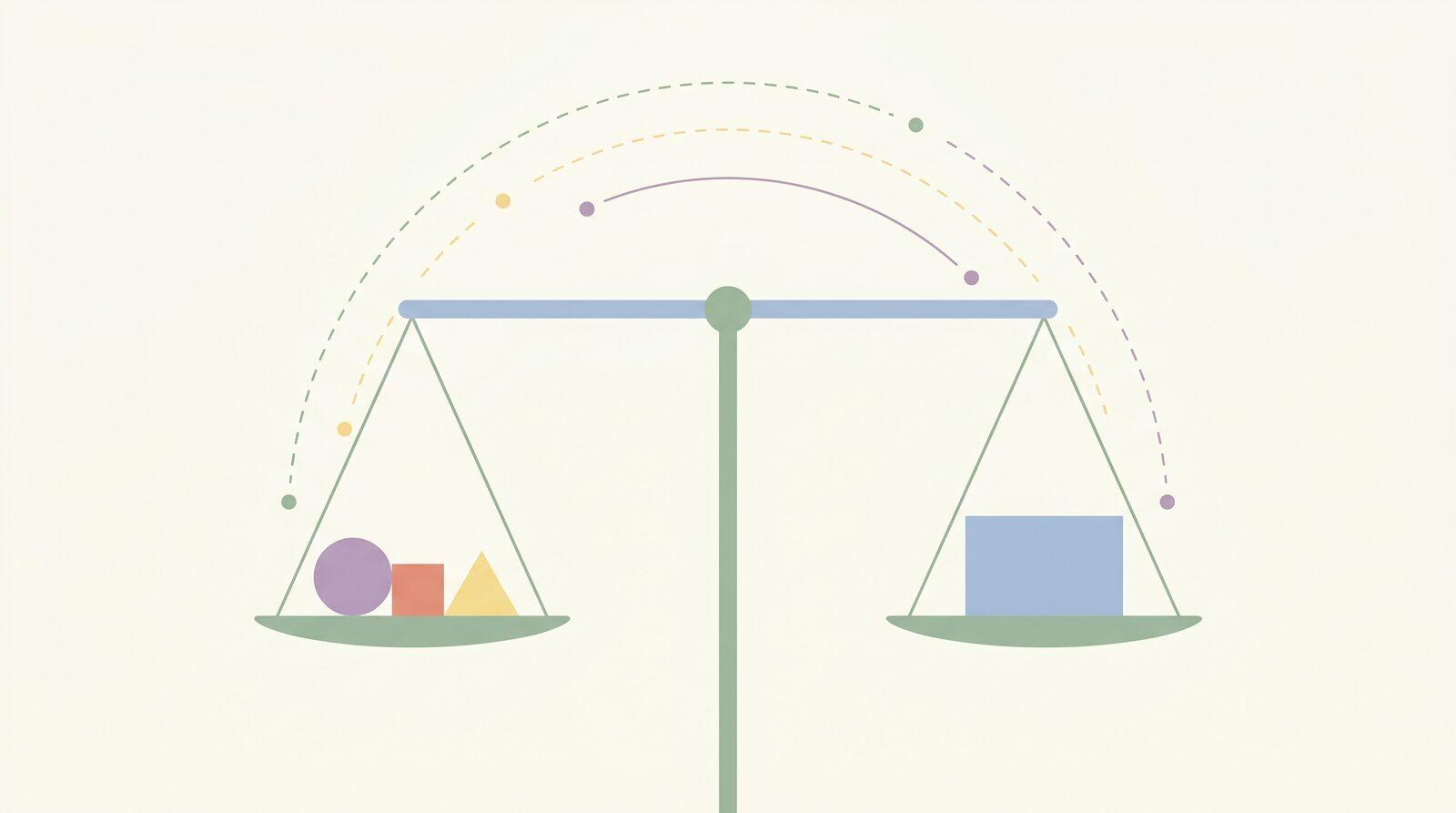
This is why "do the same thing to both sides" works. Picture a balanced scale with 3x + 5 grams on the left and 14 grams on the right. If you remove 5 grams from one side, you have to remove 5 from the other to keep the scale level. Algebra is exactly that scale, and "solve for x" is the question "what number on the left makes the scale balance with 14 on the right."
Subtract 5 from both sides: . Divide both sides by 3: . The reasoning is mechanical, but it is also concrete. Every step is a move you would make on a real scale.
Why Letters? Why Not Just Words?
Students sometimes ask why mathematicians use letters instead of saying "the unknown number." It is a fair question, and the answer is purely practical.
Letters are short. Once a problem has more than one unknown ("the number of apples plus twice the number of oranges equals twelve"), spelling them out gets tedious fast. Algebra's notation lets you write instead of a sentence, and the compact form is easier to read and to manipulate.
Letters are also reusable. The same equation , with different numbers plugged in for a, b, and c, describes thousands of real situations. Algebra is the language for talking about all those situations at once. As we noted in the fractions post, algebra is largely "fractions with letters in them," and the letters are what make the rules apply to every problem instead of just the one in front of you.
Solving Is Undoing
Once you accept that algebra is balance, the act of solving an equation reduces to one move: undo whatever was done to x.
If , multiplication has been done to x, so divide. If , addition has been done to x, so subtract. If , division has been done to x, so multiply. Every operation has an inverse, and solving is the practice of applying the inverse on both sides until x stands alone.
The order matters too. In an equation like , x has been multiplied by 3 and then 5 was added. To undo, reverse the order: subtract first, then divide. This is the same logic as taking off shoes and socks: the socks went on first, so they come off last.
If the meaning is in place, the procedure follows. If only the procedure is memorized, students forget the order, panic, and reach for a flowchart that they only half remember.
The Distributive Property Is Just Distributing
The line is a famous source of student frustration. Why do you multiply 3 by both terms inside the parentheses? Why does the 3 "distribute"?
Because 3(x + 4) literally means three groups of (x + 4). Three groups of "x and 4" is three xs and three 4s, which is 3x + 12. It is not a rule to memorize. It is what "three of something" means when the something is a sum.
The same picture explains why is not . If you said "three groups of x and 4" and only multiplied the x, you would have three xs and a single 4, which is not what "three groups" means at all.
When students misapply the distributive property, the fastest fix is not a re-explanation of the rule. It is a quick translation back to "groups of." The mistake usually corrects itself within a sentence.
Variables on Both Sides
The first time a student sees an equation with x on both sides, like 3x + 5 = x + 13, the urge is to panic. There is nothing to panic about. You can move xs across the equals sign the same way you move numbers, because xs are just numbers in disguise.
Subtract x from both sides: 2x + 5 = 13. Now there is only one x. Subtract 5: 2x = 8. Divide by 2: x = 4. The procedure is the same balance reasoning. The only adjustment is the recognition that you can subtract a variable just as easily as you can subtract a number, because both are quantities.
This is the moment many learners stop trusting algebra, because the symbol manipulation no longer maps onto an obvious picture. The trick is to remember that x is still just a number, even when it appears in two places. Whatever number it stands for, removing one x from each side keeps the scale balanced.
Word Problems: Translation, Not Math
Most of the algebra people remember hating was buried inside word problems. "If a train leaves Chicago at sixty miles per hour..." The arithmetic in these problems is rarely hard. The translation from English into algebra is what trips people up.
There is a small set of phrases that almost always means the same thing. "Is" or "equals" maps to "=". "Of" usually means multiplication. "Less than" or "fewer than" means subtraction, with the order reversed: "five less than x" is x minus 5, not 5 minus x. "Sum" means addition. "Product" means multiplication. "Per" means division. Building this dictionary is half the battle.
A word problem is solved in three steps:
- Name the unknown. ("Let x be the number of apples.")
- Translate the English sentence into an equation, one phrase at a time.
- Solve the equation. (The arithmetic, which is the easy part once the equation is written.)
The hardest step is almost always the translation, and the way to get better at it is practice mixed with patience. Read the sentence aloud. Identify what is unknown. Write down what each phrase represents before you write the full equation. Once the equation is on the page, the rest is mechanical.
Where Algebra Shows Up After Eighth Grade
Many students assume algebra is a one-year topic that ends when the textbook closes. The opposite is true. Algebra becomes more important, not less, as the math gets harder.
Geometry is full of algebra. Calculating the missing side of a triangle, finding the area of an irregular shape, or proving a result about parallel lines almost always reduces to solving an equation.
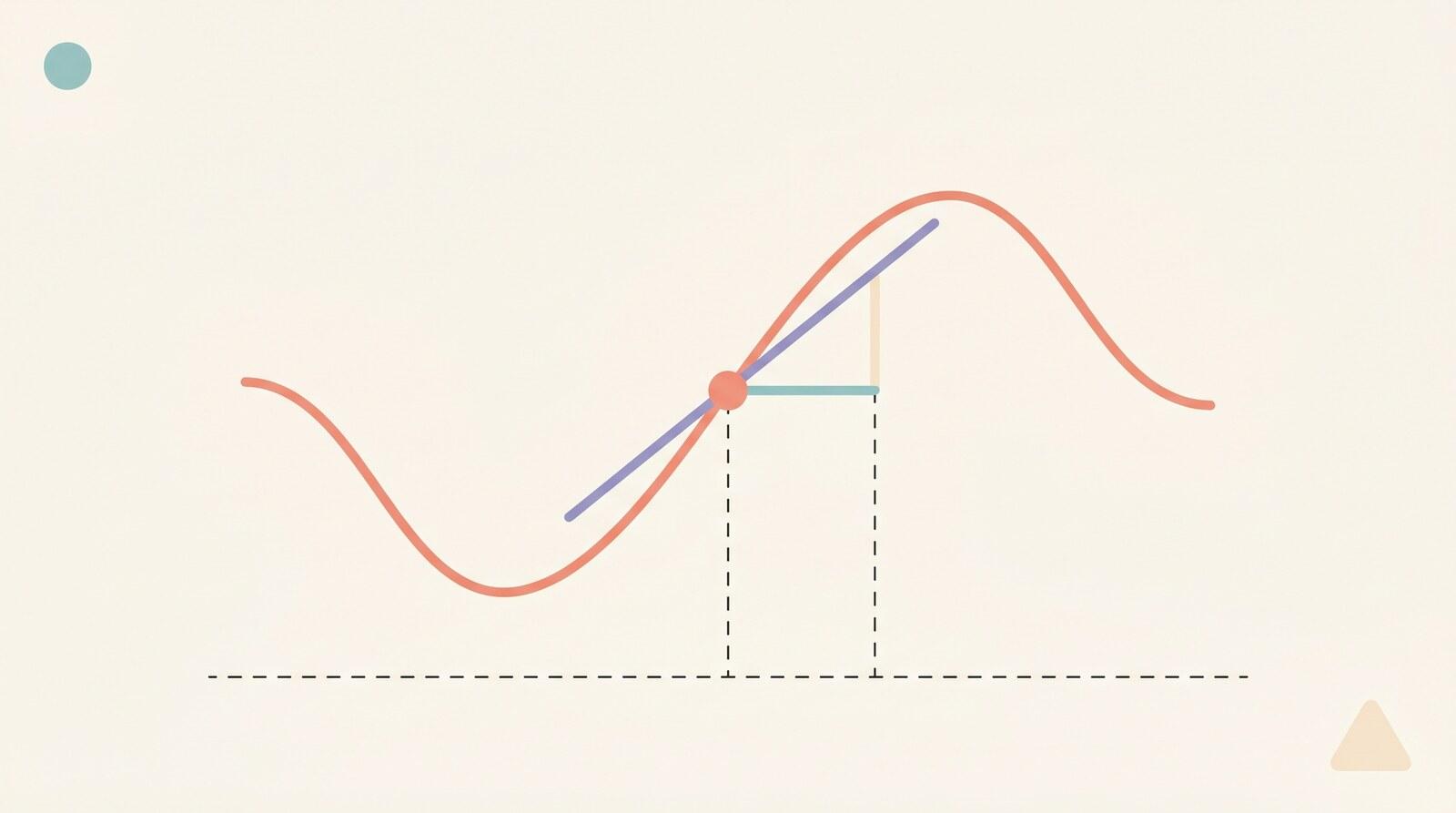
Calculus is, at its core, advanced algebra. The slope of a curve, the area under it, the rate of change of a quantity, are all defined through algebraic manipulation. As we covered in our post on derivatives from scratch, the derivative formula is a rearrangement of fractions with limits attached. A student who never made peace with rearranging equations will struggle with the symbol pushing that calculus demands.
Standardized tests. The SAT, ACT, GRE, and most college entrance exams are largely algebra exams in disguise. As we wrote in the SAT prep guide, strong algebraic fluency, not advanced topics, is what raises scores fastest.
Statistics, finance, physics, computer science. All of them are written in algebraic notation. A formula in physics is just an equation. A model in finance is just a system of equations. A function in code is the algebra of inputs and outputs. The notation is the same notation, used over and over.
Students who struggle in any of these later courses are usually struggling with eighth-grade algebra they never solidified. Plugging that hole pays off for the rest of their education.
Why Algebra Is Often Taught Badly
If algebra is this fundamental, why do so many students leave middle school still afraid of it? A few honest reasons.
First, the introduction often skips meaning. Students are handed a procedure ("isolate the variable") before they understand why isolating works, or what an equals sign actually claims. A procedure without meaning is fragile: forget one step and the whole thing collapses.
Second, the connection to arithmetic is not made explicit. Students believe they are learning a new topic, when in fact they are doing the same arithmetic they always did, with placeholders in some of the slots. If the same teacher had said "today we are doing arithmetic except some of the numbers will not be revealed yet," half the fear would evaporate.
Third, word problems are introduced in volume before the translation skill is built. A learner who is not yet confident reading a single sentence as algebra is buried under twenty multi-sentence problems and concludes they cannot do "real" math. They can. They simply were not given enough practice on the translation step alone.
The good news is that fixing these gaps as a teenager or an adult is genuinely fast. Algebra rests on a small number of ideas, and once those ideas connect, the rules feel obvious instead of arbitrary.
Practicing Until It Is Automatic
Reading this once gives you the picture. Making algebra fluent is a separate task, and it benefits from short, deliberate practice rather than long cramming sessions.
Drill the basics. Solve fifty one-step equations a week for a few weeks. x + 7 = 12. 4x = 24. x/3 = 9. The variety is small, and the goal is for the moves to become automatic, the way single-digit multiplication eventually does. As we covered in the mental math post, automaticity at the basics is what frees the brain to work on harder steps later.
Mix the operations. Once one-step equations feel boring, mix them with two-step, then three-step problems. Mixed practice forces you to identify what move to make, which is the skill that actually matters in real problems. As we covered in the spaced repetition post, mixed practice is what builds long-term recall.
Check by substitution. After solving and getting , plug 3 back in: 3(3) + 5 = 14, true. This habit catches almost every algebraic mistake within seconds, and it doubles as a reinforcement that the equals sign means "same number, two ways." Substitution is the cheapest sanity check in math, and most students never use it.
Translate sentences daily. Take any sentence with a number in it ("the meeting is in fifteen minutes" or "the recipe doubles for six people") and rewrite it as a small equation. Translation is a muscle. Five sentences a day for a few weeks turns word problems from a wall into a routine.
Where Math Zen Fits In
Math Zen's bucket progression maps cleanly onto how algebra actually wants to be learned. The earliest buckets cover the meaning of variables and one-step equations, where the move set is small and the goal is to make the operations automatic. The middle buckets drill multi-step equations and the distributive property, with mixed practice so the brain learns to identify the right move rather than blindly apply a flowchart. The later buckets work on equations with variables on both sides, word-problem translation, and small systems of equations.
Because the practice is short and spaced, you build the pattern recognition that turns algebra from a topic you survive into a tool you reach for. Most learners do not need a tutor or a thicker textbook. They need fifteen minutes a day, three or four times a week, on the right kind of problem.
The Bottom Line
A variable is a number you have not found yet. The equals sign means "the same number, written two ways." Solving is undoing whatever was done to the variable, applied equally to both sides so the scale stays balanced. The distributive property is what "groups of" means when the something is a sum. Word problems are translations, and the translation is the hard part, not the arithmetic.
That is the entire foundation. The rules in your textbook are not separate facts; they are what the meaning looks like in shorthand. If an algebra problem ever stumps you, do not reach for the rule first. Read what the equation says in plain English, decide what was done to x, and undo it. The answer will usually appear before the procedure does.