Understanding Percentages Intuitively (Tips, Discounts, and Percent Change)
A person who can split a dinner bill four ways without blinking will pull out their phone the second the waiter mentions a 18 percent gratuity. The arithmetic underneath is the same arithmetic they just did with the split. The only thing that changed is that one number is now wearing a percent sign, and that sign is where most people quietly decide they are bad at "the math part" of everyday life.
The fix is small, and it is not a stack of formulas. Percentages rest on one idea, and once that idea clicks, tips, discounts, tax, interest, and "the price went up 30 percent" all become the same move done in slightly different clothes. This article is the picture of what a percent actually is, why each shortcut works, and how to do most of it in your head.
The One Idea: Percent Means "Out of 100"
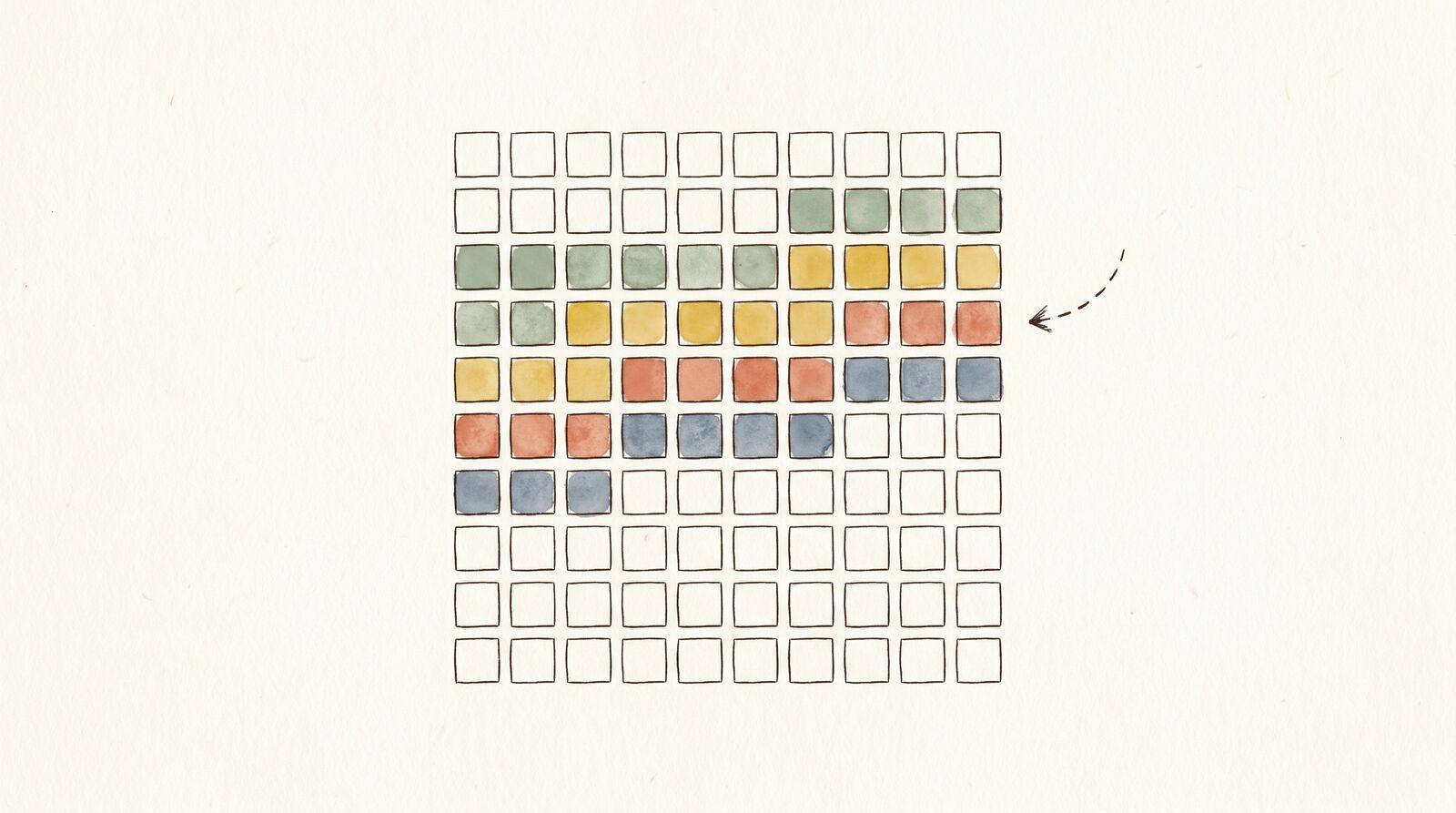
The word percent is Latin for "per hundred." That is the whole definition. A percent is a fraction whose bottom number is always 100, with the 100 left unwritten and replaced by the % sign.
So 40% is just 40/100. It is the same quantity as 0.40, and the same quantity as two fifths. Three different costumes, one number. As we covered in the fractions post, a fraction is a division waiting to happen, and a percent is simply a fraction that already agreed on its denominator. Nothing new is being introduced. A percent is a fraction with the bottom pre-filled.
This is why "what is 40% of something" and "what is 40 hundredths of something" are the exact same question. Percent is not a new operation. It is a unit, the way "dozen" is a unit. Once you read the % sign as "divided by 100," the mystery mostly evaporates.
"Of" Means Multiply
The second idea is the word "of." In percentage problems, "of" almost always means multiply.
"40% of 250" translates directly to 0.40 × 250. Read the sentence left to right and write down what each piece means: 40% becomes 0.40, "of" becomes ×, 250 stays 250. The English sentence and the arithmetic line are the same statement in two languages. There is no formula to memorize because the sentence is the formula.
This single translation handles tips, tax, discounts, commission, and most of the percentages anyone meets in a normal week. "20% of 60" is 0.20 × 60 = 12. "7% of 40" is 0.07 × 40 = 2.80. The hard part was never the arithmetic. It was believing the sentence could be trusted to mean exactly what it says.
Percent Is Reversible (and That Is the Secret Mental Trick)
Here is a fact that turns a calculator habit into a mental one: x% of y is always equal to y% of x.
18% of 50 is the same as 50% of 18. The second version is trivial: half of 18 is 9. So the tip is 9, with no calculator. This works because both expressions are the same multiplication, (x/100) × y, just read in the other order. Multiplication does not care which factor comes first.
This flip is the single most useful percentage trick in daily life, and almost nobody is taught it. 4% of 75 looks annoying; 75% of 4 is three quarters of 4, which is 3. Same answer, one second of thought. As we covered in the mental math post, the goal of these moves is to turn an intimidating problem into a boring one you can finish before you would have unlocked your phone.
Build Big Percentages from 10% and 1%
Most everyday percentages can be assembled from two cheap building blocks.
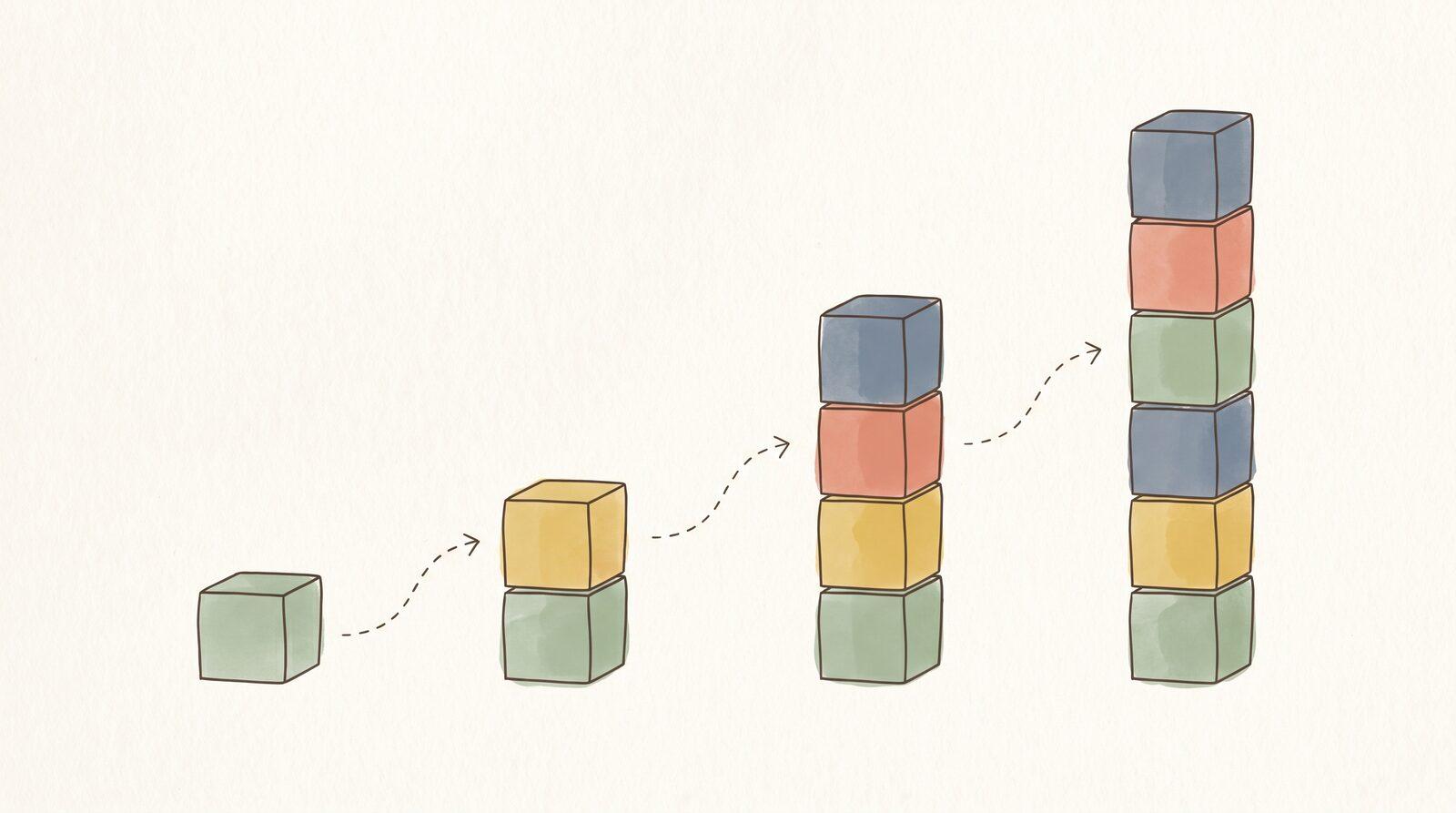
Ten percent is just the number with the decimal point moved one place left. 10% of 240 is 24. One percent moves it two places: 1% of 240 is 2.40. Every other percentage is these two pieces added or scaled.
Want 30%? That is three 10%s: 24 + 24 + 24 = 72. Want 15%? That is 10% plus half of 10%: 24 + 12 = 36, which is exactly the restaurant-tip move people fumble. Want 7%? That is seven 1%s, or 5% (half of 10%) plus two more 1%s. You are never computing a percentage from scratch. You are stacking 10% and 1% blocks until they add up to the one you want.
Percent Change Is a Different Question
This is where most real confusion lives, and it is worth slowing down. "What is 40% of 250" and "the price rose 40%" are not the same question, and treating them as the same is the most common percentage mistake adults make.
Percent change always compares the change to where you started. The structure is: take the difference, divide by the original amount, then read that fraction as a percent. A price that goes from 200 to 250 changed by 50, and 50 out of the original 200 is 25/100, so it rose 25%. The new value is not the reference point. The starting value is.
The reason this trips people is that the same dollar change is a different percentage depending on where you started. Going from 100 to 150 is a 50% increase. Going from 100 to 150 and then back down to 100 is not a 50% decrease; it is a 33% decrease, because the second time you started from 150, not 100. The percent always answers "compared to what," and the "what" is whatever you had before the change.
Why a 20% Cut Then a 20% Raise Does Not Bring You Back
A salary is cut 20%, then restored with a 20% raise. Most people expect to be back where they started. They are not, and seeing why locks in everything above.
The 20% cut is taken from the original. The 20% raise is taken from the already-shrunken number, which is a smaller base, so it adds back less than was removed. Start at 100. Cut 20%: you have 80. Add 20% of 80, which is 16: you reach 96, not 100. The percentages looked symmetric, but they were measured against different starting points, so they do not cancel.
This is the same "compared to what" idea as the previous section, and it is the root of nearly every misleading statistic in advertising and news. A discount of 50% followed by an extra 20% off is not 70% off. The 20% is taken from the already-halved price, so the real discount is 60%. Percentages do not add across different bases. They multiply, and as we covered in the exponents post, repeated multiplicative changes are exactly what compound growth and compound interest are made of.
Reverse Percentages: Finding the Original Price
A jacket is on the tag at 64 dollars after a 20% discount. What was the original price? The instinct is to add 20% of 64 back on. That is wrong, and it is wrong for the reason the previous two sections set up: the 20% was taken off the original, not off 64.
Think in terms of what survived. After a 20% discount, 80% of the original price is what you actually pay. So 64 is 80% of the original, which means 64 = 0.80 × original. Undo the multiplication by dividing: original = 64 / 0.80 = 80. The jacket was 80 dollars. The move is the same "undo what was done" reasoning from the algebra post: a percentage was applied by multiplying, so you reverse it by dividing, not by applying the percentage a second time.
Percent, Probability, and Why "100% Sure" Is a Red Flag
Percentages and probabilities are the same notation pointed at different things. A 30% chance of rain is the fraction 30/100 of likelihood, exactly the way 30% off is 30/100 of price. This is why the percent skills here transfer straight into reasoning about risk, and as we covered in the probability post, the place people go wrong is rarely the arithmetic. It is forgetting the "compared to what." A test that is "95% accurate" is not the same as "95% chance you have the disease," for the same base-rate reason a 20% raise does not undo a 20% cut. The number is meaningless until you know what it is a percent of.
Why Percentages Are Often Taught Badly
If percentages are this simple, why do so many capable adults still reach for a phone? A few honest reasons.
First, they are taught as three separate formulas, one for "percent of," one for "percent change," one for "reverse percent," with no hint that all three are the same "fraction out of 100" idea read in different directions. Three memorized formulas are fragile; one understood idea is not.
Second, the "of means multiply" translation is rarely made explicit, so word problems feel like a separate, harder subject instead of a sentence you can transcribe.
Third, percent change is introduced in the same breath as "percent of," with no warning that the reference point just moved from the total to the original. That single unmarked switch is responsible for most adult percentage anxiety, and it is a one-sentence fix once someone names it.
The good news is that patching these gaps as an adult is fast, because there were never many ideas to begin with.
Practicing Until It Is Automatic
Reading this once gives you the picture. Making percentages automatic is a separate task, and it rewards short, frequent reps over one long session.
Drill the 10% and 1% blocks. Take any number you see, a receipt total, a speed limit, a step count, and say its 10% and 1% out loud. The decimal-shift should become reflexive, the way single-digit multiplication eventually does.
Use the flip every time. Whenever a percentage looks ugly, swap the two numbers before reaching for anything. 8% of 25 is 25% of 8, which is 2. Building this reflex removes most calculator moments from a normal day.
Always ask "compared to what." For every percent-change statement you read in the news or on a price tag, name the base out loud before you trust the number. This one habit catches nearly every misleading statistic you will ever be shown.
Mix the three question types. Practice "percent of," "percent change," and "reverse percent" in the same session rather than in separate blocks. As we covered in the spaced repetition post, mixed practice is what builds recall that survives outside the worksheet, where the problem never tells you which type it is.
Where Math Zen Fits In
Math Zen's bucket progression maps cleanly onto how percentages actually want to be learned. The early buckets drill the "percent means out of 100" translation and the 10% and 1% building blocks until they are automatic. The middle buckets introduce the reversibility flip and "of means multiply" on mixed numbers so the moves stop depending on a clean example. The later buckets focus on percent change, reverse percentages, and the "compared to what" trap, with mixed practice so your brain learns to identify which question is being asked rather than blindly applying one formula.
Because the practice is short and spaced, you build the pattern recognition that turns percentages from a phone-reaching reflex into a mental one. Most learners do not need a thicker textbook. They need ten minutes a day, a few times a week, on the right kind of problem.
The Bottom Line
A percent is a fraction whose denominator is always 100. "Of" means multiply, so "40% of 250" is literally 0.40 × 250. The flip, x% of y equals y% of x, turns most ugly percentages into easy ones in your head. Percent change is a different question: it always compares the change to where you started, which is why a 20% cut and a 20% raise do not cancel, and why a discounted price is reversed by dividing, not by adding the percent back.
That is the entire foundation. The formulas in the textbook are not separate facts; they are this one idea read in different directions. If a percentage ever stumps you, do not reach for the rule first. Say what it is a percent of, replace "of" with multiply, and ask "compared to what." The answer almost always shows up before the calculator does.