Understanding Probability Intuitively (Why "1 in a Million" Lies to You)
The forecast says 30 percent chance of rain. A medical test for a rare disease comes back positive. The lottery jackpot is at 200 million dollars and your coworker is buying a stack of tickets. In every one of these situations your gut has an opinion, and your gut is usually wrong. Probability is the place where mathematical intuition fails the most people the most often, even bright ones, even people who teach the subject. The numbers are not difficult. The instincts that surround them are misleading.
This article is the picture of what a probability actually is, why familiar intuitions break, and how to fix them. The math is simple. The shift in thinking is the harder part, and it pays off in nearly every domain a person ever touches: weather, medicine, sports, finance, gambling, machine learning, even ordinary risk decisions about flying versus driving.
The One Idea: Counting
Strip everything else away, and probability is counting. To find the probability of an event, you count the outcomes where the event happens, then divide by the total number of outcomes you started with. That is the entire definition. Every formula in the chapter is a careful way to count.
Roll a fair six-sided die. The chance of getting a 4 is one outcome (a 4) divided by six total outcomes (1 through 6), which is 1/6. The chance of getting an even number is three outcomes (2, 4, 6) divided by six total, which is 3/6, or 1/2. The chance of getting a number greater than 7 is zero outcomes divided by six, which is 0, because no such outcome exists.
If the picture sounds like fractions, that is because it is. As we showed in the fractions post, a fraction is a division waiting to happen. Probability is that exact same idea applied to outcomes: the matching ones over all of them. The whole subject is fractions all the way down.
The catch is that "counting outcomes" gets harder as the situations get more complicated. The rest of the chapter, permutations, combinations, conditional probability, Bayes' theorem, is just careful accounting for how to count well when the situation is not as simple as a die.
Independent Events: When Probabilities Multiply
Suppose you flip a fair coin twice. What is the probability of heads twice in a row?
Many people guess 1/2 plus 1/2, which is 1, and that obviously cannot be right. Some answer 1/2, which feels safer but is also wrong. The right answer is , and the reason is worth thinking about for a moment, because it is the move that breaks intuition for most beginners.
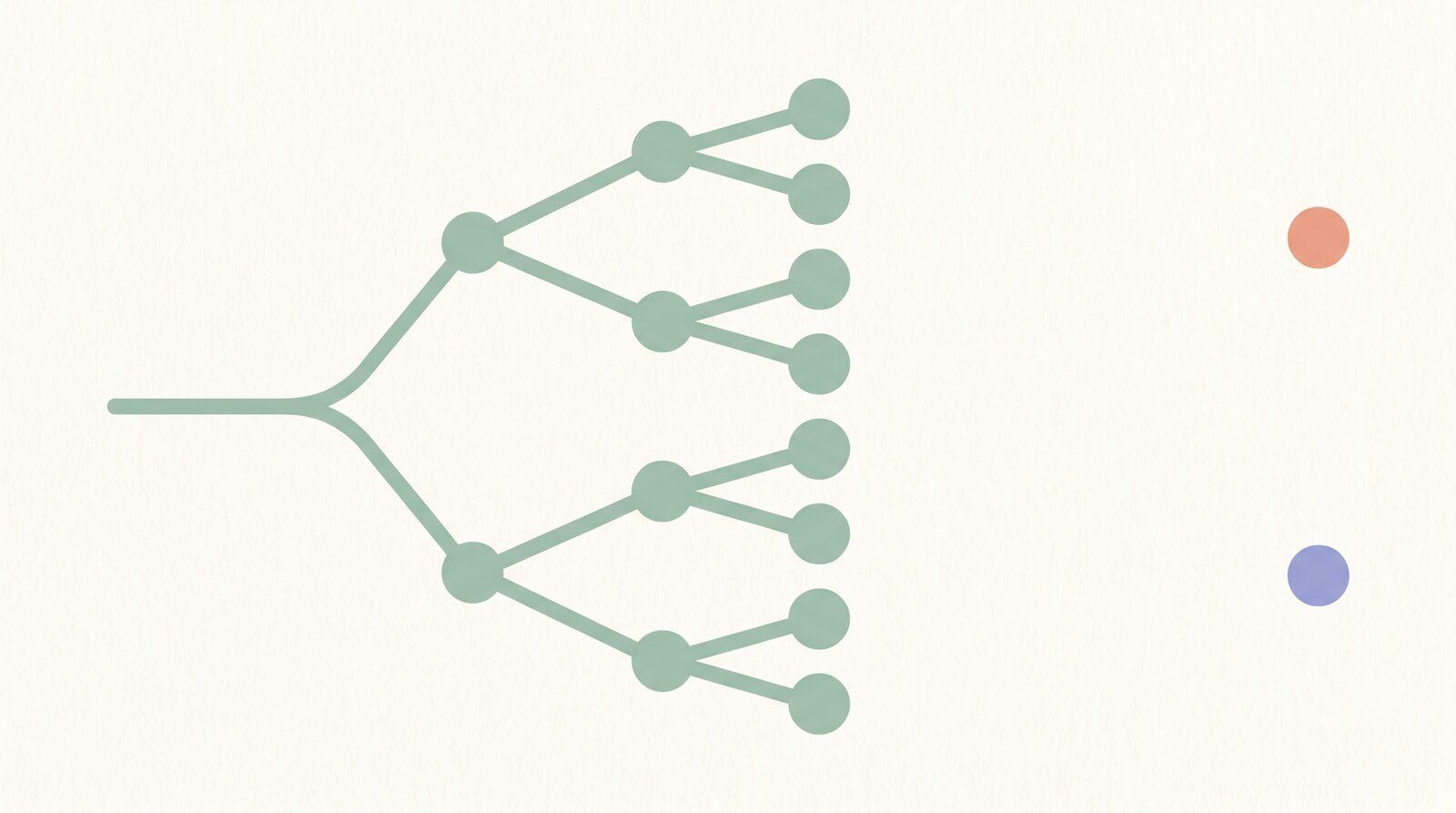
When two events are independent (the outcome of one has no effect on the outcome of the other), the probability of both happening is the product of their individual probabilities. Why multiply? List every possible outcome of two coin flips: HH, HT, TH, TT. There are four total, and only one of them is HH, so the answer is 1/4. The multiplication is just a shortcut for that listing.
The same idea explains why long streaks are so rare. The chance of flipping heads ten times in a row is (1/2) to the tenth power, which is about 1 in 1,024. Not impossible, but not common. And the chance of correctly guessing a six-digit PIN at random is (1/10) to the sixth power, which is one in a million. That is the kind of "one in a million" that is real. We are about to meet several that are not.
When Events Are Not Independent
Independence is the assumption that breaks more probability problems than any other. If you draw two cards from a deck without putting the first one back, the probability of the second card is not the same as the first, because the deck has changed. There are 52 cards and 4 aces, so the probability of drawing an ace first is 4/52. After you draw an ace, the deck has 51 cards and 3 aces, so the probability of a second ace is 3/51. The probability of two aces in a row is therefore .
This is conditional probability: the probability of one event given that another has already happened. It is written , and it is what most real-world reasoning actually wants. "What is the chance it rains tomorrow?" is one number. "What is the chance it rains tomorrow given that the radar shows a storm cell over the city?" is a different, much higher number. The new information rearranges the count of relevant outcomes.
Most "paradoxes" in probability are conditional probability problems with the conditioning quietly hidden. Untangle the conditioning, and the paradox usually disappears.
The Birthday Paradox
Here is a question that catches almost everyone. In a room of 23 people, what is the probability that at least two of them share a birthday?
The intuitive answer is small, because there are 365 days and only 23 people. The actual answer is just over 50 percent. With 50 people in the room it climbs to 97 percent. With 70 people it is over 99.9 percent. This is the birthday paradox, and it is not a glitch in the universe. It is a glitch in the way intuition counts.
The trap is that you are not asking "what is the probability that someone shares my birthday." You are asking "what is the probability any two people share." With 23 people there are different pairs of people, and each pair has a small chance of matching. That is a lot of chances, and small probabilities add up faster than the gut expects.
The lesson is general. When the number of opportunities for an event grows quadratically (every pair, every interaction), rare events become common quickly. A 1 in 365 chance per pair turns into a better-than-even chance overall once there are 253 pairs.
Base Rates and the One in a Million Trick
A medical test is "99 percent accurate" for a disease that affects 1 in 10,000 people. You test positive. What is the probability you actually have the disease?
Many people, including doctors, guess somewhere around 99 percent. The right answer is closer to 1 percent.
Here is why. Imagine 10,000 random people. About 1 of them has the disease, and the test will probably catch them. The other 9,999 do not have it, but a 99 percent accurate test misclassifies 1 percent of healthy people as positive, which is about 100 false positives. So out of every 101 positive results, 100 are false alarms and only 1 is real. The probability that you actually have the disease, given a positive test, is roughly 1 in 101, or about 1 percent.
This is the base rate fallacy. When the underlying event is rare (low base rate), even a very accurate test produces mostly false positives. Most people skip the base rate entirely and only think about the test accuracy, which leads them to a number that is wrong by two orders of magnitude.
The lesson generalizes far beyond medicine. "1 in a million" is a number that should always trigger a follow-up question: 1 in a million of what? 1 in a million per day, per year, per attempt, per person? A 1 in a million daily event happens roughly 365 times a year if the world has enough days, and about 8 billion times a year if the world has enough people. Once you fold in the population and the time window, "1 in a million" usually stops feeling rare. The headline that opens this article works the same way: most "miracles" reported in the news are 1 in a million events that had several billion chances to happen.
The Gambler's Fallacy
A roulette wheel has come up red eight times in a row. Surely black is overdue?
It is not. The wheel has no memory. The probability of black on the next spin is the same as it was on the first. This is the gambler's fallacy, the belief that past independent events change the odds of future ones. They do not.
The mirror version of the same mistake is the hot hand fallacy: the belief that a player who has just made several shots in a row is more likely to make the next one. For coin flips and roulette this is clearly wrong, because the device has no memory. For human performance the picture is genuinely more complicated (real skill exists, real momentum sometimes exists), but the underlying lesson stands: most streaks are pattern matching by an animal that evolved to find patterns whether they were there or not.
Where Probability Shows Up
Once you have the counting frame, probability appears everywhere.
Weather forecasts: a 30 percent chance of rain means that, across a large set of similar atmospheric conditions, it rained on about 30 percent of them. It is not a guarantee, and it is not a coin flip.
Medicine: every test, screening, and risk score involves the base rate trick above. A "positive" test means very different things for common and rare conditions, and "99 percent accurate" without a base rate is almost meaningless.
Insurance and finance: every premium, expected return, and risk model is a weighted average over possible outcomes. The math is just probability multiplied by payoff, summed over all the possible scenarios.
Standardized tests: the SAT, ACT, GRE, AP Statistics, and GCSE all include probability questions, and many of them are conditional probability problems in disguise. As we noted in our SAT prep guide, the trick is not the arithmetic, it is recognizing the structure.
Machine learning: every classifier is producing probabilities, and every metric (precision, recall, ROC curves) is a careful application of conditional probability and base rates. The base rate fallacy strikes again here: a model that is 99 percent accurate on a rare event might still be useless in production.
Estimating Odds Quickly
Most real-life probability questions do not need an exact answer. They need a fast, defensible estimate. Here are the moves that get you most of the way there.
Translate to a fraction first, then a percent or decimal. "1 in 100" is 1/100 is 1 percent is 0.01. As we covered in mental math tricks, fluency with these conversions is one of the highest-leverage skills you can build, because almost every probability problem ends with a translation between notations.
Always look for the base rate, especially when someone hands you an accuracy number for a rare event. If the base rate is small, the accuracy number is misleading.
Check independence carefully. Two events look independent when in fact one drives the other (test results within the same patient, stocks within the same sector, students in the same class). When events share a hidden cause, multiplying the probabilities gives an answer that is too small or too big.
Stress-test "1 in a million". Ask: per what, across how many people, over how long? Most "rare" events are not rare once you count the opportunities.
How Practice Builds the Reflex
Probability is the topic where pattern recognition matters most, because the same problem arrives in twenty different costumes. The student who has seen and re-seen the structures (independent versus dependent, with replacement versus without, conditional versus joint) starts spotting the structure within seconds, and the arithmetic falls out of that recognition.
Math Zen's bucket progression maps cleanly onto how the topic actually wants to be learned. The earliest buckets cover counting outcomes for simple experiments (dice, cards, coins). The middle buckets drill the multiplication rule and the addition rule for unions, with mixed practice so the brain learns to identify the situation rather than blindly apply a formula. The later buckets work on conditional probability, expected value, and the classic puzzles (birthday paradox, Monty Hall, base rate problems). Because the practice is short and spaced, you get repeated chances to recognize the structure, which is what eventually turns the rules into reflexes.
The Bottom Line
Probability is one idea: count the outcomes that match, divide by all the outcomes that exist, and stay honest about whether the events you are counting are really independent. The "paradoxes" are just situations where the gut counts something different from the math. Multiply when events are independent. Add when you want the chance of either (subtracting the overlap, so you do not double-count). Condition when new information arrives. Always look for the base rate, especially when someone hands you a "1 in a million."
Once you start asking "1 in a million of what, per what, across how many?" the everyday world stops feeling random in the same way. The lottery becomes a small expected loss with rare jackpots. The medical test becomes a question about base rates. The hot streak becomes a coincidence that the brain is dressing up in causality. The numbers do not change, but the way you read them does, and that change pays off forever.