Understanding Negative Numbers Intuitively (Why a Negative Times a Negative Is Positive)
Almost everyone can tell you that a negative times a negative is a positive. Far fewer can tell you why, and most who try fall back on "that is just the rule" or a half-remembered phrase about two wrongs not making a right, which is the opposite of what the rule actually says. The honest situation is that negative numbers are usually taught as a list of sign rules to memorize, with no picture underneath. The rules then feel arbitrary, and arbitrary rules are the ones that quietly fall apart on a test.
The fix is the same as it was for every other topic in this series. There is one idea underneath all the sign rules, and once you see it, you stop memorizing "negative times negative is positive" and start being unable to imagine it working any other way. This article is the picture: what a negative number actually is, why each sign rule has to be true, and how to stop second-guessing them.
A Negative Number Is a Direction, Not a Smaller Kind of Number
The first repair is conceptual. Many people secretly think of negative numbers as broken or lesser numbers, a sort of damaged version of the real ones. They are not. A negative number is an ordinary number that also carries a direction.
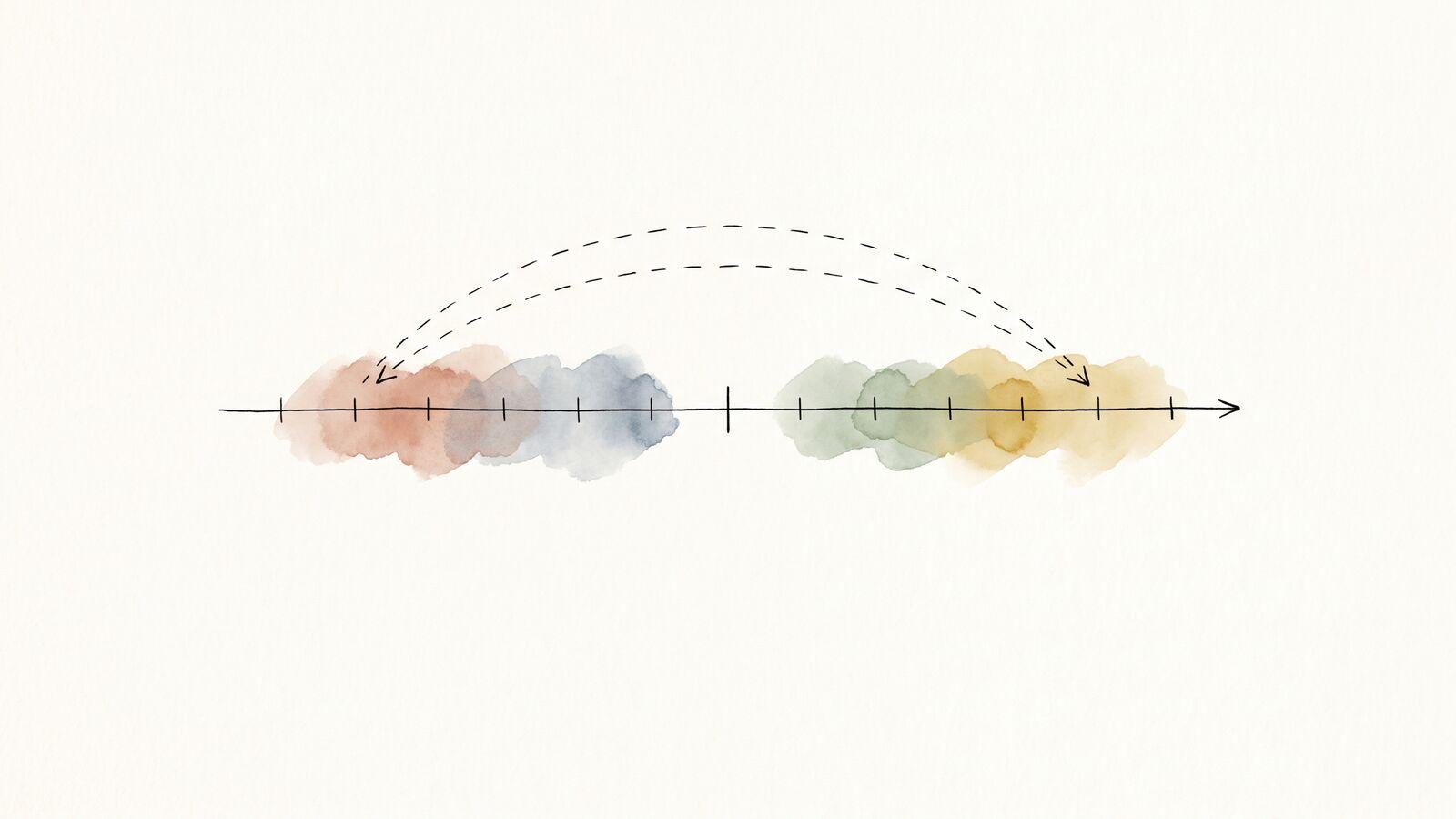
Picture the number line, with zero in the middle. Positive numbers are positions to the right of zero. Negative numbers are positions to the left. The number 5 and the number -5 are the same distance from zero. They are not different sizes. They point opposite ways. The minus sign is not damage. It is an arrow.
This is why negatives show up the moment a quantity can go two ways from a natural zero. Temperature above and below freezing. Money you have and money you owe. Steps forward and steps back. Elevation above and below sea level. In every case, zero is just the agreed starting point, and the sign records which side of it you are on. As we covered in the fractions post, most math anxiety comes from treating a notation as a new kind of object instead of a new label on a familiar one. A negative is a familiar number wearing a direction.
Adding Is Moving, and the Sign Tells You Which Way
Once the number line is the picture, addition stops being a rule and becomes a walk.
To add a positive number, you move right. To add a negative number, you move left. That is the entire operation. Start at 3 and add -5: begin at 3, walk 5 steps left, land on -2. You did not apply a rule about "when signs are different, subtract and keep the sign of the larger." You just walked, and the answer is wherever you stopped.
This is why 3 + (-5) and 3 - 5 give the same answer. They are the same instruction written twice: from 3, go 5 steps left. Adding a negative and subtracting a positive are not two facts to memorize. They are one motion described in two grammars. The textbook rule about matching and mismatching signs is just a verbal summary of "which direction do I walk, and how far," and the walk is always easier to trust than the summary.
Subtraction Is the Step That Trips Everyone
Adding negatives feels manageable. Subtracting them is where confidence collapses, almost always at one specific phrase: subtracting a negative is the same as adding a positive. Stated as a rule, it sounds like a trick. It is not. It follows from what subtraction means.
Subtraction asks a distance-and-direction question: "to get from the second number to the first, how far do I move, and which way?" 7 - 2 asks how to get from 2 to 7, which is 5 steps right, so the answer is +5. Now apply the same question to 7 - (-2): how do I get from -2 to 7? That is 9 steps to the right. The answer is +9, which is exactly 7 + 2.
Nothing was reversed by decree. Removing a leftward thing pushes you rightward, the same way taking a 50 dollar debt off your books leaves you 50 dollars richer even though no cash arrived. The "minus a minus becomes a plus" rule is not a quirk of notation. It is what removal of a negative quantity has to mean, and the debt picture makes it concrete: cancel what you owe and you are better off, by exactly the amount you owed.
Why Negative Times Positive Is Negative
Multiplication by a whole number starts life as repeated addition, a connection we leaned on in the exponents post. 3 times 4 is 4 + 4 + 4. Keep that meaning and the first multiplication sign rule writes itself.
What is 3 times -4? It is -4 added three times: (-4) + (-4) + (-4). On the number line that is three jumps of 4 to the left, landing on -12. So a positive times a negative is negative, not because a rule says so, but because adding a leftward quantity repeatedly keeps moving you left. Multiplication has not changed. It is still repeated addition. The only new ingredient is that the thing being repeated points the other way.
Why Negative Times Negative Has to Be Positive
Now the famous one, the rule everyone can recite and almost nobody can justify. There are two clean ways to see it, and seeing both is what makes it permanent.
The first is the pattern argument. Look at what happens when you multiply -3 by a column of shrinking numbers:
Every time the right-hand factor drops by 1, the result goes up by 3. The pattern is rigid and self-imposed. Continue it honestly and you cannot stop: -3 × -1 must be +3, then -3 × -2 must be +6. Making negative times negative positive is the only way the pattern stays consistent. Any other choice would force multiplication to jump unpredictably exactly when one factor crosses zero, and an operation that behaves like that is useless for everything else math needs it to do.
The second is the reversal argument, and it is the one that tends to stick. Multiplying by a negative does two jobs at once: it scales by the size of the number, and it flips you to the other side of zero, the way a 180-degree turn reverses the direction you face. Multiplying by -1 is exactly that flip. So multiplying by -1 twice is flipping, then flipping back, which leaves you facing the original way. -1 times -1 is +1 for the same reason that turning around twice points you where you started. A negative times a negative is positive because two reversals cancel. As we covered in the algebra post, the deepest math rules are almost never decrees. They are the only option that keeps everything else from contradicting itself, and this is the cleanest example of that in the whole curriculum.
The Sign of a Product Is Just a Reversal Count
Both arguments collapse into one habit you can use forever. Every negative factor in a multiplication is one reversal. To find the sign of a product, do not chant a rule. Count the negatives.
An even number of negative factors means an even number of flips, and you end up facing forward, so the product is positive. An odd number means one flip is left over, so the product is negative. (-2) × (-3) × (-4) has three negatives, an odd count, so the result is negative, no matter what the digits are. The size of the answer comes from the digits. The sign comes only from the reversal count. Separating those two questions removes most sign mistakes people make under exam pressure, because you are no longer juggling a chain of pairwise rules in your head. You are just asking: how many flips, odd or even.
Division carries the identical logic, because dividing is multiplying by the reciprocal, and taking a reciprocal never touches the sign. Count the negatives there too. There was never a separate division rule to memorize.
Where the Mistakes Actually Come From
If negatives are this orderly, why do they cause so much grief well into adulthood? The errors cluster in a few honest places, and naming them is most of the cure.
The first is the missing minus sign in a chain of steps, especially when distributing across a subtraction. The negative is not conceptually hard there. It is just easy to drop, the way a carried digit gets dropped in long addition. It is a bookkeeping slip, not a comprehension gap, and the order of operations habits of slowing down at the risky step are what catch it.
The second is conflating "negative" with "subtract" because they share a symbol. In -5, the minus is part of the number. In 8 - 5, it is an instruction. The expression -3 - (-7) contains both meanings of the same symbol in one short line, which is precisely why it looks intimidating until you read each minus as either a direction or a motion and walk it on the number line.
The third is trusting the memorized sign rule over the picture under pressure. The picture, the walk, the flip count, never abandons you. The rule, recalled in a hurry, often arrives slightly wrong, which is how "two negatives make a positive" gets misapplied to addition, where it is simply false. -3 + (-4) is -7, because adding two leftward moves sends you further left. The picture would never let you make that mistake. The half-remembered slogan invites it.
Where Math Zen Fits In
Math Zen's bucket progression is built for exactly the topic where a single weak idea poisons everything downstream, and negatives are the clearest case of that. The early buckets drill the number line until "negative means the other direction" is reflexive rather than recited, and until adding and subtracting negatives is a walk you do not have to narrate. The middle buckets move into multiplication and division of signed numbers, deliberately mixing the cases so you practice counting reversals instead of pattern-matching a single tidy example. The later buckets fold signed numbers back into algebra and arithmetic, where the real test of understanding is whether the sign survives a multi-step problem, not whether you can recite the rule in isolation.
Because the practice is short and spaced, the reversal-count habit becomes automatic the same way single-digit multiplication eventually did, which is the entire point of practicing in small spaced sessions rather than one long cram. Most learners do not have a negative-numbers gap that needs a thicker textbook. They have one missing picture and a few unpracticed reps.
The Bottom Line
A negative number is an ordinary number pointing the other way from zero. Addition is a walk: add a positive and step right, add a negative and step left, which is why adding a negative and subtracting a positive are the same instruction. Subtracting a negative is adding a positive because removing a leftward quantity, like canceling a debt, pushes you right. A negative times a negative is positive because multiplying by a negative reverses direction, and two reversals cancel, the same way turning around twice leaves you facing forward.
That is the whole foundation. The list of sign rules in the textbook is not a list of separate facts. It is this one idea, direction and reversal, read in different situations. When a sign question stumps you, do not reach for the rule. Put it on the number line, decide which way each piece points, and count the reversals. The sign will be right before the rule would have finished loading.