Understanding Geometry Intuitively (Shapes, Space, and Why Proofs Exist)
Geometry is the study of shape and space. That is the whole subject in one line: how figures are built, how they relate to each other, and how much room they take up. A floor plan, a slice of pizza, the path a ball arcs through the air, the screen you are reading this on, all of it is geometry.
Yet geometry is often taught as a thick stack of theorems and two-column proofs to memorize, which is exactly backwards. The theorems are the conclusions. The interesting part is the reasoning that gets you there, and that reasoning is something you can feel. This article builds geometry from the ground up: what it actually studies, the handful of ideas everything rests on, and why those proofs you were forced to write turn out to matter.
Geometry Is the Math of Shape and Space
Algebra works with numbers and the symbols that stand in for them. Geometry works with the shapes those numbers describe. The two are partners: give a triangle some side lengths and you can compute with them, but the triangle itself, its corners and edges and the space it encloses, is geometry's territory.
The subject starts with objects so basic they are almost impossible to define and easier to just point at:
- A point is a position with no size. Pure location.
- A line is a straight path of points, stretching forever in both directions.
- A plane is a flat surface, like an endless tabletop, that holds points and lines.
Everything else is built from these. A triangle is three points joined by three line segments. A circle is every point sitting the same distance from a center. Once you see the pieces, the shapes stop being a vocabulary list and start being things you can construct.
Angles Measure Turning, Not Length
An angle is one of the first ideas that trips people up, because it is easy to confuse it with length. An angle does not measure how long the sides are. It measures how much you turn between them.
Picture standing at a corner and pivoting from one wall to the other. The amount you rotate is the angle, and it does not change if the walls are long or short. We measure that turn in degrees, where a full spin is 360 degrees, a half spin (a straight line) is 180, and a quarter turn (a right angle) is 90.
This turning picture explains facts that otherwise look like rules to memorize:
- Angles on a straight line add to 180 degrees, because a straight line is a half turn.
- Angles around a single point add to 360 degrees, because going all the way around is a full turn.
You are not memorizing numbers. You are counting how much of a full rotation you have used up.
Area and Perimeter: Two Different Questions
Two of the most-confused words in geometry describe genuinely different things.
Perimeter is the distance around the edge of a shape: the length of fence you would need to enclose it. You find it by adding up the sides.
Area is the amount of flat space inside: the amount of grass the fence encloses. You measure it in square units, because area answers the question "how many unit squares fit inside?"
That question is the key to every area formula. A rectangle that is 4 units wide and 3 tall holds exactly 4 × 3 = 12 unit squares, which is why area is width times height. Everything else follows from rearranging:
- A triangle is half of a rectangle (slice a rectangle along its diagonal), so its area is half the base times the height.
- A parallelogram is a rectangle with a triangle shifted from one end to the other, so it has the same base times height.
You do not need to memorize these as separate formulas. You need to see that each one is a rectangle in disguise. (For why the multiplying itself behaves the way it does, see understanding exponents, where squaring is exactly the area of a square.)
The Pythagorean Theorem: Geometry's Workhorse
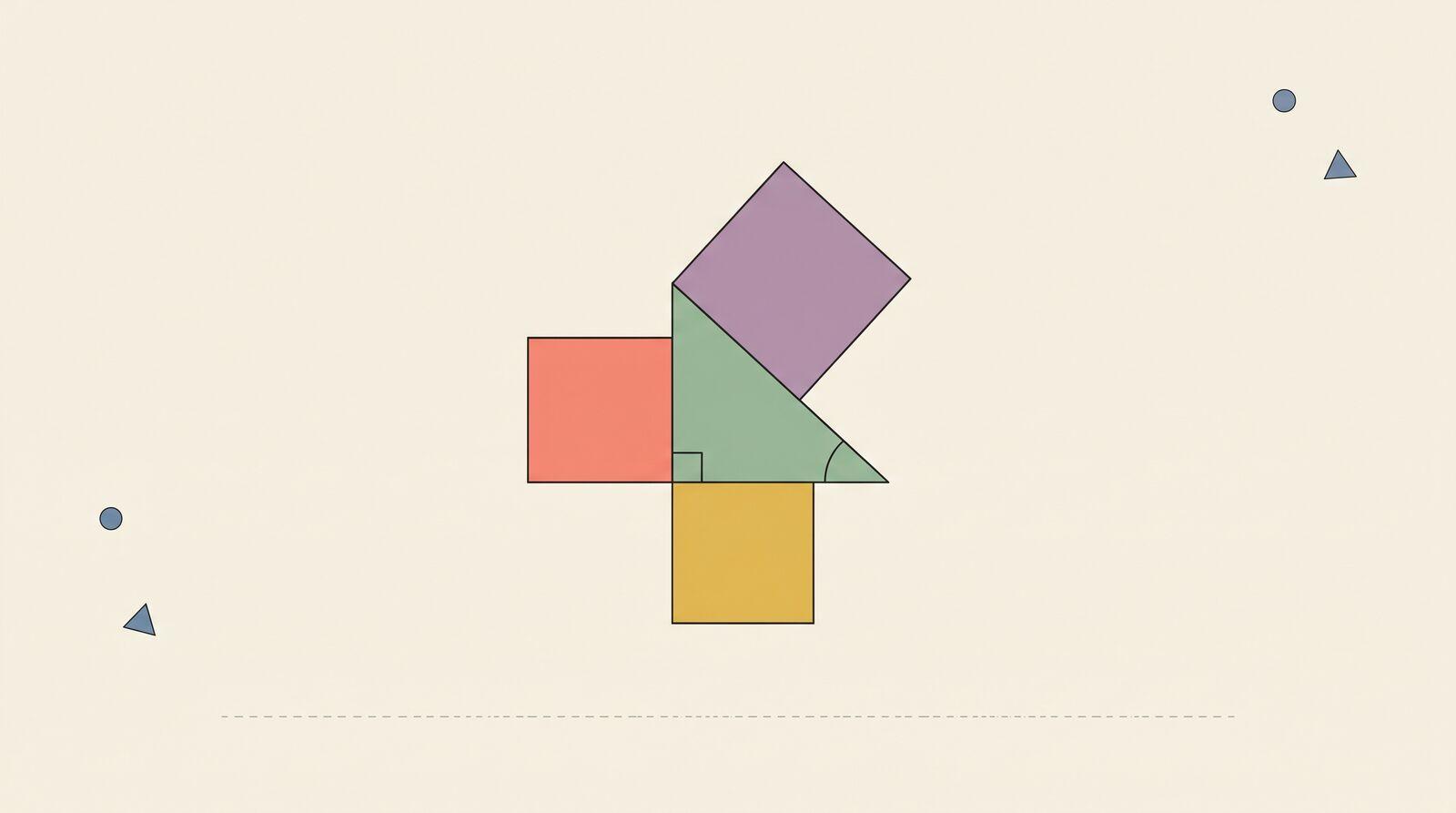
If geometry has one celebrity result, it is the Pythagorean theorem: in a right triangle, the square of the longest side equals the sum of the squares of the other two. In symbols, ², where c is the side opposite the right angle.
What makes it more than a formula is what it really says. Build an actual square on each side of a right triangle, and the two smaller squares hold exactly as much area as the big one. The relationship is about areas fitting together, not just numbers in an equation.
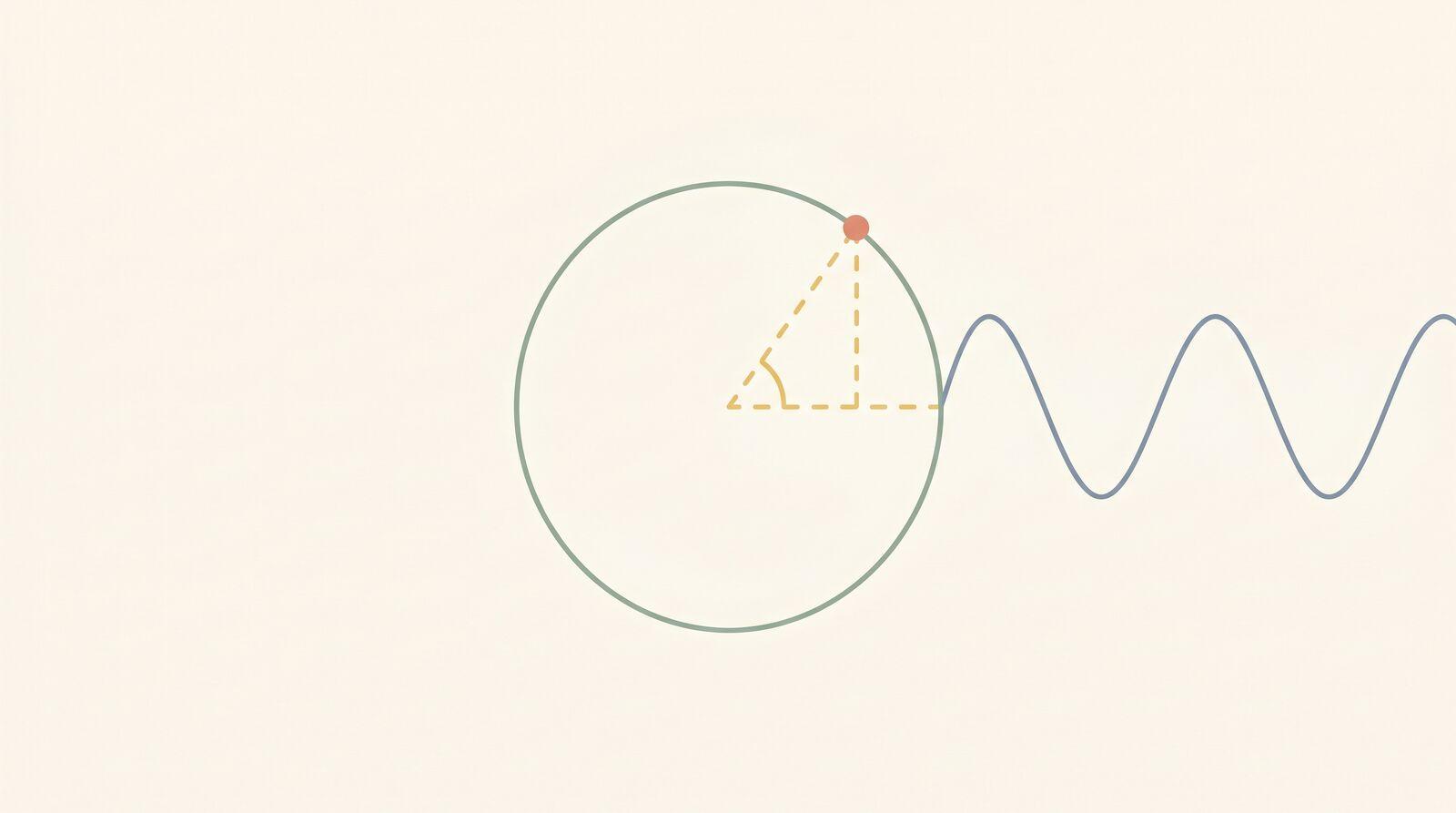
This single fact is the engine behind an enormous amount of math. It is how you find the straight-line distance between two points, which is why it sits underneath coordinate geometry and the distance formula. It is also the seed of trigonometry, where sine and cosine turn out to be nothing more than the coordinates of a point on a circle, governed by this same right-triangle relationship.
Why Proofs Exist (and Why They Are Not Busywork)
Here is the part students dread and the part that actually defines geometry: the proof.
A proof is an argument that something must be true for every possible case, not just the ones you happened to check. And this is not pedantry. Measuring can only ever test examples. You could measure the angles of a thousand triangles, find they each total 180 degrees, and still not know whether triangle number one-thousand-and-one breaks the pattern. Measurement covers cases one at a time, and there are infinitely many.
A proof covers them all at once by reasoning about what the shape is, rather than what any particular drawing measures. Take the triangle angle fact. Draw a line through the top corner parallel to the bottom side. The two angles spilling out to the sides exactly match the triangle's two base angles, and the three angles at that top corner sit on a straight line, which is 180 degrees. So the triangle's angles must total 180 degrees, for every triangle, forever. No measuring required, and no exception possible.
That is the real lesson hiding inside geometry: it is where most people first meet the difference between "true in the examples I tried" and "true because it cannot be otherwise." That habit of mind, demanding a reason rather than a sample, is worth more than any single theorem.
Geometry Connects to Everything Else
Geometry is not a sealed-off island of shapes. It is the visual layer underneath much of the rest of math.
- The coordinate plane married geometry to algebra: every equation became a shape, and every shape an equation. A line is y = mx + b, a parabola is y = , a circle is ².
- Because of that marriage, a function can be pictured as a curve, and the questions calculus asks (how steep is it, how much area is under it) are geometric questions in disguise.
- Trigonometry is just geometry done on a circle, turning angles into precise coordinates.
Learn to see shapes clearly and a surprising amount of later math arrives already half-understood.
Why This Matters for Learning
When you practice geometry in Math Zen, the problems build from naming and measuring angles up through area, the Pythagorean theorem, and the reasoning behind short proofs, with difficulty that adapts to where you actually are.
Seeing geometry as shape-and-space rather than a formula list helps because:
- Area stops being a stack of formulas once you see every shape as a rearranged rectangle.
- Angle facts stop being arbitrary once you read them as fractions of a full turn.
- Proofs stop being busywork once you notice they are the only honest way to make a claim about every shape at once.
The same intuition carries into the spaced repetition you will use to keep these results fresh, so the theorems stay reasons you understand instead of facts you are hoping to recall.
The Takeaway
Geometry is the study of shape and space, built from points, lines, and planes. Angles measure turning, perimeter measures the edge, area counts the unit squares inside, and the Pythagorean theorem ties the sides of a right triangle together through their squares. Proofs exist because the claims are about every shape of a kind at once, and reasoning is the only way to cover infinitely many cases honestly.
Next time geometry looks like a wall of theorems, remember it is really one question asked over and over: what is this shape, and why must it behave the way it does? That shift, from memorizing results to seeing why they hold, is what makes geometry click.
Common Questions
- What is geometry in simple terms?
- Geometry is the study of shape, size, and space: how figures like lines, angles, triangles, and circles are built, how they relate, and how much space they take up. Where algebra works with numbers and symbols, geometry works with the shapes those numbers describe. It is the branch of math you use whenever you measure a room, read a map, or notice that two things are the same shape at different sizes.
- Why does geometry have so many proofs?
- A proof is an argument that something must be true for every case, not just the ones you measured. You can measure a hundred triangles and find their angles add to 180 degrees, but measuring never rules out the hundred-and-first. A proof shows it could not be otherwise. Geometry leans on proofs because its claims are about all shapes of a kind at once, and the only honest way to cover every case is to reason rather than measure.
- What is the difference between area and perimeter?
- Perimeter is the distance around the edge of a shape, the length of the fence. Area is the amount of flat space inside it, the amount of grass that fence encloses. Perimeter is measured in regular units like meters, area in square units like square meters, because area counts how many unit squares fit inside. Two shapes can share a perimeter while having very different areas.
- Why do the angles in a triangle always add up to 180 degrees?
- Draw a line through one corner of a triangle parallel to the opposite side. The two outer angles at that corner match the triangle's other two angles (they are alternate angles across parallel lines), and together with the corner's own angle they form a straight line, which is 180 degrees. So the three angles of the triangle must total 180 degrees too. This is a small proof, and it works for every triangle.
- Do I need to memorize all the geometry formulas?
- No. Most geometry formulas come from a few ideas: area counts unit squares, perimeter adds up edges, and the Pythagorean theorem relates the sides of a right triangle. If you understand why a rectangle's area is length times width, you can rebuild the triangle and parallelogram formulas instead of memorizing them. Understanding the handful of core ideas beats memorizing the long list every time.