Understanding Trigonometry Intuitively (Why sin and cos Are Just Coordinates)
The first time most students meet trigonometry, it arrives as a wall: three new functions with cryptic names, a mnemonic that nobody can spell, a unit circle full of fractions involving square roots, and identities that look like algebra mistakes. Within a week the topic feels like a foreign language with no dictionary.
It does not have to feel that way. Trigonometry has one central picture, and that picture is a point walking around a circle. Almost every formula in your textbook is a direct, almost literal description of what that point is doing. Once the picture is clear, the mnemonics become unnecessary, the identities become obvious, and the topic stops being a memorization exercise.
This article is the picture. It is not a replacement for practice, and there is no shortcut around drilling the values until they are automatic. But the meaning comes first. Without the meaning, the practice is just shuffling symbols.
The One Idea: A Point Walking Around a Circle
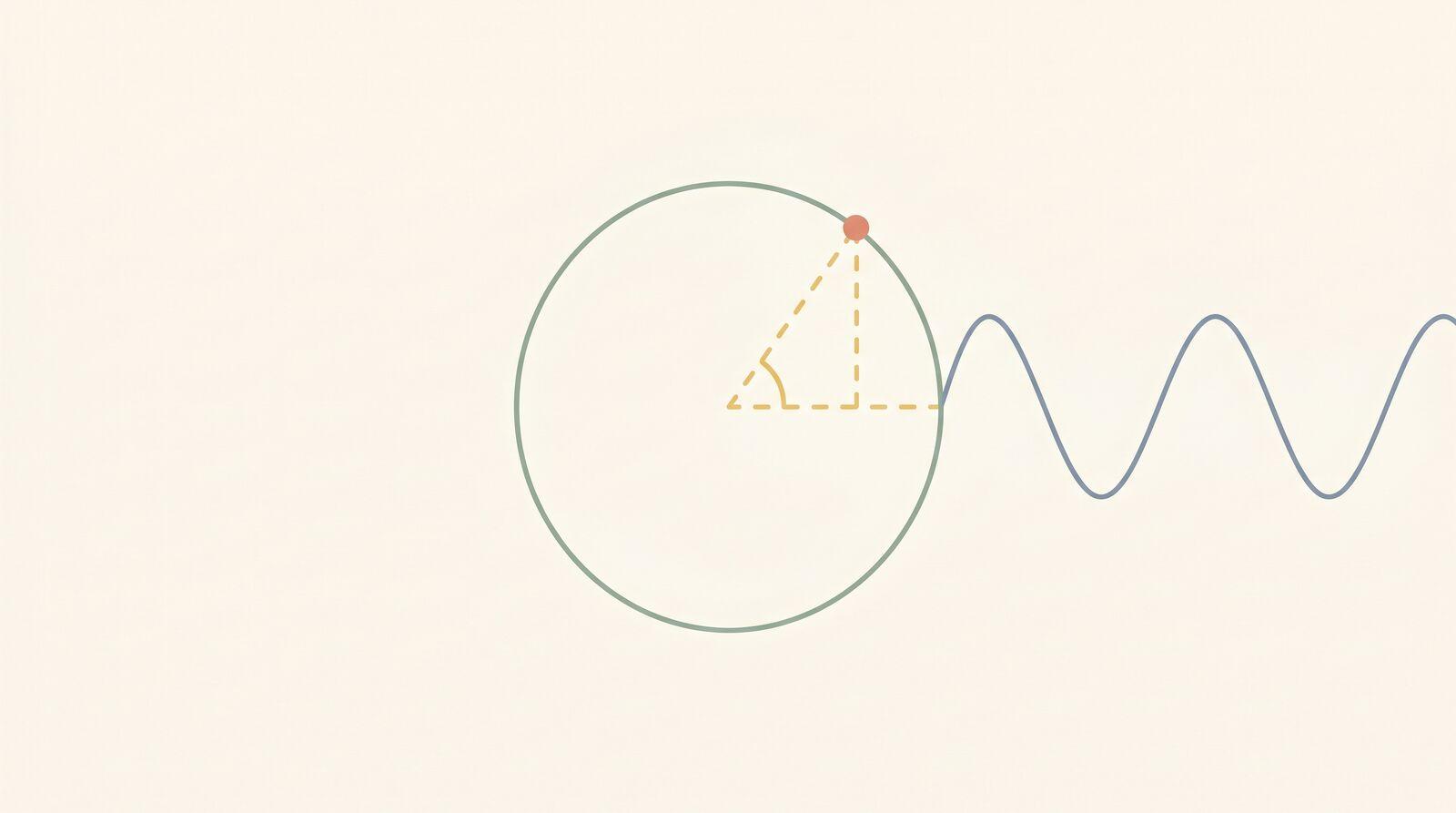
Draw a circle with radius 1, centered at the origin. Pick any point on it. That point has an x-coordinate and a y-coordinate. Both depend on where the point sits on the circle, and they change as the point moves around.
That is trigonometry. The whole topic is bookkeeping on this one picture.
Now we need a way to describe "where the point sits on the circle." The standard way is to measure the angle from the positive x-axis, sweeping counterclockwise. Call that angle θ (theta).
When θ is 0, the point is at (1, 0), the rightmost point of the circle. When θ is 90 degrees, the point has rotated up to (0, 1), the top of the circle. When θ is 180, it is at (-1, 0). When θ is 270, it is at (0, -1).
The two coordinates of the point have names. The x-coordinate is called cos(θ). The y-coordinate is called sin(θ).
That is the entire definition. Cosine is the x-coordinate of a point on the unit circle. Sine is the y-coordinate. Everything else in the textbook is a consequence of those two sentences.
Why a Circle Instead of a Triangle?
You may have learned trigonometry first through right triangles, with phrases like "opposite over hypotenuse." That definition is fine for a narrow case, but it stops working the moment the angle goes past 90 degrees, because right triangles do not have angles bigger than 90.
The circle definition has no such limit. The point can rotate forever, the angle can be any number, and sin and cos are still well-defined coordinates. That is why mathematicians eventually moved to the circle: it is the more general picture.
The triangle picture is still useful, and it slots cleanly inside the circle picture. Drop a vertical line from the point on the circle down to the x-axis. You now have a right triangle whose hypotenuse is the radius (length 1), whose horizontal leg has length cos(θ), and whose vertical leg has length sin(θ). The familiar "opposite over hypotenuse" definition is just a description of this triangle when the radius happens to be 1.
The triangle is one snapshot. The circle is the whole movie.
SOH CAH TOA Without the Mnemonic
The mnemonic SOH CAH TOA is a memory aid for three ratios in a right triangle:
- sin = opposite over hypotenuse
- cos = adjacent over hypotenuse
- tan = opposite over adjacent
These look like three separate facts to memorize. They are not. They are the same picture, scaled up.
Take the right triangle from the unit circle. Hypotenuse 1, horizontal leg cos(θ), vertical leg sin(θ). Now scale the whole triangle by some factor, say 5. Hypotenuse becomes 5, horizontal leg becomes 5·cos(θ), vertical leg becomes 5·sin(θ).
Compute opposite over hypotenuse for the scaled triangle: (5·sin(θ)) / 5 = sin(θ). The 5s cancel. The ratio is the same as it was on the unit circle.
That is the only reason SOH CAH TOA works. The trig values are ratios, and ratios do not care about the size of the triangle. Whatever angle you have, the proportions of the sides are fixed, which is why a single sin(30°) value works for every right triangle in the universe with a 30-degree angle in it.
Tangent is just sin divided by cos. If sin is the y-coordinate and cos is the x-coordinate, then tan(θ) is rise over run, which is the slope of the line from the origin out to the point. That is also why tan(90°) is undefined: the line is vertical, the slope is "infinite," and division by cos(90°) = 0 falls apart.
Why Pi Shows Up Everywhere
Trigonometry classes spend a lot of time switching between degrees and radians. Most students treat radians as a weird alternative unit invented to confuse them. They are not. Radians are the natural unit for angles, and the reason will save you a lot of grief in calculus.
A radian is defined this way: the angle that makes an arc of length 1 on a unit circle. Since the full circle has circumference 2π, the full angle (360 degrees) is 2π radians. Half a circle is π radians. A right angle is π/2 radians.
Why bother? Because once you use radians, the numbers in formulas line up cleanly with the geometry. The arc length traveled around a unit circle equals the angle in radians, exactly. The derivative of sin(x), in calculus, is cos(x), exactly. If you use degrees instead, the derivative of sin(x) is (π/180)·cos(x), and that ugly factor follows you around forever.
Radians are not harder. They are the unit the math wants you to use. Degrees are a human convention left over from the Babylonians, and they work fine for navigation and architecture. For pure mathematics, switch to radians early and the formulas stop looking like they have errands attached.
The Famous Identities Are Just the Picture
The identity students remember most is . It looks mysterious. It is not. It is the Pythagorean theorem on the unit circle.
The point on the unit circle has coordinates (cos(θ), sin(θ)) and sits on a circle of radius 1. The distance from the origin to that point is + (θ)), and that distance is the radius, which is 1. Square both sides and you get the identity. It is Pythagoras dressed up in trig notation.
Most "identities" in your textbook have similar simple origins. The double-angle formula describes what happens to the y-coordinate when you double the angle. The angle-sum formula is a description of how rotating by α and then by β combines into a single rotation. Each identity is a sentence about the geometry, written in the trig alphabet.
The identities are easier to derive from the picture than to memorize from a list. Anyone who has memorized the Pythagorean theorem already knows , just not under that name. As we covered in the algebra post, most "rules" in math are pictures wearing notation. Trig is no exception.
Where Trig Actually Shows Up
Trigonometry is one of the most-used branches of math outside school, and the reason is that anything that oscillates, rotates, or repeats reduces to sines and cosines.
Sound and light are waves. A pure musical tone is a sine wave, and the sine of time governs the air pressure at your eardrum. Speakers, microphones, and noise-canceling headphones all run on this idea. The decomposition of complicated waveforms into simple sines is called Fourier analysis, and it underlies MP3 encoding, image compression, MRI machines, and modern wireless communication.
GPS and navigation rely on trigonometry. Your phone's location is found by measuring distances to several satellites and solving the resulting triangles. Surveyors, pilots, and astronomers all use the same methods.
Computer graphics, video games, and animation lean on trig constantly. Every time a character rotates, every time a camera pans, every time a planet orbits in a simulator, sine and cosine are doing the work.
Engineering and physics use trig to describe alternating current, the swing of a pendulum, the orbit of a satellite, the vibration of a bridge, and the motion of a piston. If something repeats over time, the math of that repetition is sines and cosines.
Calculus. As we covered in the derivatives post, sine and cosine are unusually clean to differentiate, and most of physics is built on top of them. The wave equation, the Schrödinger equation, and the equations of electromagnetism all have sines and cosines as their basic solutions.
Hyperbolic functions reuse that coordinate idea on a hyperbola, replacing circular motion with balanced exponential growth and decay.
If algebra is the language you use to talk about unknown numbers, trigonometry is the language you use to talk about anything that goes around in circles. That is a very long list.
Why Trig Is Often Taught Badly
If trigonometry is this useful, why do so many students leave high school convinced they hate it? A few honest reasons.
First, the topic is often introduced as triangles before the circle. The triangle definition is fine for the simplest cases, but it makes sin and cos look arbitrary. Students memorize the mnemonic without ever seeing the picture that makes the mnemonic obvious. When the angle goes past 90, they panic, because the triangle picture has just broken and nobody told them why.
Second, the unit circle is presented as a chart to memorize, with the values at 0, π/6, π/4, π/3, π/2 listed as a table. That makes the chart look like an arbitrary set of facts. It is not. Each value comes from a 30-60-90 or 45-45-90 triangle, and you can derive any entry in under thirty seconds if you understand where it comes from.
Third, identities are taught as a long list rather than as consequences of the picture. Students treat them as separate spells to memorize, panic at the volume, and try to brute-force them through repetition. The shortcut is to spend an hour with the unit circle until the picture is automatic, and then most identities become obvious.
The good news is that fixing these gaps is fast. Trig rests on a small number of ideas. Once those ideas connect, the topic becomes manageable.
Practicing Until It Is Automatic
Reading this once gives you the picture. Making trig fluent is a separate task.
Memorize the unit circle, but understand it first. Spend an hour drawing the unit circle from scratch, marking the values at 0, π/6, π/4, π/3, π/2, and the rest by symmetry. Use 30-60-90 and 45-45-90 triangles to derive the exact values. After the first hour, drilling the values for ten minutes a day for a week or two locks them in.
Drill sign rules by quadrant. sin is positive in the upper half, negative in the lower half. cos is positive on the right, negative on the left. tan follows from those. After a week of mixed quadrant practice, you can read off the sign of any trig value at a glance.
Translate identities into pictures. When you meet a new identity, do not memorize it first. Draw what it claims about the unit circle. The double-angle formula? Plot a point at θ and one at 2θ, and check that the y-coordinate matches. The sum formula? Stack two rotations. After a few weeks of this, identities feel like sentences instead of spells.
Mix with algebra and calculus problems. As we covered in the spaced repetition post, mixed practice builds long-term recall. Once the trig basics are in place, mix them with algebra (solving 2·sin(θ) = 1) and pre-calculus (graphing y = sin(2x) + 1). Mixed practice is what builds fluency.
Check answers against the picture. If you compute sin(150°) and get a negative number, you have made a sign error, because 150° puts the point in the upper-left quadrant where y is positive. The unit circle doubles as a sanity check that catches most mistakes within seconds.
Where Math Zen Fits In
Math Zen's bucket progression maps cleanly onto how trigonometry actually wants to be learned. Early buckets cover the unit circle, sign rules, and the values at common angles, drilled until they are automatic. Middle buckets practice converting between degrees and radians, evaluating arbitrary angles by reflection and symmetry, and applying SOH CAH TOA to right triangles. Later buckets cover identities (Pythagorean, double-angle, sum and difference) and graphs of sin, cos, and tan with phase shifts and amplitude changes.
Because the practice is short, mixed, and spaced, the unit circle stops being a chart you re-derive every time and becomes a fact you can read off in under a second. That is the level of fluency that makes calculus, physics, and standardized tests like the SAT feel routine instead of frantic. Most students do not need a tutor or a thicker textbook. They need ten or fifteen minutes a day on the right kind of problem.
The Bottom Line
A point walks around a circle. Its x-coordinate is called cos. Its y-coordinate is called sin. Their ratio is called tan. Every formula in trigonometry is a description of what the point is doing.
That is the entire foundation. SOH CAH TOA is what those coordinates look like inside the right triangle. The unit circle chart is the values at the most common angles. The identities are sentences about the geometry, written in trig notation. None of it is arbitrary, and none of it is hard once the picture is in your head.
Next time you see sin(θ), do not just think "the trig function." Think: "the y-coordinate of a point at angle θ on a circle of radius 1." That shift in perspective makes the rest of trigonometry, and most of the math after it, fall into place.