How to Prepare for GSAT Math (學測數學): A 12-Week Study Plan

In January 2026, the level width for Math A dropped from 6.12667 to 5.72333. That width (級距) is the average raw score of the top 1% of candidates divided by 15, so the drop means the top 1% averaged about 85.85 points out of 100, down from about 91.9 the year before. The paper got harder, and the scale absorbed it. A raw score just above 80 was enough for the maximum of 15 levels (級分).
So the target is not a perfect paper but a share of the points, on a scale the top of the field resets every year. That is how the General Scholastic Ability Test (學科能力測驗, usually 學測 or GSAT) scores every subject. The College Entrance Examination Center (大學入學考試中心, CEEC) runs it every January, with mathematics set as two separate, optional papers: Math A (數學A) and Math B (數學B), 100 minutes each. This guide covers which paper to sit, how points are won and lost, what each paper covers, and how to spend the 12 weeks before January 22, 2027.
Two Papers, 100 Minutes Each
GSAT mathematics has been two subjects since the January 2022 sitting, each marked out of 100 raw points. Part I holds the single-choice, multiple-select and fill-in questions; Part II is a mixed question set that combines choice items with written answers. This is how the January 2026 papers were built:
| Paper | Part I: choice and fill-in | Part II: mixed set | Points | Time |
|---|---|---|---|---|
| Math A | 6 single-choice, 6 multiple-select, 5 fill-in (85 points) | Items 18-20 (15 points) | 100 | 100 min |
| Math B | 7 single-choice, 5 multiple-select, 5 fill-in (85 points) | Items 18-20 (15 points) | 100 | 100 min |
Every Part I item was worth 5 points, and the 2025 papers used the same splits. Treat them as recent practice, not a rule: CEEC's exam description fixes only the proportions, about 80 to 85% for Part I and 15 to 20% for Part II, so the mix can shift. That description has applied since 2022, and CEEC lists no revision of it for 2027.
For the January 2027 sitting (116學年度), the exam regulations for the 2027 GSAT put Math A on Friday, January 22, and Math B on Sunday, January 24, both from 09:20 to 11:00. Registration runs from October 27 to November 10, 2026, and scores are released on February 25, 2027.
No calculator is allowed. You may bring a ruler, a set square, a protractor and a compass; scratch paper and stationery printed with formulas are not allowed. Each paper ends with printed reference formulas and values. One rule is new for 2027: bringing smart glasses to your seat, whether you use them or not, voids your score for that session.
Math A or Math B: Let Departments Decide
Math A and Math B are two separate subjects, not two levels of one exam, and the GSAT lets each candidate choose which of its six subjects to sit. Many take both. In 2026, of 121,535 registered candidates, 92,951 chose Math A and 101,718 chose Math B, and CEEC's breakdown of subject combinations shows more than 77,000 of them chose both.
Both papers share the grade 10 core: polynomials, lines and circles, trigonometric ratios, sequences, counting, probability and data analysis. Grade 11 is where they part.
- Math A adds the A-track material: plane and space vectors with the cross product, 3×3 determinants, planes and lines in space, the sum and difference formulas, matrices with inverses and linear transformations, the laws of logarithms with exponential and logarithmic functions, trigonometric graphs, and conditional probability.
- Math B adds the B-track material: plane vectors, conic sections met visually as slices of a cone, matrices as data tables with 2×2 inverses, sine-wave models, growth models with e and the natural logarithm, and conditional probability with Bayes' theorem.
The official rule is short: each university department decides which GSAT subjects it uses for thresholds, screening and scoring, across school recommendation (繁星推薦), personal application (申請入學) and placement (分發入學). So list the departments you would realistically apply to, check which math subject each one uses, and sit what they use; if the list mixes the two, sit both. A paper's reputation is not a reason, and the familiar shortcut of Math A for science and Math B for everything else is not a CEEC rule. Settle it before grade 12 if you can, and in any case before week 1 of the plan below, where most blocks differ by track.
How the 0-15 Scale Works
GSAT results are reported in levels from 0 to 15, not raw points, and the conversion is set again for each subject every year. CEEC averages the raw scores of the top 1% of candidates in the subject and divides by 15 to get the level width. Each level is one width of raw score: anything above 14 widths earns 15 levels, a score above 9 widths and up to 10 earns 10, and a raw zero is level 0.
CEEC's 2026 score statistics put the Math A width at 5.72333, so the line for 15 levels works out to 80.13 raw points: anything above it earned the maximum. Math B's width of 6.21400 puts its line at about 87. On Math A, 1,112 candidates (1.23%) reached 15 levels.
CEEC also publishes five standards (五標) for every subject. The top (頂標), front (前標), average (均標), back (後標) and bottom (底標) standards are the levels of the candidates at the 88th, 75th, 50th, 25th and 12th percentiles. In 2026 they were 12, 10, 8, 5 and 4 levels on Math A, and 11, 9, 5, 3 and 2 on Math B.
The width also tells you how to study. On recent papers every Part I item was worth 5 points whatever its difficulty, and in 2026 one Math A level was 5.72 raw points wide, a little more than one item. Each item you secure or drop moves you by roughly a level, and an easy one counts exactly as much as the hardest. Consistency on the items you can do is the most reliable way up.
Scoring Rules That Should Change How You Answer
Three marking rules should shape your practice from the first week.
Multiple-select: every option is an answer. On the 2026 papers, each multiple-select item had five options, at least one of them correct, and each option is judged on its own, marked or not. An unmarked option that is actually true counts as wrong, exactly like a marked option that is false. One wrong option leaves you 3/5 of the item, or 3 of its 5 points; two leave 1/5; three or more leave nothing, and so does a blank item. So marking only the options you are sure of is not playing safe. Decide true or false for all five, every time.
Fill-in: every blank or nothing. A fill-in item prints the format of its answer, and you mark it digit by digit, sign included. It scores only if every blank is right, so one wrong digit costs the whole item. Wrong answers carry no deduction, though, so do not leave one empty. The format doubles as a check: if it leaves room for a one-digit numerator over a two-digit denominator and your result does not fit, recheck the working.
Part II: the working is part of the answer. Part II is a question set that guides you through one multi-step problem. On both 2026 papers it was items 18 to 20, worth 15 points: single-choice items at 3 points each, plus written items with their points printed at the end. Written answers must show the calculation or the reasoning, or marks are deducted, so a correct number with no route to it can still lose points. CEEC publishes the marking principles for these items (非選擇題評分原則) next to each year's paper in its past-paper archive. Read them for two or three recent papers; they show exactly what earns credit at each step.
Single-choice items are the simplest: a wrong answer, a blank or more than one mark scores zero, and nothing is subtracted. Never leave one blank.
Reading Is Part of the Mathematics
CEEC's exam description says the papers assess whether you can apply concepts to problems from everyday life and academic inquiry, including reading comprehension, logical reasoning and reading charts. Expect items that set up a situation, a data table or a graph before they ask for anything.
Train extraction as a skill of its own. Before computing, restate in one line what the item wants: the quantity, the condition, the form of the answer. It takes seconds and catches expensive mistakes, such as computing a joint probability when the item asked for a conditional one.
Data items lean on standard deviation, scatter plots and correlation, so know what the center and spread of a data set actually measure, not just how to compute them. Counting items reward organization more than recall, which is why the curriculum calls the topic systematic counting. The counting guide starts from positions rather than formulas and gives a quick test for whether order matters.
With no calculator in the room, the arithmetic buried in a long setup is part of the item too, so practice it by hand.
Diagnose Before You Plan
Before week 1, sit one recent official paper for your subject cold: 100 minutes, no calculator, only the instruments the rules allow. Mark Part I with the official answer key and Part II against the published marking principles, as strictly as a real marker would. If you are sitting both papers, diagnose both, on different days. Use a paper from 2022 or later: the archive goes back decades, but only the recent papers have the current format.
Then sort every lost point into one of five bins:
- Concept gaps: you did not know the idea.
- Method gaps: you knew the idea but not the route to the answer.
- Arithmetic slips: right method, wrong number.
- Reading and time problems: you misread the item or never reached it.
- Format errors: a multiple-select option judged carelessly, a fill-in answer copied wrongly onto the sheet, a written answer without its working.
Each bin has its own fix. Concept gaps need an explanation and easy examples first. Method gaps need worked solutions you then reproduce from a blank page. Arithmetic slips need daily computation by hand. Reading and time problems need timed mixed sets and the one-line restatement. Format errors need fixed habits: true or false on all five options, a format check before every fill-in, a full line of reasoning for every written step. Then put your hours where the points went.
The 12-Week Study Plan
The plan runs in five two-week content blocks and ends with two weeks of full papers. Where the tracks differ, the Math A and Math B material is marked; if you sit both papers, cover both. Keep every session calculator-free and close it with ten minutes of mixed problems from earlier blocks. Short daily review holds skills better than occasional long sessions, which is the idea behind spaced repetition for math practice.
Weeks 1 and 2: polynomials, functions, lines and circles. Polynomial division with the factor and remainder theorems, the graphs of linear, quadratic and cubic functions, polynomial inequalities, and absolute value equations and inequalities. Then coordinate geometry: lines, and circles in standard form. Math B: add conic sections, met visually as slices of a cone.
Weeks 3 and 4: trigonometry. Trigonometric ratios, polar coordinates, and the sine and cosine rules, practiced until you pick the correct triangle without hesitating, then radians on both tracks. Math A: add the sum and difference formulas with double and half angles, and trigonometric graphs. Math B: add sine-wave models of periodic change. The trigonometry guide treats sine and cosine as coordinates on a circle, the shortest route to the graphs and the wave models.
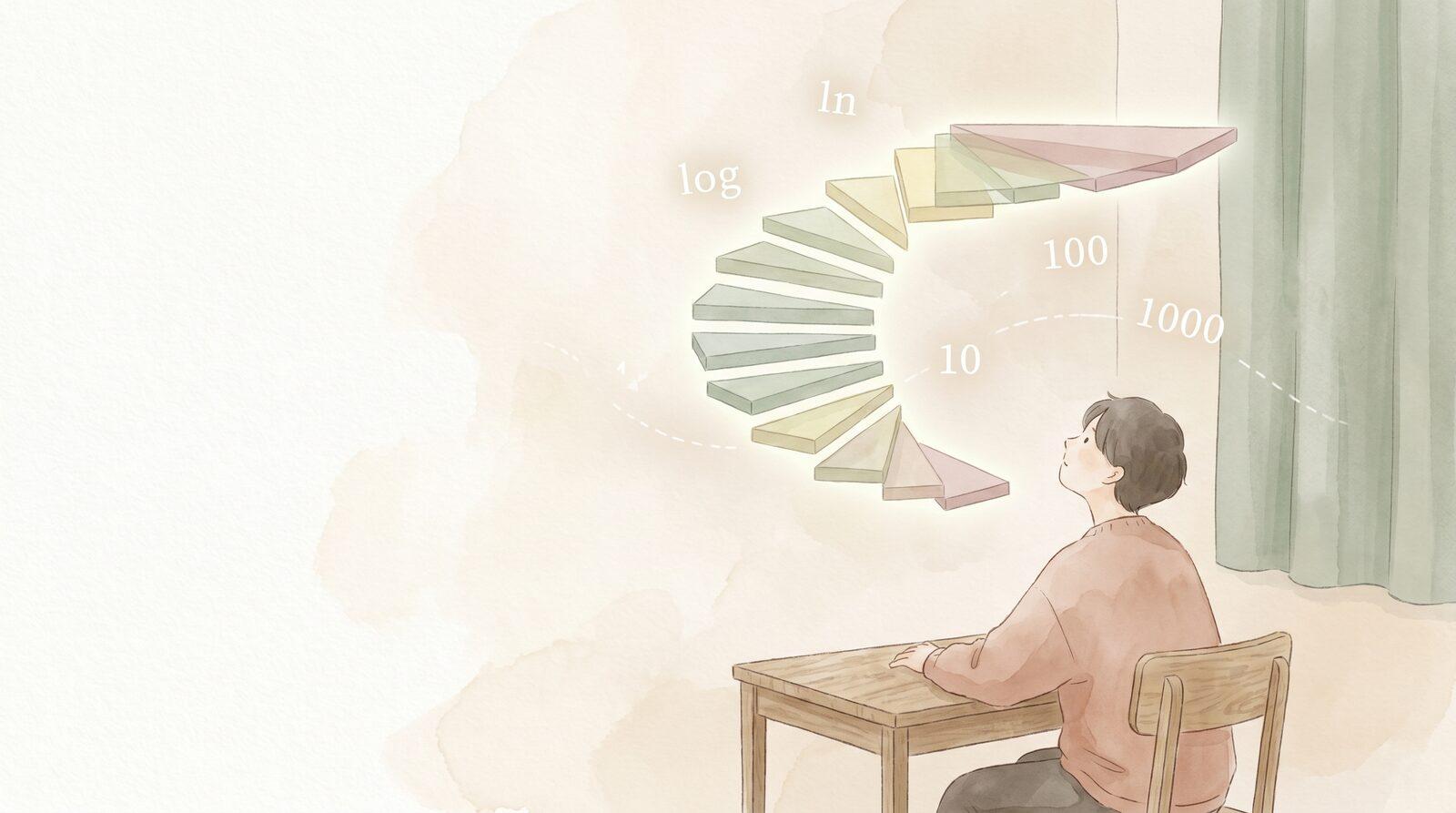
Weeks 5 and 6: exponentials, logarithms and sequences. Exponents and common (base 10) logarithms with their link to scientific notation, worked without a calculator. Math A: add the laws of logarithms, logarithms in other bases, exponential and logarithmic functions with their graphs, and exponential equations. Math B: add exponential and logarithmic functions as growth models, with continuous compounding, e and the natural logarithm. Then sequences and finite geometric series. The logarithms guide explains a logarithm as a count of multiplications, which makes the laws obvious, and the sequences guide derives the geometric sum formula instead of asking you to memorize it.
Weeks 7 and 8: counting, probability and data. Systematic counting, permutations and combinations, classical probability, expected value, and conditional probability on both tracks. Math B: add Bayes' theorem. Then data analysis: mean and standard deviation, scatter plots, the line of best fit and correlation. Write down the model before calculating anything. The probability guide covers independence and base rates, the intuition underneath Bayes' theorem.
Weeks 9 and 10: vectors and matrices. Math A: plane and space vectors, the dot and cross products, 3×3 determinants as the volume of a parallelepiped, planes and lines in space, then matrices with three-variable linear systems, inverses and linear transformations. Math B: plane vectors and the dot product, then matrices as data tables and 2×2 inverses. The vectors guide shows what the dot product measures, and the matrices guide treats a matrix as a machine that moves the plane and its inverse as the move that undoes it. From this block on, add a ten-minute no-calculator drill every day: fractions, roots, powers, small determinants.
Weeks 11 and 12: full official papers. Sit complete papers from 2022 onward, the two-paper years, under real conditions: 100 minutes, starting at 09:20 if your schedule allows, no calculator. Mark them with the official key and the Part II marking principles. Review each paper for as long as the sitting took, and redo every lost item from a blank page the next day. In the final days, freeze the routine: no new topics, only your error notes and the pacing plan below.
For daily calculator-free practice, Math Zen has a GSAT (學測) path with 35 exam-specific problem templates across polynomials, exponentials and logarithms, sequences, counting, probability, statistics, trigonometry, lines and circles, vectors, and matrices. Difficulty adapts as you answer, so short sessions stay at the edge of what you can do. It does not replace official past papers or the Part II marking principles; it fills the days between them.
Exam-Day Pacing for 100 Minutes
This is a suggested budget, not a CEEC rule; test it on your practice papers and adjust.
- Minute 1: read the Part II set, so its setup is already in your head when you get there.
- About 65 minutes for Part I: 17 questions on recent papers, a little under 4 minutes each, less on single-choice and more on fill-in.
- About 20 minutes for Part II, written working included.
- The last 10 to 14 minutes for returns: items you marked to revisit, a format check on every fill-in answer, and any single-choice question still blank.
When an item has taken twice its share, mark it and move on. The next Part I item is worth the same points, and it may be easier.
If you sit both papers, Math B comes two days after Math A, with English on January 23 in between. Use the evenings for light review of your error notes, not new material, and leave Math A behind once it is handed in.
The Bottom Line
GSAT math is two optional 100-minute papers on grade 10 and 11 mathematics, and the rules around the mathematics decide almost as much as the mathematics does. Choose Math A, Math B or both from what your target departments use, not from reputation. Know the mechanics: every multiple-select option is an answer, every fill-in blank must be right, and Part II pays for working. The 0-15 scale is reset by the top 1% each year, so steady points on the items you can do matter more than chasing a perfect paper. Work without a calculator from the first day, study in two-week blocks, and finish with full official papers under real timing. Start with the diagnostic paper; by January 22, the format should hold no surprises.
Common Questions
- How long is the GSAT math exam?
- Each math paper lasts 100 minutes and is marked out of 100 raw points. Math A and Math B are separate, optional subjects sat on different days: in the January 2027 sitting, Math A is on January 22 and Math B on January 24, both from 09:20 to 11:00. On the 2025 and 2026 papers, Part I had 17 questions worth 85 points and Part II was worth 15.
- What is the difference between Math A and Math B?
- Both papers share the grade 10 core: polynomials, lines and circles, trigonometric ratios, sequences, counting, probability and data analysis. Math A adds the A-track grade 11 content, including space vectors, the cross product, 3×3 determinants, planes in space, the sum and difference formulas and matrix transformations. Math B adds the B-track content, including plane vectors, conic sections, matrices as data tables, sine models, growth models and Bayes' theorem. Both are optional, and each university department decides which one it uses.
- Can you use a calculator on GSAT math?
- No. Calculators are on CEEC's list of items you may not bring to your seat, along with phones and other devices that can calculate, store or transmit information. You may bring a ruler, a set square, a protractor and a compass. Each paper ends with printed reference formulas and values, and stationery printed with formulas is not allowed. Train all arithmetic by hand from the first week.
- How is GSAT math scored?
- Each paper is marked out of 100 raw points and converted to levels from 0 to 15. The level width is the average raw score of the top 1% of candidates divided by 15; in 2026 it was 5.72333 for Math A and 6.21400 for Math B. Multiple-select items give partial credit option by option, fill-in items score only if every blank is right, and no item ever scores below zero.
- How many points do you need for 15 levels in GSAT math?
- The line moves every year because it depends on how the top 1% score. Level 15 starts above 14 level widths. In 2026 that worked out to a raw score above 80.13 on Math A and above about 87 on Math B. On Math A, 1,112 candidates, or 1.23%, reached 15 levels. A perfect paper is not required for the maximum.
- When is the 2027 GSAT and when do you register?
- The January 2027 GSAT runs from January 22 to 24, 2027, with Math A on January 22 and Math B on January 24. Registration is open from October 27 to November 10, 2026, and scores are released on February 25, 2027. The exam regulations published by CEEC give the full timetable and the registration procedure.