Understanding the Fourier Transform Intuitively (Signals into Frequencies)
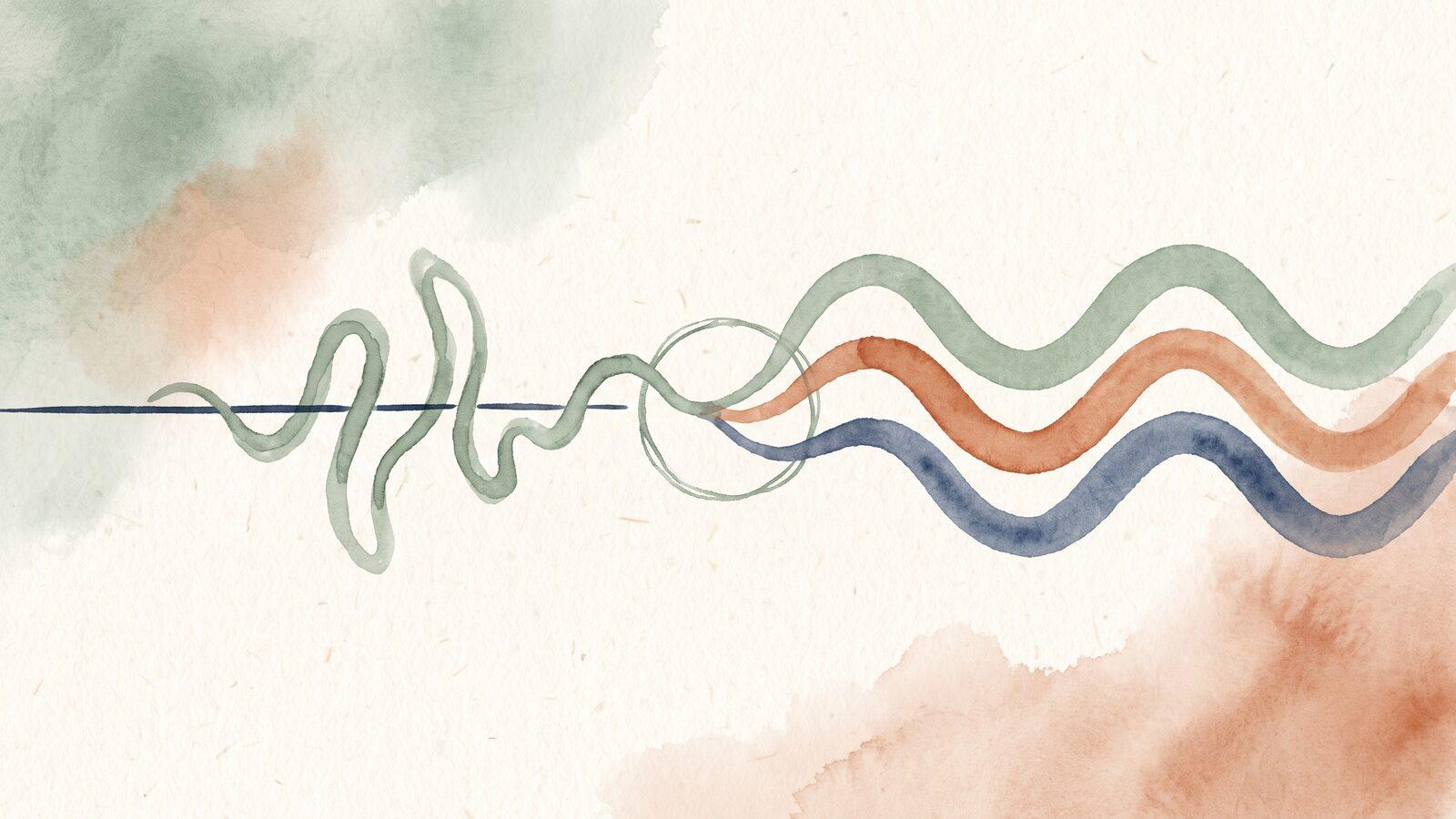
Press three keys on a piano at once and a single, tangled pressure wave leaves the instrument. It hits your eardrum as one wobbling line, not three. Yet your inner ear separates that line back into its three notes without any effort, and a trained musician can name the chord. Somewhere between the air and your awareness, a mixed signal was unmixed into its pure frequencies.
That unmixing has a name. The Fourier transform is the mathematical machine that takes any signal, a sound, an image row, a stock price, the vibration of a bridge, and rewrites it as a list of the pure frequencies inside it. It is the reason your phone can compress audio, the reason MRI machines produce images, and the reason engineers can look at a rattling engine and say "that is the 400 hertz component."
Most students meet the Fourier transform as a formula to memorize: an integral with a complex exponential inside and no obvious reason for any of it. This guide builds the picture from the ground up. We covered the closely related Laplace transform recently, and by the end you will see that both are the same machine with a different dial setting.
Two Descriptions of the Same Thing
Think about a recipe for a cake. You can describe the finished cake by listing what you would observe at every point inside it, layer by layer, crumb by crumb. Or you can describe it by listing the ingredients: 200 grams of flour, 3 eggs, 100 grams of sugar. Both descriptions contain the same cake. One describes where things are; the other describes what it is made of.
A signal has the same two descriptions:
- The time domain lists the value of the signal at every instant: the pressure at your eardrum at 0.001 seconds, at 0.002 seconds, and so on. This is how signals arrive in the real world.
- The frequency domain lists the ingredients: how much of a 440 hertz sine wave is present, how much of 523 hertz, how much of every possible frequency. This is what the Fourier transform produces.
Fourier's insight, first published in 1822 while studying heat flow, was that these ingredient lists are complete. Any reasonable signal, no matter how jagged, can be reconstructed exactly from a sum of smooth sine waves. There is no third ingredient hiding somewhere. Sines are enough.
Why Sine Waves Are the Alphabet
Why sines rather than squares, triangles, or any other shape? Because sine waves are the only shapes that survive the operations physics cares about.
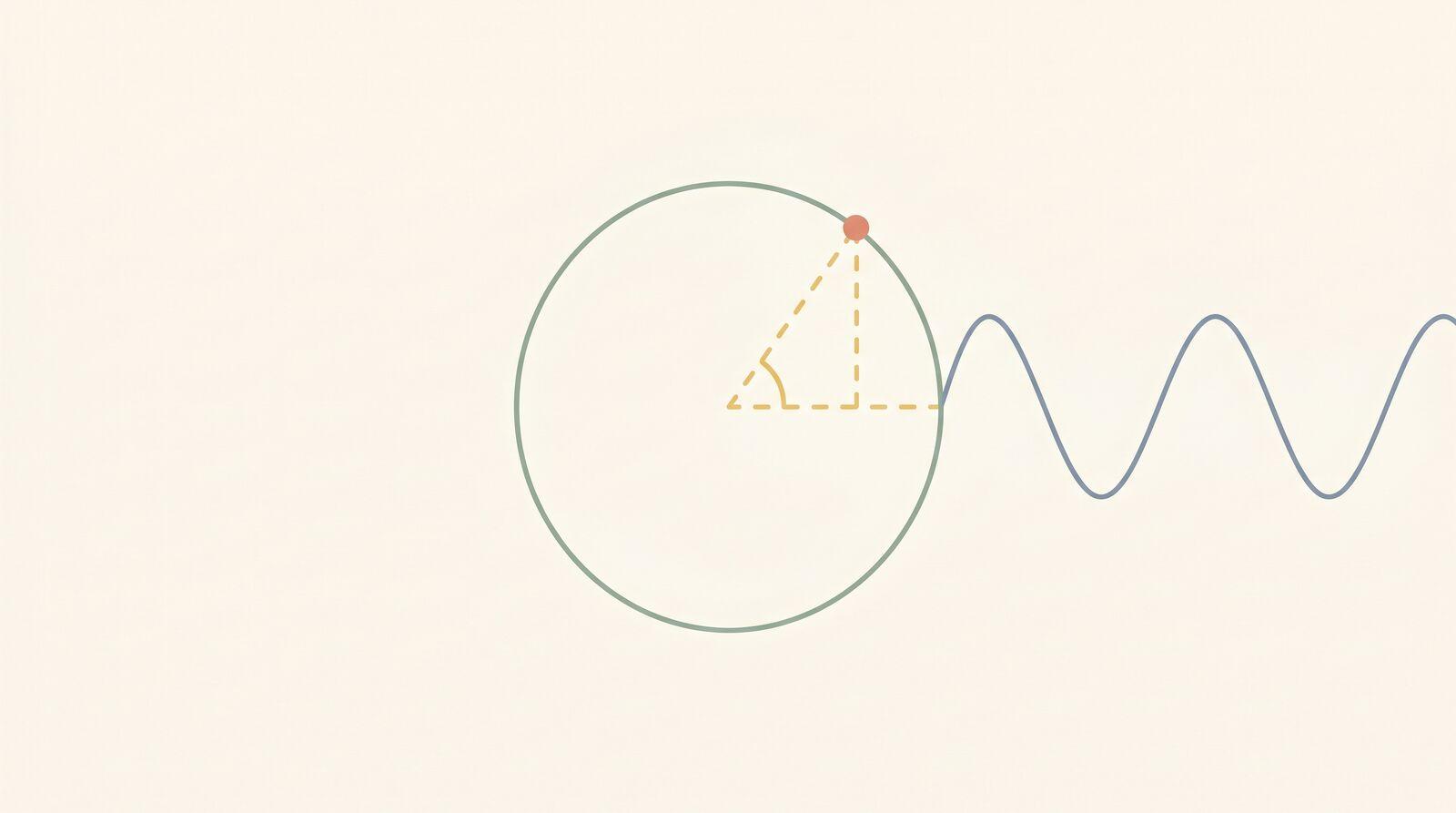
Take the derivative of a sine wave and you get a cosine, which is the same wave shifted a quarter cycle. Take the derivative again and you get a negative sine: the same shape again, scaled. As we explored in the trigonometry post, a sine wave is a circle viewed from the side, and rotating a circle never changes it into something else.
Feed a sine wave into a spring, a circuit, or a concert hall, and what comes out is a sine wave of the same frequency, possibly louder or quieter and possibly delayed, but never a different shape. Engineers call systems with this property linear and time-invariant, and nearly every physical system is one, at least approximately.
This is the whole reason the frequency domain is useful. If you know what a system does to each pure frequency, and you can split any input into pure frequencies, you know what the system does to every input. The hard problem of "what does this bridge do when a truck hits it" becomes a list of easy problems: "what does this bridge do at 1 hertz, at 2 hertz, at 3 hertz."
The Winding Machine
Now to the mechanism. Suppose you have a signal and you want to know how much of a particular frequency, say 3 cycles per second, is hiding inside it. Here is a physical procedure that answers the question.
Take the graph of your signal, which is a line drawn along a time axis. Now wrap that line around a circle, at a winding rate of 3 turns per second of signal time. Where the signal is large, the wrapped line sits far from the center; where the signal is small, it hugs the center. You get a scribble drawn around the origin.
Now find the center of mass of that scribble.
If the signal contains nothing at 3 hertz, the highs and lows of the signal land at random angles around the circle. They cancel, and the center of mass sits near the origin. But if the signal does contain a 3 hertz component, its peaks all land on the same side of the circle, turn after turn. They pile up, and the center of mass swings away from the origin.
Repeat this for every possible winding rate, plot the distance of the center of mass against the winding rate, and you have drawn the Fourier transform. Peaks in the plot are frequencies present in the signal. That is the entire idea. Everything else is notation.
The Formula, Piece by Piece
The winding machine, written in symbols, is:
Each piece corresponds to a step in the procedure.
The winding. The factor is the spin. By Euler's formula, , a point moving clockwise around the unit circle at angular frequency ω. As t advances, this point spins. That spin is the winding, and ω is the winding rate.
The wrapping. The product is the scribble. Multiplying the spinning unit-length point by the signal value f(t) stretches it outward or pulls it inward. Large signal values push the point far from the center; small values pull it in. The product traces exactly the scribble from the previous section.
The center of mass is the integral. Adding up the position of the scribble at every instant, from the beginning of time to the end, and treating the result as a single complex number, gives a point whose distance from the origin measures how strongly the signal resonates at ω. Strictly this is the total rather than the average, so it scales with the signal's duration, but the shape of the spectrum is the same.
The result is a complex number for each ω, and both parts matter. Its magnitude is the amplitude of that frequency: how much of the ingredient is in the recipe. Its angle is the phase: when in the cycle that ingredient starts. Two signals can share the same amplitudes at every frequency and sound completely different because their phases differ.
Why the Exponential Instead of a Sine
Students often ask why the kernel is a complex exponential rather than simply a sine wave. You could, after all, multiply your signal by and integrate.
The problem is phase. If your signal contains a cosine at frequency ω and you test it against a sine at the same frequency, the product averages to zero, because sine and cosine are a quarter cycle apart. You would conclude the frequency is absent when it is fully present. To catch every phase you would need two tests, one against sine and one against cosine, and then combine the results.
The complex exponential does both tests at once. Its real part is the cosine test and its imaginary part is the sine test, packaged in a single rotating object. Whatever phase the frequency arrives with, some part of the rotation lines up with it. The magnitude of the resulting complex number is what you would get from the two-test method combined, and the angle tells you the phase for free. In the imaginary numbers post we described i as a rotation; here that rotation is doing honest engineering work.
Negative Frequencies Are Not a Mistake
The integral runs over all ω, including negative values, and the transform of a real signal always shows a mirror image on the negative side. This unsettles people. What is a negative frequency supposed to mean physically?
Look at Euler's formula again. A real cosine is the average of two rotations:
The first term spins counter-clockwise at rate ω; the second spins clockwise at the same rate. Clockwise rotation at ω is what the transform records as frequency minus ω. A real-valued signal cannot tell the two directions apart, so it always contains both in equal measure, and the spectrum is symmetric.
The negative half carries no new information for real signals, and in practice engineers often plot only the positive side. But keeping both halves makes the formulas symmetric and lets the same transform handle complex-valued signals, such as those in radio and MRI, where the two rotation directions genuinely differ.
The Return Journey
Turning a recipe back into a cake is the inverse Fourier transform:
Read it as an instruction: for every frequency ω, take the amount of that ingredient, spin it counter-clockwise at that rate, and add everything up. The sign in the exponent has flipped from minus to plus because you are now unwinding rather than winding. The factor of 2π is bookkeeping, correcting for the fact that a full turn is 2π radians; some textbooks split it symmetrically as on both transforms, and some hide it entirely by measuring frequency in hertz rather than radians per second. The physics does not change, only the constant.
The pair of formulas is almost perfectly symmetric. That symmetry is a deep hint: time and frequency are two views of one object, and neither is more fundamental than the other.
Derivatives Become Multiplication Again
The Laplace transform earned its keep by turning derivatives into multiplication by s. The Fourier transform does the same trick with iω.
Differentiate the inverse transform formula with respect to t. The only place t appears is inside , and its derivative pulls down a factor of iω:
So the Fourier transform of is simply . Taking a derivative in time multiplies each frequency component by iω: high frequencies get amplified, low frequencies get suppressed, and every component is rotated by a quarter turn. That is precisely why differentiation makes noisy signals noisier. Noise lives at high frequencies, and the derivative multiplies those by large numbers.
The same logic turns a differential equation with constant coefficients into an algebraic equation in ω, which is how physicists solve wave and heat equations. Fourier invented the tool for exactly that purpose.
Fourier and Laplace: One Machine, Two Dial Settings
Put the two transforms side by side:
In the Laplace post we described s as a dial with two knobs, : σ for exponential decay, ω for oscillation. Set the decay knob to zero, so σ = 0 and s = iω, and the Laplace kernel becomes the Fourier kernel . The Fourier transform is the Laplace transform evaluated along the imaginary axis of the s-plane.
The other difference is the lower limit. Laplace starts at t = 0 because it is built for cause-and-effect systems with a switch-on moment and initial conditions. Fourier runs over all time because it is built for steady signals that have always been there and always will be: a held note, a carrier wave, a stationary hum.
Which to use follows from the question. Transients, switches, and initial conditions: Laplace. Spectra, filters, and steady oscillation: Fourier. The decay knob is what lets Laplace handle signals that grow without bound, which the Fourier integral cannot absorb; the two-sided integral is what lets Fourier describe signals with no beginning.
The Trade-Off You Cannot Escape
One last property explains a surprising amount of physics. A signal that is narrow in time is wide in frequency, and a signal that is narrow in frequency is wide in time. You cannot have both.
A pure sine wave has a single frequency, so its spectrum is a single spike. But a pure sine wave lasts forever. Clip it to one second and the spectrum spreads out around the original frequency; clip it to one millisecond and the spectrum spreads much further. In the limit, an instantaneous click contains every frequency equally, which is why a hand clap sounds like white noise while a tuning fork sounds like a tone.
The winding picture makes this obvious. A short burst of signal wraps around the circle only a few times at any winding rate, so the center of mass never has a chance to cancel cleanly. Many nearby winding rates all give a similar, moderate result. A long signal wraps thousands of times, and only the exact matching rate survives the cancellation.
In quantum mechanics, position and momentum are Fourier pairs, and this same trade-off is the Heisenberg uncertainty principle. It is not a limitation of measurement. It is a property of waves.
Where the Mistakes Come From
Students working with Fourier transforms stumble in three predictable places.
The first is dropping the phase. Because the amplitude spectrum is what gets plotted, students start thinking of the transform as a list of amplitudes only. Then an inverse transform comes out wrong because the angles of were discarded. The transform is a list of complex numbers, and half of each number is its angle.
The second is sign and constant confusion. Different textbooks put the 2π in different places and choose different signs in the exponent, and all of them are correct as long as forward and inverse agree. Pick one convention, write both formulas at the top of the page, and check that transforming and inverse-transforming a simple function returns it unchanged.
The third is expecting a finite signal to have a clean spectrum. Real measurements are finite, so their spectra always show the spreading from the previous section, plus ripples from the abrupt cut-off at the edges. That is not an error in the calculation. It is the trade-off asserting itself, and window functions exist to manage it.
Where Math Zen Fits In
The Fourier transform is built from three skills that need to be automatic before the intuition can carry you: trigonometric identities, complex exponentials, and integrals of products.
If converting between and complex exponentials takes conscious effort, or if integrating by hand feels uncertain, the transform will always look like a black box. Math Zen drills those pieces in short daily sessions:
- Trigonometry: Fluency with sum and double-angle identities and the circle picture behind them, in the trigonometry practice module.
- Complex Numbers: Polar form, Euler's formula, and rotating by multiplication, in the complex numbers practice module.
- Transforms: The same kernel-integral mechanics, including transforms of derivatives, in the Laplace transforms practice module.
Once those are reflexes, the Fourier transform stops being a formula and becomes what it is: a winding machine that reads the recipe of a signal.
The Bottom Line
The Fourier transform rewrites a signal from "what is the value at each time" into "how much of each frequency is present." It works because sine waves are the shapes that physical systems leave unchanged, so knowing a signal's frequency content tells you how any linear system will respond to it.
The formula is a winding machine: wraps the signal around a circle at rate ω, the integral finds the center of mass, and a center of mass far from the origin means that frequency is present. The complex exponential catches every phase at once, negative frequencies are the mirror image every real signal carries, and the inverse transform unwinds by spinning the other way.
Set the decay knob of the Laplace transform to zero and you have the Fourier transform. Use Laplace for switches and transients, Fourier for spectra and steady signals, and remember that whichever you use, a signal short in time is always wide in frequency.
Common Questions
- What does the Fourier transform actually do?
- It takes a signal described over time and rewrites it as a recipe of pure frequencies. Instead of listing the value of the signal at every instant, it lists how much of each sine wave frequency is present, and with what phase. The information is identical; only the description changes, from when things happen to which frequencies are involved.
- Why does the Fourier transform use complex exponentials instead of sines and cosines?
- A complex exponential e^(iωt) packs a cosine and a sine into one rotating object, so a single integral captures both the amplitude and the phase of each frequency. Working with sines and cosines separately gives the same answer but takes two integrals per frequency and loses the clean rotation picture.
- What is the difference between the Fourier transform and the Laplace transform?
- Both test a signal against exponential kernels. The Laplace transform uses e^(-st) with a complex s = σ + iω, so it probes decay as well as oscillation and runs from t = 0 forward. The Fourier transform sets σ = 0 and integrates over all time, so it probes pure oscillation only. The Fourier transform is the Laplace transform restricted to the imaginary axis.
- Why does the Fourier transform have negative frequencies?
- A real-valued cosine can be written as half of a counter-clockwise rotation plus half of a clockwise rotation. The clockwise one is the negative frequency. Real signals always produce mirror-image spectra, and the negative half carries no new information, but keeping it makes the transform work for complex signals and keeps the formulas symmetric.
- How do you take an inverse Fourier transform?
- You run the same integral in the opposite direction: multiply each frequency component by e^(+iωt), add them all up, and divide by 2π. In practice most inverses are found by pattern matching against standard transform pairs and using properties such as shifting, scaling, and the derivative rule, rather than evaluating the integral directly.