e^(iπ) + 1 = 0: Why e^(iπ) = -1 (Euler's Identity)
There is an equation that mathematicians, when asked to name the most beautiful result in their field, return to again and again. It is not long. It does not require advanced machinery to state. It reads:
In one short line it gathers five numbers that arrive from entirely separate parts of mathematics: e from the study of growth, i from the square roots of negative numbers, π from circles, and the two numbers, 1 and 0, on which all of arithmetic is built. They have no business being in the same room, and yet here they sit in a single exact relationship, with nothing left over. The remarkable part is not just that the equation is pretty. It is that it is true, and that the reason it is true can be seen clearly in one sitting.
What the Equation Is Saying
Most people meet exponents as repeated multiplication. Two to the third power is two times two times two. That picture works fine for whole-number exponents, but it falls apart the moment someone writes e raised to an imaginary power. You cannot multiply e by itself "i times." So the first thing to accept is that is not asking you to do repeated multiplication at all. It is the value of a deeper function, and that function is the key to everything.
What Is e, and What Is e to the Power of 1?
Before going further, it helps to pin down the first constant. The number e is about 2.71828, and its decimals never end or repeat. Raising any number to the power of 1 leaves it unchanged, so e to the power of 1 is simply e itself:
Where does that value come from? One way to see it is compound growth. Grow 1 by 100% in one step and you get 2. Split the same growth into n smaller steps and compound them, and the result is . As n grows without limit, that number climbs toward a ceiling it never passes, and the ceiling is e. Another way is a sum that adds smaller and smaller pieces:
where each term is 1 divided by a factorial. If exponents themselves feel shaky, understanding exponents intuitively rebuilds them from the ground up. For Euler's identity, e matters because is the function whose rate of change equals itself, and that property is what lets an imaginary exponent turn into a rotation.
Euler's Formula: The Engine Behind the Identity
The whole thing rests on one more general fact, discovered by Leonhard Euler, known as Euler's formula:
This says that raising e to an imaginary power does not produce a single ordinary number. It produces a combination of a cosine and a sine, which together describe a point in the plane. As the angle θ grows, that point moves. And where it moves is the heart of the matter. For a sense of where cosine and sine come from in the first place, the article on understanding trigonometry intuitively is a natural companion, since those two functions are exactly what Euler's formula is built from.
Reading as Rotation
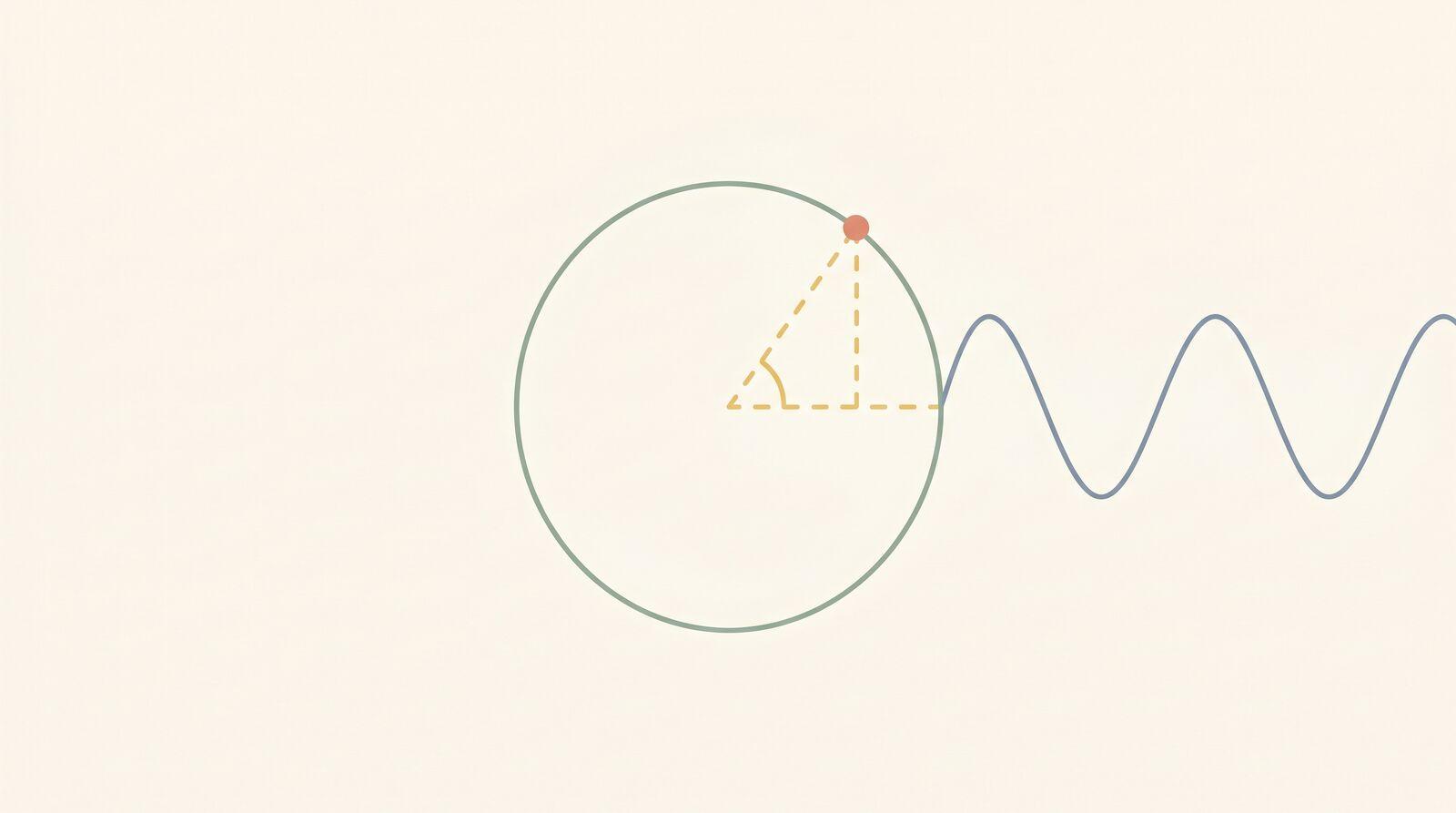
Here is the picture that makes Euler's identity feel inevitable rather than mysterious. Imagine the plane, with the ordinary number line running left to right and the imaginary numbers running up and down. The point cos θ + i sin θ always sits exactly one unit away from the center, because cosine and sine are precisely the coordinates of a point on a circle of radius one. So as θ increases, does not race off to infinity the way real exponential growth does. It walks, at steady speed, around the unit circle.
When θ is 0, you are at the starting point, one unit to the right, which is the number 1. A quarter turn, θ = π/2, brings you to the top of the circle, the point i. Keep going to a half turn, and you arrive at the far side. That is all the identity is really claiming, and once rotation is the picture, the proof is just bookkeeping.
The Proof in Four Steps
Start from Euler's formula
Take Euler's formula as the foundation: for any angle θ, . This is the one fact we build on. It can itself be proved by comparing the infinite series for the exponential, cosine, and sine functions, but for our purposes it is the trustworthy starting point.
Set the angle to π
Substitute θ = π, a half turn around the circle. The formula becomes . Everything now reduces to reading off two familiar values.
Evaluate the cosine and the sine
At a half turn, the point on the unit circle sits directly opposite where it started. Its horizontal coordinate is cos π = -1, and its vertical coordinate is sin π = 0. So , which is simply -1.
Add 1 to reach zero
We have shown . Add 1 to both sides: . That is the identity, and every step of it was nothing more than walking halfway around a circle and writing down where you landed.
Why It Feels Like Magic
Notice that nothing in the proof is hard once you accept Euler's formula. The difficulty was never the algebra. It was the willingness to reinterpret what an exponent means. Repeated multiplication is a fine first picture, but it is a special case of something larger: the exponential function describes how things change in proportion to their current size, and when you feed it an imaginary input, that "change" turns out to be rotation instead of growth. The same machine that models compound interest and population growth, redirected sideways into the imaginary direction, traces out a perfect circle.
That is the surprise at the center of the identity. Growth and rotation look like unrelated ideas, and the exponential function quietly reveals them to be two faces of the same thing. The constant π, defined purely through circles, has to appear, because a half turn is exactly π radians. The imaginary unit i has to appear, because it is what points the exponential sideways. And once both are present, can only be -1.
The Zen of It
Euler's identity earns its reputation not by being complicated but by being unavoidable. Each symbol is there because it has to be, and remove any one of them and the statement collapses. It is the same quality that makes Euclid's proof of the infinitude of primes and other elegant arguments endure: you can see the entire thing in a single pass, and at the end there is no step you have to take on faith.
It also sits beside another kind of mathematical beauty, the proofs that show something must exist without ever building it. Erdős and the probabilistic method is the sharpest example, and it makes an interesting contrast: Euler's identity is beautiful because it is so concrete and exact, while Erdős's method is beautiful because it conjures existence out of pure counting.
What Euler's identity asks you to hold in mind is just this: an exponent does not have to mean repeated multiplication. Once it can mean rotation, five strangers from across mathematics turn out to be standing in one line, and the line is exact. If you want to feel the foundations it rests on, understanding exponents intuitively rebuilds the idea of an exponent from the ground up, which is exactly the leap that makes this identity click.
Common Questions
- What is Euler's identity?
- Euler's identity is the equation e^(iπ) + 1 = 0. It is famous because it connects five of the most important constants in mathematics in a single short statement: e (the base of natural growth), i (the imaginary unit), π (the circle constant), 1, and 0. It also uses the three basic operations of addition, multiplication, and exponentiation exactly once each.
- Why is e^(iπ) equal to -1?
- Because of Euler's formula, e^(iθ) = cos θ + i sin θ, which says that raising e to an imaginary power traces a point around the unit circle, with θ measuring the angle. Setting θ = π means rotating exactly half a turn from the starting point at 1. Half a turn lands you on the opposite side of the circle, at -1. So e^(iπ) = -1, and adding 1 gives 0.
- What is e equal to, and what is e to the power of 1?
- The constant e is about 2.71828, an irrational number whose decimals never end or repeat. Anything to the power of 1 is itself, so e to the power of 1 is just e, about 2.71828. e is the limit of (1 + 1/n)^n as n grows, and also the sum 1 + 1 + 1/2 + 1/6 + 1/24 and so on, where each term is 1 over a factorial.
- Is Euler's identity the same as Euler's formula?
- They are closely related but not identical. Euler's formula is the general statement e^(iθ) = cos θ + i sin θ, true for every angle θ. Euler's identity is the single most striking special case of that formula, obtained by plugging in θ = π. The formula is the engine; the identity is the one beautiful number it produces.
- Why do people call it the most beautiful equation in mathematics?
- Two reasons. First, economy: it gathers the constants e, i, π, 1, and 0, which arrive from completely different corners of mathematics, into one compact line with nothing wasted. Second, surprise: there is no obvious reason exponential growth, imaginary numbers, and circles should have anything to do with each other, yet the identity shows they are deeply linked. Beauty in mathematics often means exactly this combination of inevitability and surprise.
- Does Euler's identity have any practical use?
- The identity itself is more a landmark than a tool, but the formula behind it, e^(iθ) = cos θ + i sin θ, is one of the most used results in all of applied mathematics. It turns rotations and oscillations into simple multiplication, which is the foundation of how engineers handle alternating current, signal processing, quantum mechanics, and Fourier analysis.
Put This Into Practice
Enjoyed thinking this through?
Math Zen turns this kind of intuition into daily practice, with adaptive problems across 24 math topics.