Understanding Partial Derivatives Intuitively (Slope in One Direction)
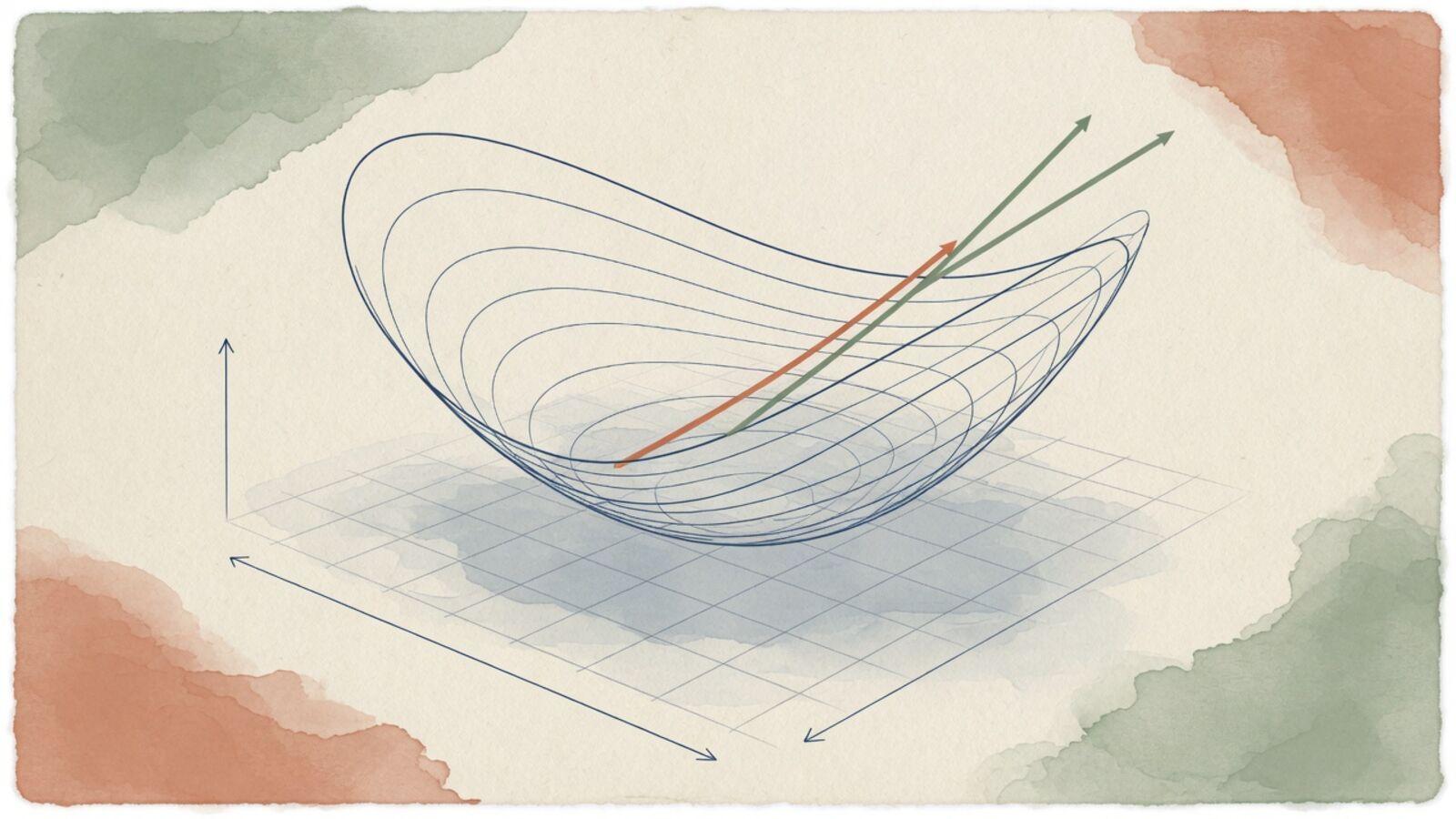
An ordinary derivative is the slope of a curve. You have one input, one output, and at each point a single number that says how fast the output is changing. That picture fails the moment the function has two inputs. A graph in three dimensions is a surface, not a curve, and a surface does not have one slope. From the same point you can walk east and find a gentle climb, or walk north and find a drop.
A partial derivative is the honest replacement. It answers a narrower question: if I hold every other input still and walk in only this direction, what is the slope? The rest of the chapter, mixed partials, the gradient, the multivariable chain rule, is that same question asked along more than one path.
A Surface Has No Single Slope
A function of one variable draws a curve in the plane. A function of two variables, f(x, y), draws a surface in space. Each pair (x, y) is a point on the floor, and f(x, y) is the height of the roof above that point.
Take the bowl
At the origin the height is 0. At (1, 0) it is 1. At (0, 2) it is 4. At (1, 2) it is 5. Standing at (1, 2), there is no single number that deserves the name "the slope." Walk in the x direction and the roof keeps rising. Walk in the y direction and it rises faster. Walk diagonally and you get a mixture of the two.
This is why students who have mastered one-variable calculus feel the ground move. The derivative they trusted was a complete description of local change. On a surface it is only a description of one chosen walk.
Weather maps and topographic maps already use the idea. A contour line is a set of points at the same height. Where the contours bunch, the surface is steep. Where they spread out, it is gentle. A partial derivative is the slope you would measure if you followed one grid line on that map and ignored the other.
Hold One Input Still
The move that makes the surface readable is a slice.
Fix y at a constant, say y = 2, and look only at how height depends on x. The function collapses to
which is an ordinary parabola sitting four units above the x-axis. Its derivative is 2x. That number is the partial derivative of f with respect to x, evaluated along the line y = 2. At x = 1 it equals 2: if you stand at (1, 2) and take a tiny step in the x direction, the roof rises about 2 units of height per unit of step.
Fix x instead, say x = 1, and the slice is
with derivative 2y. At y = 2 that slope is 4. Same point, different walk, different slope. There is no contradiction. You asked two different questions.
Computationally the rule is the one already used in one-variable calculus. To find , treat y as a constant and differentiate in x. To find , treat x as a constant and differentiate in y. For the bowl, = 2x and = 2y. The other variable does not even appear, because each term in depends on only one input. In a product such as y both inputs appear: gives 6xy, because 3y is a fixed coefficient of , and gives , because is a fixed coefficient of y.
The phrase "hold the other variable constant" is not a trick for exams. It is the slice. You are standing on a grid line and asking for the slope of the roof along that line.
The Curly d Is a Warning Label
The symbol ∂, the curly d, exists so this slice is not confused with two other derivatives.
The ordinary d in belongs to a function of one variable. If someone writes for f(x, y), they have not said what is happening to y. Maybe y is independent and frozen, which is the partial. Maybe y is secretly a function of x, in which case x can change the output through both channels at once, and you need the total derivative. The curly d announces the first reading: this input is moving, the others are not.
Notation then branches into two habits that mean the same thing:
- Leibniz form: and
- Subscript form: and
Both are the slope of one slice. Higher-order partials stack the subscripts or the denominators. is "slice in x, then slice that slope in x again," the ordinary second derivative along that grid line. is "slice in x, then ask how that x-slope changes as you move in y."
The curly d is not a new algorithm. Power rule, product rule, chain rule, all still apply. The new information is which variables are frozen. Forgetting that is the entire subject, misread as a new subject.
Mixed Partials Measure Twist
Once you have , you can differentiate it again. Differentiating with respect to x produces , the concavity of the east-west slice. Differentiating with respect to y produces the mixed partial : how the east-west slope itself changes as you walk north.
On the bowl , = 2x, so = 0. The east-west slope depends only on x. Walking north does not change it. The surface is a circular bowl, rotationally symmetric, with no twist.
On the saddle
the first partials are = 2x and = -2y. The mixed partials are both zero again. The interesting mixed example is a product,
Here = 2xy, then = 2x. Starting from the other side, = , then = 2x. The two mixed partials agree.
That agreement is the usual case, not a coincidence. For the smooth functions of a first multivariable calculus course, the mixed partials are equal: the twist you feel by walking east then north is the twist you feel by walking north then east. The theorem has technical hypotheses (the mixed partials need to be continuous), but the picture does not. On a surface with no crease, the order of the two small steps does not matter.
When a textbook asks you to "verify that = ," it is asking you to check that the surface is not secretly twisted in one order and not the other. For every function you will meet in an introductory course, it checks out, and the computation is practice with the slice rule, not a new idea.
The Gradient Collects the Slopes
Two first partials at a point are two numbers. Written as a pair they become a vector in the input plane:
That vector is the gradient. Each component is the slope of one slice, so the whole object is a trip: "this far east, that far north" in the floor coordinates, not in the height. The trip points in the direction of steepest increase. Its length is how steep that climb is. The opposite trip, -, points downhill, which is why gradient descent walks against the gradient.
At (1, 2) on the bowl , the gradient is (2, 4). From that floor point, the fastest way up the roof is the direction of the vector (2, 4), which is the same direction as (1, 2) itself. The steepest path on a circular bowl is radially outward, which is what the picture already suggested and the gradient confirms.
A point where both partials vanish is a critical point. The gradient trip has length zero: to first order, no direction is uphill or downhill. That can be a minimum (the bottom of the bowl, at the origin), a maximum (the top of a hill), or a saddle (a mountain pass: a minimum along one slice and a maximum along another). The saddle has a critical point at the origin. The x-slice is a valley, the y-slice is a ridge, and the gradient is zero because those two first-order slopes cancel into a flat instant rather than a flat neighborhood.
Optimization in several variables is this search. Find where the gradient is the zero trip, then read the second partials, or the nearby slices, to see whether you have a bowl, a hill, or a pass. The second-derivative test with D = - ()² is a packaged version of that reading. D itself is not the idea. The idea is that the two slices, and the twist between them, classify the point.
The multivariable chain rule is the same pairing in motion. If a path (x(t), y(t)) walks across the floor, the height along the path changes at the rate
which is the dot product of the gradient with the velocity of the path. The surface offers a trip of slopes. The path offers a trip of motion. Their agreement is the rate at which height changes for someone actually walking. When the path is parallel to the gradient, height changes as fast as possible. When the path is perpendicular to it, height is instantaneously constant, which is the geometric meaning of a contour line.
Where the Mistakes Come From
Partial-derivative errors are almost all failures to freeze the right variable.
The first is differentiating everything in sight. Asked for of y, a student writes 6xy + , which is the sum of both partials, or 6x, which treats y as if it were x. The slice rule is stricter: y is a number during this derivative. It stays in the answer only as a coefficient.
The second is believing a surface has one slope. Graphing software that colors by height can hide this, because the eye reads a single steepness. Ask for the slope at a point and you must answer "in which direction?" A partial derivative is one such answer. The gradient is the collection of the axis-aligned answers. Neither is "the" slope of the roof.
The third is mixing ∂ with d. If y really depends on x, freezing y is the wrong model of the situation. Related rates and some differential equations need the total derivative, which lets every channel of dependence contribute. A partial derivative is correct when the other inputs are genuinely independent, or when you have chosen to study one channel on purpose.
The fourth is treating a zero gradient as a guaranteed minimum. The origin of is critical and is not a min or a max. First-order flatness is not second-order flatness. You still have to look at the slices.
The fifth is reading as a value of f. The gradient is not the height. It is a trip in the input plane built from slopes. Confusing the two is the same mix-up the vectors article warned about: treating a direction as if it were a location.
Where Math Zen Fits In
Partial derivatives sit on top of ordinary derivatives the way matrices sit on top of vectors. If the one-variable rules are still verbal, every slice becomes a ritual. If they are fluent, a partial derivative is one extra decision: which input is moving.
Math Zen's partial-derivative practice follows that order. Early buckets drill the slice itself: given f(x, y), write and by treating the other variable as a constant. Later buckets stack derivatives (, , ), assemble the gradient, apply the chain rule along a path, and classify critical points. The pictures in this article are exactly that list.
A useful loop is: pick a function of two variables, draw the two slices at a point, compute both first partials, form the gradient, and say out loud which way is uphill. Then come back after a gap, using the same spaced-repetition schedule as the rest of the calculus sequence. The goal is not to memorize that "y is constant." It is to see a surface and know which walk you are taking.
The Bottom Line
A partial derivative is the slope of a surface in one direction, with every other input held still. The curly d marks that freeze. Mixed partials ask how one slice's slope changes as you walk along the other axis, and on a smooth surface the two orders agree. The gradient gathers the first partials into a trip that points uphill. Critical points are where that trip vanishes, and they may be bowls, hills, or saddles.
Held together this way, multivariable differentiation is not a new kind of calculus. It is ordinary calculus, aimed along one grid line at a time, then reassembled. The surface has many slopes. A partial derivative is what you get when you finally say which one you mean.
Common Questions
- What is a partial derivative in simple terms?
- A partial derivative is the slope of a surface in one direction, with every other input held still. For a function f(x, y), the partial derivative with respect to x asks how the output changes when you move only in x, keeping y fixed. It is the ordinary derivative of that one-variable slice. The surface itself has no single slope; it has a slope for each direction you choose to walk.
- What does the curly d (∂) mean?
- The symbol ∂, often read as 'del' or 'partial,' marks a derivative in which some inputs are being held constant. For f(x, y), ∂f/∂x is the rate of change in x with y frozen, and ∂f/∂y is the rate of change in y with x frozen. The curly d is not a new operation. It is a warning label: this is a slice of a multivariable function, not the derivative of a function of one variable, and not the total change when every input moves at once.
- How do you compute a partial derivative?
- Treat every variable you are not differentiating with respect to as a constant, then use the ordinary derivative rules. For f(x, y) = x² + y², ∂f/∂x = 2x because y² does not depend on x, and ∂f/∂y = 2y because x² does not depend on y. For f(x, y) = 3x²y, ∂f/∂x = 6xy and ∂f/∂y = 3x². If a term contains both variables, keep the other one as a fixed coefficient while you differentiate.
- What is the difference between a partial derivative and an ordinary derivative?
- An ordinary derivative is the slope of a curve: a function of one input. A partial derivative is the slope of a surface along one axis: a function of two or more inputs, viewed through a single slice. Both use the same computational rules. The difference is the picture. If y is not an independent input but is itself a function of x, you need the total derivative, which accounts for every path by which x can change the output, not a partial derivative that freezes y.
- What is a gradient in plain language?
- The gradient of f is the list of its first partial derivatives, written as a vector. For f(x, y), that vector is (∂f/∂x, ∂f/∂y). Each component is the slope in one coordinate direction, so the whole vector is a trip in the input plane. It points in the direction of steepest increase, and its length is how steep that climb is. Setting the gradient to zero finds the points where no first-order direction is uphill or downhill: minima, maxima, or saddles.