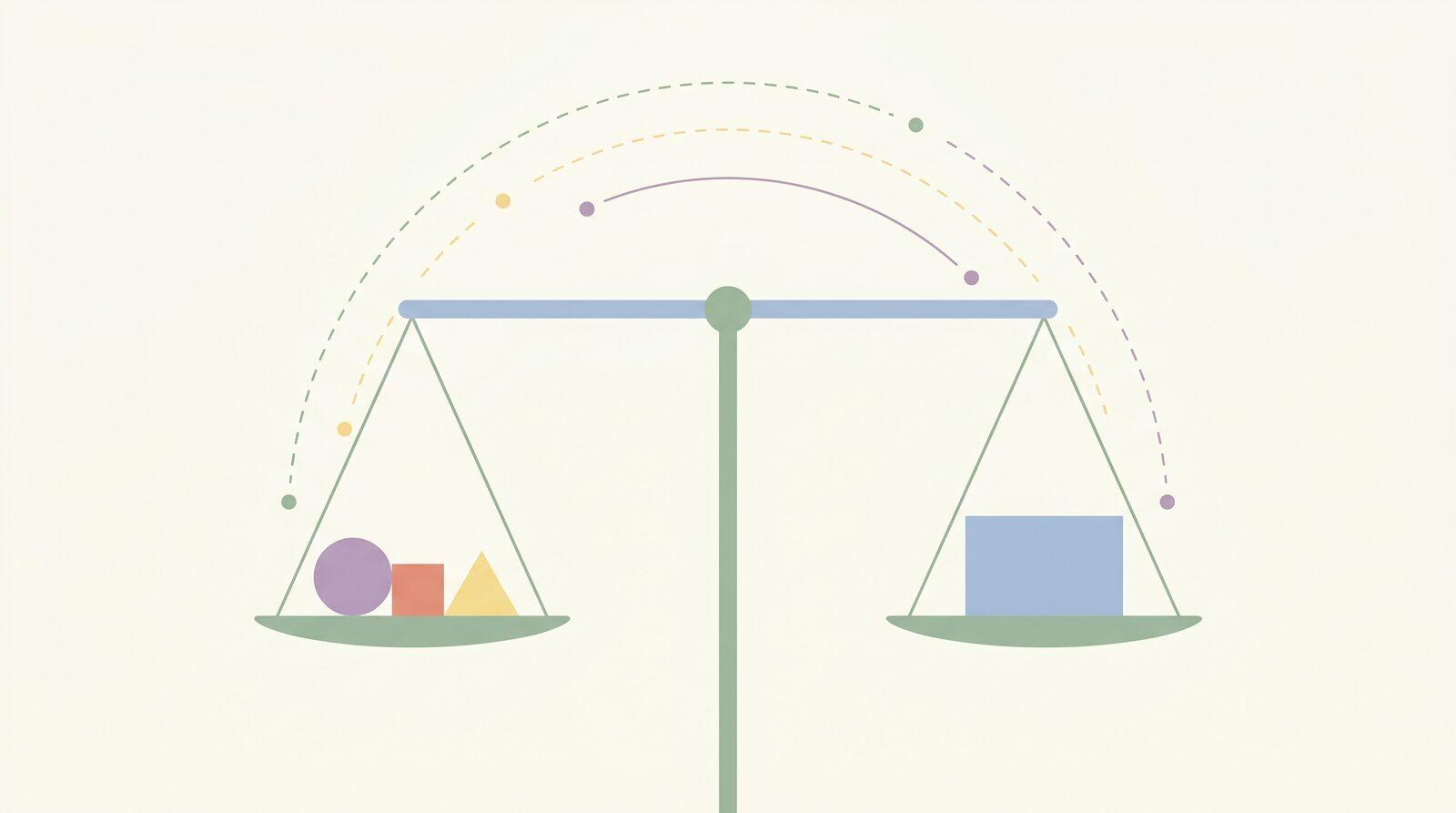
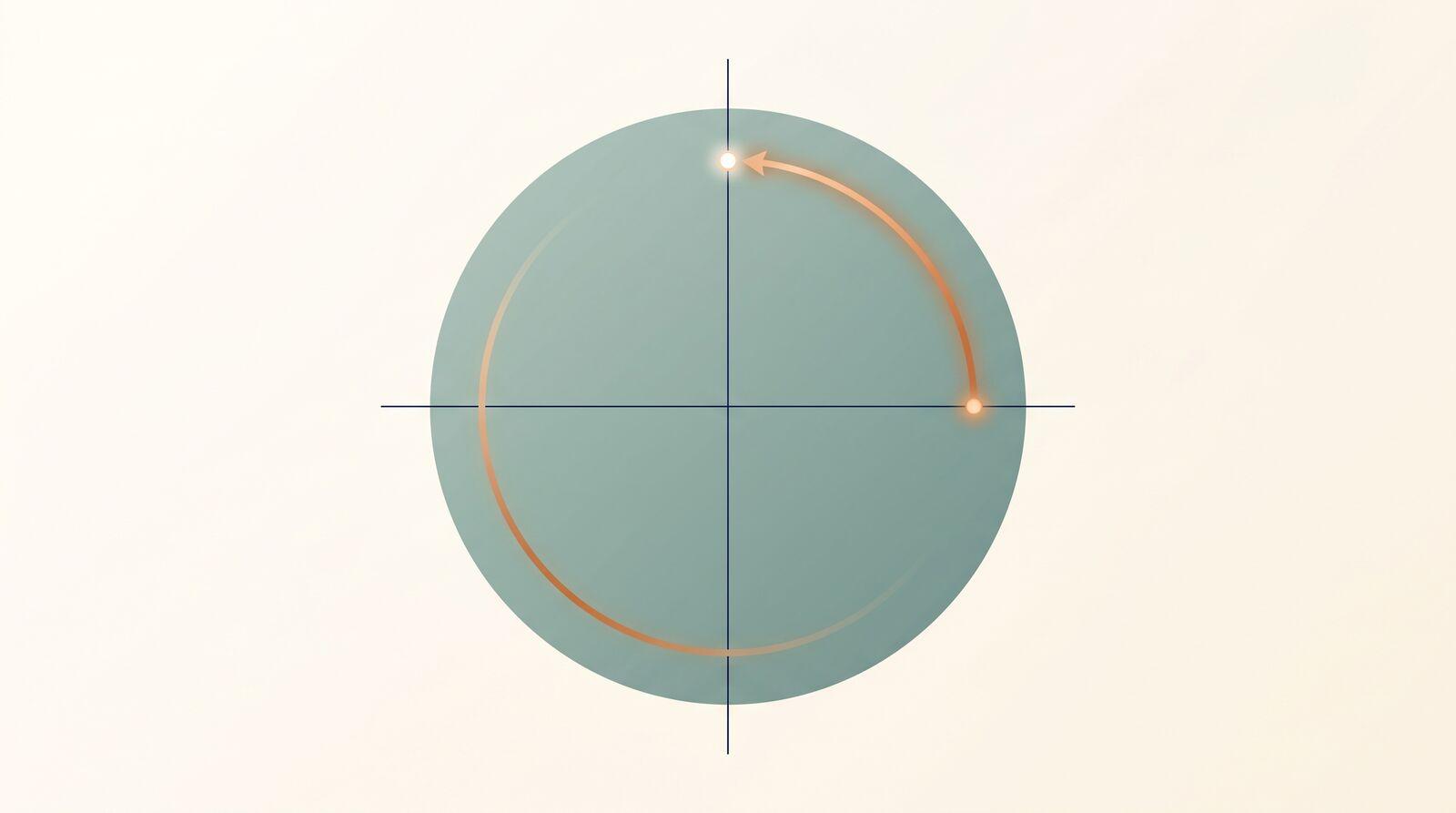
Understanding Matrices Intuitively (Machines That Transform Trips)

Matrices are the topic that makes capable students feel suddenly stupid. Up to this point, every operation has had a picture. Addition is combining. Multiplication is scaling. Even the vector operations from last week's article were trips you could walk. Then someone writes two grids of numbers, announces that you multiply them by taking "rows times columns," and the picture disappears. The rule works. Nobody can say what it is doing.
The result is a second double vision, the sibling of the one in the vectors post. In algebra class, a matrix is a box of numbers. In later courses it is a "linear transformation," a phrase that sounds like an answer and explains nothing. This article is the bridge: a matrix is a machine that takes a trip and returns a trip, every column of the grid is a record of where one axis landed, and the multiplication rule is just the bookkeeping for running two machines in sequence.
A Machine That Transforms Trips
This series keeps returning to one idea: numbers point. A negative number is an ordinary number pointing backward. An imaginary number is a number pointing sideways, off the line and into a plane. A vector is the idea set free, a quantity that carries any direction. Once you have trips, the next question is almost forced. What acts on a trip? What takes "3 east, 4 north" and turns it into a different trip?
That actor is a matrix.
Think of a machine with a setting that can stretch, squash, rotate, or flip whatever you feed it. You give it a trip, it gives you a trip back. A 2-by-2 matrix is the complete instruction for one such machine acting on the plane. A 3-by-3 matrix is the same idea in space. The grid of numbers is not the object. The grid is the specification sheet.
This is why a matrix is not a bigger vector. A vector is a trip. A matrix is a rule for changing trips. Confusing the two is like confusing a journey with the weather that blows you off course.
The Columns Are Where the Axes Land
Here is the fact that makes the whole subject readable. You do not need to know what a matrix does to every possible trip. You only need to know what it does to two of them: one step east, and one step north. Every other trip is a combination of those two, so the machine's effect on any trip is the same combination of its effects on the axes.
Write those two results as columns, and you have the matrix.
Suppose the machine sends one step east to (2, 1) and one step north to (0, 3). The matrix is the 2-by-2 grid whose first column is 2, 1 and whose second column is 0, 3. Feed it the trip (3, 4), which means "3 east then 4 north," and the output is 3 copies of the first column plus 4 copies of the second: . That is matrix-vector multiplication. The row-by-column ritual in the textbook is this same sum, written so a computer can run it without drawing arrows.
Readers coming from the vectors article will recognize the sum: you are adding scaled trips. The matrix does not invent a new kind of arithmetic. It reuses the arithmetic of trips, once per column.
The identity matrix is the machine that does nothing. () One step east stays one step east, one step north stays one step north, so its columns are exactly the two axis trips. Feed it anything and you get the same anything back. It is the photocopier set to 100 percent, no rotation, and it is the reason the number 1 has a counterpart in this subject.
Multiplication Means Apply This, Then That
The rule that feels invented, multiplying two matrices, is function composition wearing a grid. To multiply A by B is to build the single machine that does B first and A second. You feed a trip to B, take whatever comes out, and feed that to A. The product AB is the specification sheet of that combined machine.
This is why the order matters, and why it feels backwards. , for the same reason that putting on socks then shoes is not putting on shoes then socks. The right-hand machine acts first because that is how we already write functions: f(g(x)) applies g first. Matrix multiplication inherited the same convention.
It is also why the row-by-column recipe exists. The columns of AB are what the combined machine does to the axes, which means they are A applied to the columns of B. Each of those is a matrix-vector product, and each matrix-vector product is a pile of dot products. The textbook ritual is three layers of the same idea, compressed into one mnemonic.
One useful consequence: you can stop memorizing when two matrices are allowed to multiply. They multiply when the trips coming out of the first machine are the right size to go into the second. A 2-by-3 matrix eats 3-dimensional trips and returns 2-dimensional ones. It can sit to the right of a 2-by-2 matrix, which eats 2-dimensional trips, and to the left of a 3-by-4, which returns 3-dimensional ones. The inner sizes have to match because they are the same hallway.
The Determinant Is How Much Area Survives
Feed the machine the unit square whose sides are the two axis trips. The image is a parallelogram whose sides are the two columns. The determinant is the signed area of that parallelogram.
If the determinant is 2, the machine doubles areas. If it is 1/2, it halves them. If it is 0, the parallelogram has collapsed into a line segment or a point: the machine has flattened the plane, two different trips can land in the same place, and information has been thrown away. If it is negative, the machine has flipped orientation, turning a counterclockwise square into a clockwise one, the same reversal negative numbers perform on the line.
The computational recipes, for a 2-by-2, the cofactor expansion later, are ways to compute that area. They are not the meaning. Once you see the parallelogram, "the determinant is zero" stops being a mysterious failure and becomes a picture: the two columns point along the same line, so they span no area, so the machine cannot be told apart from a projection onto that line.
This is also why a zero determinant forbids an inverse, which is the next section's whole point.
Inverse Means Undo
An inverse matrix is the undo button. If A sends a trip v to a trip w, then the inverse of A sends w back to v. Running the machine and then its inverse is the identity: you end up where you started, as if nothing happened.
A machine can be undone exactly when it has not thrown information away. That is the determinant test again. If two different input trips can produce the same output, there is no honest way to say which input an output came from, and no inverse exists. If every output came from exactly one input, the undo machine exists and is unique.
In school this arrives as a formula involving 1 over the determinant and a shuffled grid of entries. The formula is real, and it is worth practicing, but it is a consequence. The idea is "run the film backwards," and it only works when the film did not flatten the scene.
Systems of linear equations are this same idea in costume. Algebra taught you to solve two equations in two unknowns by elimination. Those two equations are a matrix acting on an unknown trip, set equal to a known trip. Solving the system is applying the inverse. When the system has no solution, or infinitely many, the determinant is zero: the machine flattened the plane, and the right-hand side either missed the remaining line or landed on it in infinitely many ways. The cases you memorized as "inconsistent" and "dependent" are the two ways a collapsing machine can fail to have a single undo.
Eigenvectors Refuse to Turn
Most trips go into the machine and come out pointing a new way. A few special trips come out pointing the same way they went in, only longer or shorter. Those trips are the eigenvectors, and the stretch factor is the eigenvalue.
The picture is a wind tunnel. Most arrows get knocked sideways. The eigenvectors are the arrows that the wind only lengthens or shortens. If the factor is 2, the machine doubles that trip. If the factor is 1, it leaves that trip alone. If the factor is 0, it crushes that trip to nothing, which is the flattening from the last two sections seen along a single direction. If the factor is negative, it reverses the trip as well as stretching it.
This is the one idea in the later chapters that looks advanced and is not. Asking for eigenvectors is asking: along which directions does this machine act like ordinary multiplication by a number? Once you have those directions, the machine becomes simple in that coordinate system, which is why every subject that uses matrices, from differential equations to ranking web pages, starts hunting for them.
Where the Mistakes Come From
Matrix errors cluster in three places, and each one is a picture that was never drawn.
The first is multiplying entry by entry. Students see two grids of the same size and pair off the numbers, the way you add matrices, which really is entry by entry. Multiplication is not addition. It is running one machine and then the other. Two 2-by-2 matrices produce another 2-by-2, but each output column is A applied to a column of B, not the four pairs of matching cells, multiplied.
The second is ignoring order. AB and BA are different machines whenever A and B do different things, which is almost always. Writing the factors in the order you met them, rather than the order they act, is the socks-and-shoes error, and it is the most common algebraic slip in the whole chapter.
The third is treating a zero determinant as a broken calculator rather than a flattened parallelogram. The machine still does something: it sends every trip onto a line, or to the origin. It just cannot be undone. "No inverse" is not a refusal by the universe. It is a description of a machine that has lost a dimension.
Where Math Zen Fits In
Matrices sit on top of the vector floor, and wobbles there surface immediately. Adding columns is vector addition. The "row times column" step is a dot product. The determinant of a 2-by-2 is the signed area of a parallelogram, which is the same geometry the vectors article used for the parallelogram law. If those operations are still verbal rather than visual, every matrix calculation becomes a ritual.
Math Zen's bucket progression keeps the floors in order. Early buckets drill signed arithmetic and the unit circle. The vectors buckets then make addition, scaling, and the dot product reflexive. The matrices buckets take those as given and drill the new operations: multiplying, computing determinants, inverting, solving systems, and finding eigenvalues, which is exactly the list of pictures in this article, turned into short problems you can do daily. Spaced repetition is what turns "the columns are where the axes land" from a sentence you once found convincing into a reflex you use on the second line of an exam question.
The Bottom Line
A matrix is a machine that takes a trip and returns a trip. The grid of numbers is the specification sheet: each column is where one axis landed, and the effect on any other trip is the matching combination of those columns. Multiplying two matrices builds the machine that runs the right-hand one first. The determinant is how much area survives, zero when the machine flattens the plane. The inverse is the undo button, and it exists exactly when nothing was flattened. Eigenvectors are the rare trips the machine stretches without turning.
Held together this way, the subject has one idea in it, applied to bigger and bigger machines. The double vision of the two classrooms resolves the moment you stop asking whether a matrix is really a grid or really a transformation. It is really a machine, and the grid is just the list of where the axes went.
Common Questions
- What is a matrix in simple terms?
- A matrix is a machine that takes a trip and returns a trip. The grid of numbers is not the object itself; it is the specification sheet. Each column records where one axis landed, and the effect on any other trip is the same combination of those columns. A vector is a trip. A matrix is a rule for changing trips. Confusing the two is like confusing a journey with the weather that blows you off course.
- Why is matrix multiplication so weird?
- Because it is not multiplying matching cells. It is running one machine and then another. The product AB is the single machine that does B first and A second, the same right-to-left convention already used for functions. Each column of AB is A applied to the matching column of B, and each of those is a pile of scaled trips. The row-by-column ritual in the textbook is that composition, written so you can compute it without drawing arrows.
- What does the determinant of a matrix actually mean?
- It is the signed area of the parallelogram you get by feeding the machine the unit square. A determinant of 2 means areas double. A determinant of 1/2 means they halve. Zero means the parallelogram has collapsed into a line or a point, so two different trips can land in the same place and the machine cannot be undone. A negative determinant means the machine flipped orientation, turning a counterclockwise square clockwise, the same reversal negative numbers perform on the line.
- What is an inverse matrix?
- The undo button. If A sends a trip v to a trip w, the inverse sends w back to v. Running the machine and then its inverse is the identity: you end up where you started. An inverse exists exactly when the determinant is not zero, because only then has the machine thrown no information away. Solving a system of linear equations is this same act in costume: the coefficients are the matrix, the unknowns are the input trip, and solving is applying the inverse.
- What is an eigenvector in plain language?
- A trip the machine stretches or shrinks but does not turn. Most trips go in and come out pointing a new way. An eigenvector comes out along the same line it went in, only longer or shorter, and that stretch factor is the eigenvalue. If the factor is 2, the trip doubles. If it is 0, the trip is crushed to nothing. Asking for eigenvectors is asking along which directions this machine acts like ordinary multiplication by a number.