Understanding Integrals Intuitively (Area, Accumulation, and the Other Half of Calculus)

An integral measures how much has accumulated, given how fast something is changing. If a derivative is the speedometer reading at one instant, the integral is the distance you have driven by now. The stretched-S notation is the same idea, written precisely. This article builds the picture without the formal definition, explains why integrals deserve top billing with derivatives, and walks through the Fundamental Theorem that connects them.
The first half of every calculus course is about derivatives, and most students find a way to make peace with them. The second half is about integrals, and that is where many people give up. The integral sign looks like a stretched out S, the rules for working with it seem to come out of nowhere, and the textbook quietly drops a result called the Fundamental Theorem of Calculus that ties the whole thing back to derivatives without ever quite explaining why anyone would believe it.
This article is not the formal definition. It is the picture of what an integral actually is, why it deserves to share top billing with the derivative, and why the connection between the two is the single most beautiful idea in elementary calculus. Read it once, and the rest of the chapter will stop feeling like a second, unrelated language.
What Integrals Actually Ask
Derivatives ask one question: how fast is this changing right now? Integrals ask the mirror image: how much has accumulated by now?
If you know how fast a tap is filling a bathtub at every moment, the derivative is the rate. The integral is the total water in the tub. If you know your speed at every second of a drive, the derivative is the speedometer reading. The integral is how far you have gone. Rate and total are not the same number, but they are bound together: you can get from one to the other without losing information, as long as you know how to do the bookkeeping.
That bookkeeping is integration. Everything in the chapter, the long tables of formulas, the substitution rules, the integration by parts, is just careful accounting for how to add up infinitely many tiny contributions to find a total.
The Simple Picture: Adding Up Tiny Slices
The cleanest way to see what an integral does is to start with a problem that does not need calculus, and then nudge it until calculus is the only tool that works.
Suppose a car drives at exactly 60 miles per hour for two hours. How far did it go? You do not need calculus for this. Speed times time gives 120 miles. On a graph of speed against time, that 120 is the area of a rectangle: 60 high, 2 wide. Distance equals area under the speed graph.
Now suppose the car speeds up. For the first hour it goes 40 mph, the second hour it goes 80 mph. The total distance is 40 plus 80 equals 120 miles. On the graph, that is two rectangles stacked side by side, and the total area is still the distance.
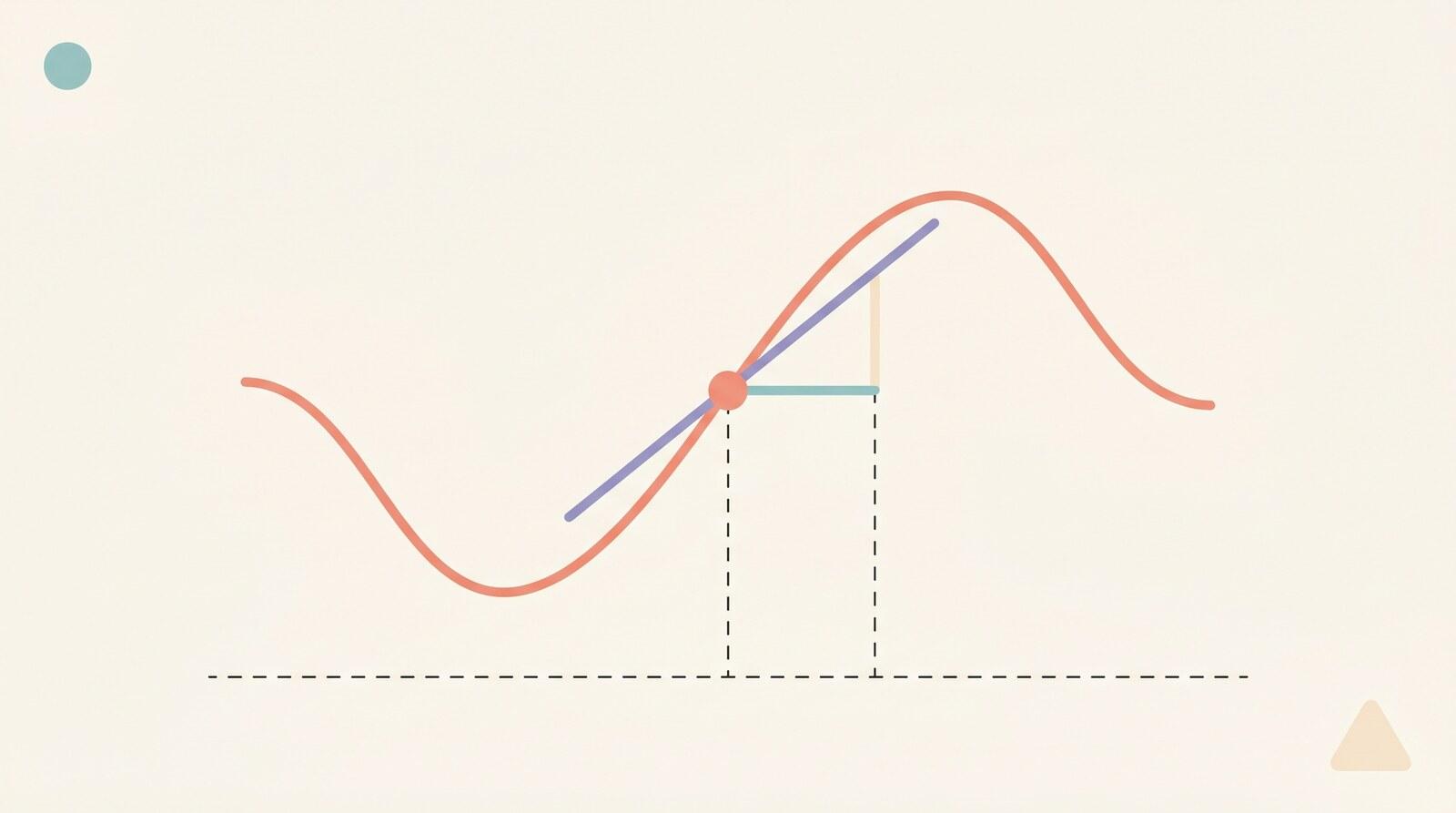
Now suppose the speed changes continuously. The graph is no longer a stack of rectangles, it is a curve. There is no obvious way to multiply speed by time anymore, because speed is different at every instant. But the same principle has to hold: the distance is still the area under the curve. We just need a way to compute the area of a shape with a curved top.
That is the integral. It is the limit of a process where you slice the area into many thin rectangles, add up their areas, and watch the answer settle as the rectangles get thinner. As we covered in the limits post, "watch what it settles to as something gets small" is the same trick that defines the derivative. Calculus uses one idea twice.
Definite vs Indefinite: Two Things That Share a Name
A textbook will introduce two flavors of integral and not always make clear why they share a symbol. The distinction is worth getting straight up front, because it removes most of the apparent weirdness later.
A definite integral is a number. It is the area under a curve between two specific endpoints, or equivalently the total accumulation of some quantity over a specific interval. "How much water flowed through the pipe between 9 a.m. and noon?" is a definite integral question. The answer is a specific amount of water.
An indefinite integral is a function. It is the answer to the question "what function, when I take its derivative, gives me back the function I started with?" Another name for it is the antiderivative, which is more honest because it tells you what the operation is doing. "What function has a derivative equal to ?" is an indefinite integral question: . The answer is (plus a constant, more on that in a moment).
These two ideas look different and feel different, and for most of history they were studied separately. Then someone noticed they are the same idea seen from two angles, and that observation is the Fundamental Theorem of Calculus.
The Fundamental Theorem in Plain English
The full statement of the Fundamental Theorem of Calculus has subscripts, integral signs, and a long sentence about continuity. Underneath, it says exactly two things, and both are short.
First half: if you have a rate of change and you want a total, you can do it by finding an antiderivative. Plug in the right endpoint, plug in the left endpoint, subtract. That is the entire procedure. The total water in the tub between 9 and noon is just (antiderivative of the flow rate at noon) minus (antiderivative of the flow rate at 9). No actual area calculation required.
Second half: if you have a total and you ask how fast it is growing at any moment, you take the derivative. The two operations, integration and differentiation, undo each other. They are inverses, the way addition and subtraction are inverses, or the way multiplication and division are inverses.
This is why the indefinite integral and the definite integral share a symbol. The indefinite integral gives you the antiderivative, which is the bookkeeping device. The definite integral evaluates that antiderivative at two endpoints to get a number. The whole rest of integration technique is about finding antiderivatives in cases where they are not obvious.
Why "Plus C" Shows Up Everywhere
The first surprise students hit is that an indefinite integral always comes with a "+ C" at the end. The textbook calls it the constant of integration, and the explanation usually feels like a footnote. It is more important than that.
The reason is simple: differentiation throws away constants. . . The derivative of x squared minus a million is also 2x. There are infinitely many functions that all have the same derivative, and they all differ by a constant.
So when you go backward from a derivative to an antiderivative, you cannot tell which constant should be there. The function you reconstruct is correct up to that constant, and "+ C" is honest notation for "I do not know, and you cannot ask me to know."
For a definite integral this does not matter. You are subtracting the antiderivative at one point from the antiderivative at another point, and the constant cancels itself out. So in the procedure where you actually want a number, the "+ C" quietly disappears and stops being a worry.
What Integrals Are Used For
The reason calculus pays off in physics, statistics, biology, and economics is that almost every interesting "total" out in the world is the integral of something easier to measure.
From speed to distance. A speedometer measures rate. Position is the integral of velocity. This is how a car's odometer works under the hood, and how navigation systems track movement when GPS briefly drops out.
From flow to total. Water meters measure rate of flow. Total usage is the integral of flow over the billing period. Same for electricity (watts to kilowatt-hours), data (bits per second to megabytes), and money (income per month to annual earnings).
From density to mass. A medical scan measures density at every point of a tumor. The total mass of the tumor is the integral of density over its volume. Engineers use the same trick to compute the weight of a beam, the moment of inertia of a wheel, and the center of mass of a complicated shape.
From probability to likelihood. In statistics, the area under a probability density curve between two values is the chance of a measurement landing in that range. The infamous bell curve is meaningful only because of the integral that sits underneath it. Standardized tests, medical reference intervals, and confidence intervals all rest on definite integrals of density functions.
From small contributions to a big result. Anytime a quantity is built up by summing many tiny pieces, an integral is the right tool. This includes work done by a varying force, the volume of a solid with a curved surface, the length of a curve, the surface area of a shape, and the average value of a quantity over an interval.
If a definition in another field starts with "the total of," the chances are excellent that an integral is hiding behind the words.
When Integration Is Hard
Differentiation is mechanical. Show a calculus student a function and they can produce its derivative in seconds, because the rules (power, product, quotient, chain) cover essentially everything. Integration is not like that. Some functions have antiderivatives that you can write down in elementary terms. Some do not. And there is no general algorithm for telling them apart at a glance.
This is why the integration chapter takes so much space in the textbook. Most of it is a tour of techniques: substitution (which is the chain rule run backward), integration by parts (which is the product rule run backward), partial fractions (which is algebra to break a hard integrand into easy pieces), trigonometric substitution (which uses identities to convert square roots into manageable forms), and a handful of others. Each technique handles a particular shape of integrand, and the skill of integration is recognizing which shape you are looking at.
A common worry is "what if I cannot find the antiderivative?" The honest answer is: sometimes there is no nice closed form, and you have to use a numerical method (Simpson's rule, trapezoidal rule, or a computer) to get a number. Some integrals that look perfectly innocent, like the integral of e to the negative x squared, do not have an elementary antiderivative at all. This is not a personal failure. It is a fact about the structure of mathematics.
For practice problems on a typical exam, though, the antiderivative is always findable, and most of the work is recognizing which technique applies.
The Connection to the Things You Already Know
If integration feels like a separate topic that only kind of relates to derivatives, here is the picture that ties it back together.
You already know that derivatives convert a function into its rate of change. You already know from the logarithms post that some operations have inverses (multiplication and division, exponentiation and logs). The Fundamental Theorem says that integration is the inverse of differentiation, exactly the way logarithms are the inverse of exponents.
That is why every derivative formula gives you an integral formula for free. The derivative of sine is cosine, so the integral of cosine is sine. The derivative of e to the x is itself, so the integral of e to the x is itself. The derivative of the natural log is one over x, so the integral of one over x is the natural log. Every line in the back-of-the-book table of integrals started life as a derivative someone had already worked out.
This is the moment integration stops feeling like a second course. It is the same course, run in reverse, with extra technique to handle the cases where reverse engineering is not obvious.
Practicing Integrals Without Burning Out
Reading once does not make this automatic. Integration responds to deliberate practice in a particular way: pattern recognition matters more than raw computation, because the hard step is almost always "which technique applies here?"
Always ask "what is this the derivative of?" first. A surprising number of integrals are direct reverses of derivatives you already know. If you spot the pattern in five seconds, you save five minutes.
Master substitution before anything else. Substitution is the workhorse. Most integrable functions you will see in a first course can be handled by spotting a "u inside the function" whose derivative also appears as a factor. This single technique covers more ground than the rest combined.
Know when to switch tools. If substitution does not work after a couple of tries, do not grind on it. Step back and ask whether integration by parts (a product of two unrelated things) or partial fractions (a rational function with a factorable denominator) is the better fit. The skill is changing tools, not forcing one tool to do everything.
Mix problem types. Drilling twenty substitution problems in a row teaches you substitution, but it does not teach you when substitution is the right choice. As we covered in the spaced repetition post, interleaved practice (where each problem might need any technique) is the only way to build the recognition muscle that integration actually requires.
Sketch the integrand when stuck. If you are integrating to find an area and the algebra is not cooperating, draw the function. Sometimes the integral is obvious geometrically (a triangle, a half-circle, a symmetric region around zero) and the algebra was the long way around.
Where Math Zen Fits In
Math Zen's bucket progression for integrals starts with direct reversal of basic derivative rules, so you build the reflex of trying the easy thing first. The middle buckets cover substitution and integration by parts with mixed problem sets that force you to identify the technique before reaching for it. The later buckets get into definite integrals, application problems (area, volume, average value), and the cases where numerical methods are the realistic answer.
Because the practice is interleaved by design and the sessions are short, you build the pattern recognition skill that makes integration feel manageable instead of arbitrary. Most students who feel stuck on integrals are not stuck on the concept. They are stuck on the algebra of choosing between techniques, and a few weeks of mixed practice usually clears it.
The Bottom Line
An integral is the answer to "how much has accumulated?" For simple cases it is the area under a curve. For everything else it is still the area under a curve, plus some technique to compute that area when the shape is awkward. The Fundamental Theorem of Calculus tells you that integration is the inverse of differentiation, which means you almost never have to compute an area by literally adding rectangles. You find an antiderivative, evaluate it at the endpoints, subtract, and you are done.
If an integration problem ever feels impossible, do not start by hunting for an exotic technique. Ask the plain-English question: what function has this as its derivative? Try the obvious reversal. If that fails, look for a substitution. If that fails, consider integration by parts. The long tables and clever tricks are a small library of moves, not a maze. Once you trust that the concept is exactly as simple as it sounds, the chapter starts to read like a natural continuation of derivatives, which is what it has been all along.
Common Questions
- What is an integral in plain English?
- An integral measures total accumulation, given a rate of change. If you know how fast water is filling a tub at every second, the integral of that rate over an hour tells you how much water is in the tub. Integration is the reverse of differentiation.
- What is the difference between a definite and an indefinite integral?
- A definite integral has bounds (from a to b) and produces a number: the accumulated amount between those two points. An indefinite integral has no bounds and produces a family of functions (the antiderivative), differing by a constant C.
- What does the Fundamental Theorem of Calculus actually say?
- It says differentiation and integration are inverse operations. If F is an antiderivative of f, then the integral of f from a to b equals F(b) minus F(a). This is what lets you compute integrals by finding antiderivatives instead of summing infinitely many tiny pieces.
- When do you use integration by parts versus substitution?
- Substitution is the inverse of the chain rule: use it when the integrand contains a function and its derivative. Integration by parts is the inverse of the product rule: use it when the integrand is a product of two different kinds of functions, like x times e to the x.
- Can every function be integrated?
- Every continuous function has an integral in the sense that the area under the curve exists. But not every integral can be written in terms of familiar functions. Examples include the integral of e to the minus x squared and sin(x) over x; these require numerical methods or special-function notation.