How to Prepare for AP Precalculus: The 2027 Exam and a 12-Week Plan

On the morning of Tuesday, May 11, 2027, AP Precalculus students will open Bluebook to 29 multiple-choice questions and 65 minutes in which no calculator is allowed. If your review book or an AP Precalc study guide you found online says 28 questions in 80 minutes, it describes the exam as it ran from 2024 to 2026. The course has not changed. The clock has.
AP Precalculus is the College Board's newest AP math course. It launched in the 2023-24 school year, held its first exam in May 2024, and sits right before AP Calculus in the sequence. This guide is built from the College Board's own documents: the AP Precalculus Course and Exam Description (the CED), its clarifications and corrections for fall 2026, and the exam pages on AP Central and AP Students.
The Exam at a Glance
Multiple choice is taken in Bluebook, the College Board's testing app, and the free-response questions are handwritten in paper booklets; AP Central calls the format hybrid digital.
| Part | Questions | Time | Calculator | Share of score |
|---|---|---|---|---|
| Section I, Part A (multiple choice) | 29 | 65 minutes | Not permitted | 43.75% |
| Section I, Part B (multiple choice) | 13 | 40 minutes | Graphing calculator (radian mode) required for some questions | 18.75% |
| Section II, Part A (free response) | 2: Questions 1 and 2 | 35 minutes | Graphing calculator (radian mode) required | 18.75% |
| Section II, Part B (free response) | 2: Questions 3 and 4 | 35 minutes | Not permitted | 18.75% |
| Whole exam | 42 multiple choice, 4 free response | 2 hours 55 minutes | 100% |
The shares and the date, Tuesday, May 11, 2027, in the morning session, come from the AP Central exam page. Multiple choice adds up to 62.5% of the score and free response to 37.5%, which the AP Students exam page rounds to about 63% and 37%. The multiple-choice questions cover Units 1 to 3 and present functions graphically, numerically, analytically and verbally, some in real-world contexts.
Each free-response question is worth 6 points. Spread each part's share evenly over its questions and a Part A question is worth about 1.5% of the score, while a single free-response point is worth about 1.6%: three points scraped from a question you could not finish count for as much as three correct answers in Part A.
AP scores run from 1 to 5, and each college sets its own credit and placement policy, so check the ones you are applying to. If you are not registered for the exam yet, talk to your school's AP coordinator now: schools submit their exam orders by November 13, 2026, and later orders, accepted until March 12, 2027, cost an extra $40 per exam.
What Changed for May 2027
For 2027 the College Board changed the exam's shape, not the course: "Course content has not changed," says the AP Central exam page. The earlier format comes from the Exam Overview in the fall 2026 CED clarifications and corrections.
| Part | 2024 to 2026 exams | May 2027 exam |
|---|---|---|
| Section I, Part A | 28 questions in 80 minutes (2.9 minutes each) | 29 questions in 65 minutes (2.2 minutes each) |
| Section I, Part B | 12 questions in 40 minutes (3.3 minutes each) | 13 questions in 40 minutes (3.1 minutes each) |
| Section I in total | 40 questions in 2 hours | 42 questions in 1 hour 45 minutes |
| Section II, Part A | 2 questions in 30 minutes | 2 questions in 35 minutes |
| Section II, Part B | 2 questions in 30 minutes | 2 questions in 35 minutes |
| Section II in total | 4 questions in 1 hour (15 minutes each) | 4 questions in 1 hour 10 minutes (17.5 minutes each) |
| Free-response Question 2 | Included a Part B(iii) | Part B(iii) removed, Part C expanded |
| Whole exam | 3 hours | 2 hours 55 minutes |
| Course content | Units 1 to 3 assessed | Not changed |
The minutes per question are our arithmetic, not the College Board's, but they show the trade. Multiple choice lost 15 minutes and gained two questions, and all 15 minutes came out of Part A, the part without a calculator: about 2 minutes 15 seconds a question now, against about 2 minutes 50 before. Free response went the other way, with two and a half extra minutes per question.
Old practice exams and review books still work, because the content has not moved. Time them at the 2027 pace, not their own: 63 minutes for a 28-question Part A, 37 for a 12-question Part B. Question 2 from those years still has a Part B(iii), and a shorter Part C than the one waiting for you in May.
Units 1-3 and Their Weights
The CED has four units; the exam assesses the first three. Unit 4 holds additional topics that schools teach based on state or local requirements. The AP Central course page gives each assessed unit's share of the multiple-choice section.
| Unit | Share of multiple choice | What to drill |
|---|---|---|
| 1 Polynomial and Rational Functions | 30 to 40% | Rates of change over intervals, polynomial zeros and end behavior, rational asymptotes and holes, transformations |
| 2 Exponential and Logarithmic Functions | 25 to 40% | Linear versus exponential data, logarithm rules and equations, semi-log plots, inverses and composition |
| 3 Trigonometric and Polar Functions | 30 to 35% | Unit circle, sinusoid features, the tangent function, inverse trig, identities, polar coordinates and polar rates of change |
| 4 Functions Involving Parameters, Vectors, and Matrices | Not assessed | Nothing, for the exam |
Unit 1 starts with rates of change, an idea that runs through the whole course. Get the average rate of change, , from a formula, a table and a graph, and know that over equal input steps a linear function's rate stays constant while a quadratic's changes by the same amount each step. For polynomials, the degree and the sign of the leading coefficient set the end behavior, and a zero of even multiplicity touches the x-axis while an odd one crosses it. For rational functions, compare degrees for the horizontal asymptote and factor before you name a vertical one, because a factor that cancels leaves a hole: is the line y = x + 1 with a hole at (1, 2).
Unit 2 rests on one contrast: over equal input steps, a linear function adds the same amount and an exponential function multiplies by the same factor. Drill telling them apart in a table, then building from two points. Then come the logarithm rules, change of base and log equations, with every solution checked against the domain; understanding logarithms intuitively rebuilds the rules from what a log counts. Composition and inverse functions belong here too, since is the inverse of . Last come semi-log plots: if , then is linear in x, so exponential data plots as a straight line.
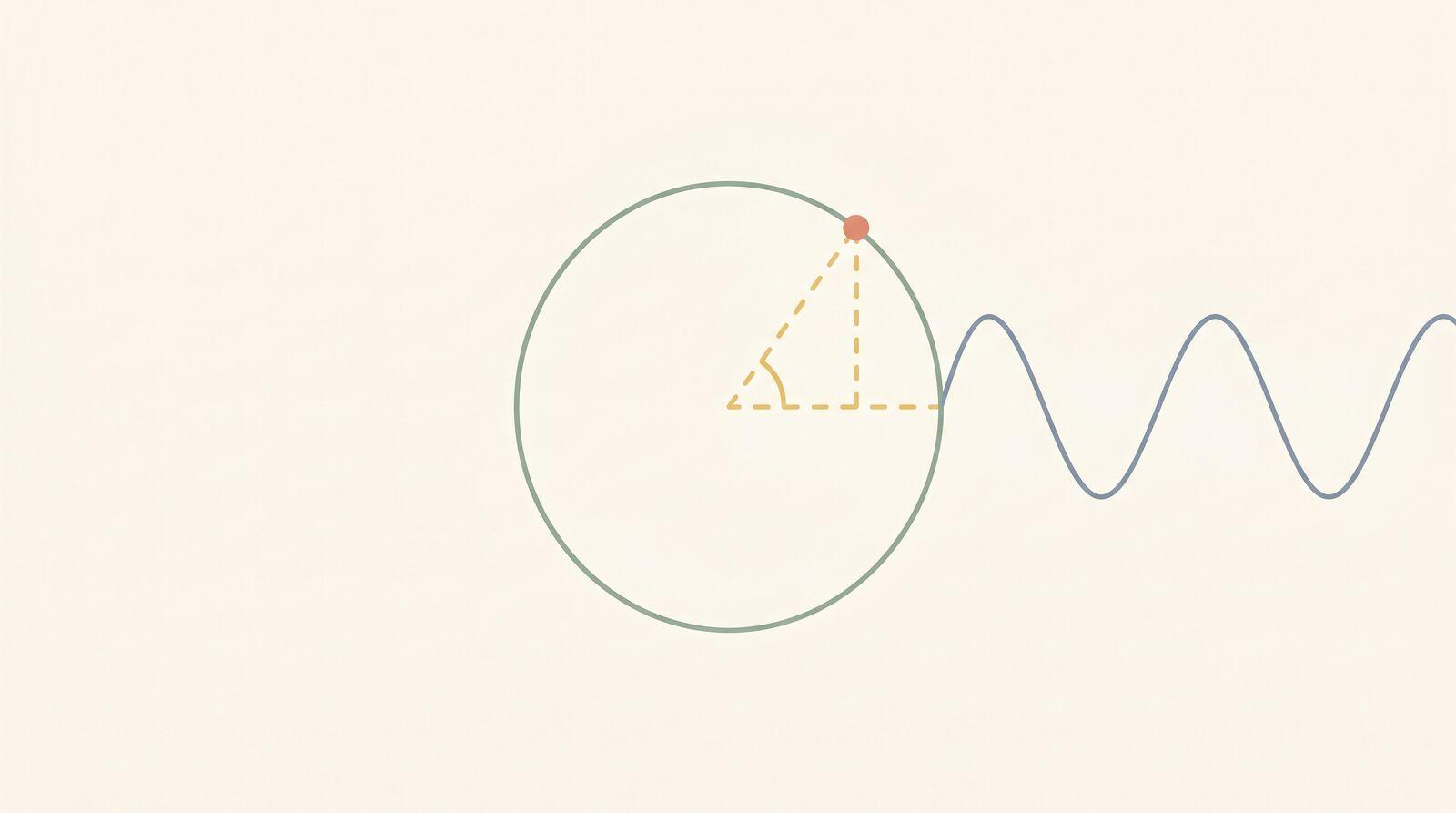
Unit 3 is trigonometry in radians. Unit circle values at multiples of π/6 and π/4 should be instant, since Part A and Questions 3 and 4 allow no calculator. For , read the amplitude |a|, the midline y = d and the period 2π/|b|, and say where the graph increases and where its concavity changes. Then learn the tangent function (period π, asymptotes where cos x = 0), the ranges of the inverse functions (arcsine and arctangent between −π/2 and π/2, arccosine between 0 and π), and the Pythagorean, sum and double-angle identities; understanding trigonometry intuitively shows the circle behind all of it. Polar coordinates close the unit. A point's distance from the origin is |r|, so when r is positive and increasing the point moves away from the origin, and when r is negative and increasing it moves toward it.
The course page also weights multiple choice by skill: Procedural and Symbolic Fluency 35 to 50%, Multiple Representations 20 to 30%, and Communication and Reasoning 30 to 40%. The diagnostic below sorts your mistakes along the same three lines.
The Four Free-Response Questions
The four free-response questions (FRQs) are the most predictable part of the exam. The CED describes the job of each one on pages 128 to 130, so you can practice every type long before May.
| Question | Units | Calculator | Real-world context | What it asks |
|---|---|---|---|---|
| 1 Function Concepts | 1 and 2 | Yes | No | Three parts on functions given as graphs, tables and formulas: composition, inverses, input and output values, zeros, asymptotes and end behavior, or which function type suits a model |
| 2 Modeling a Non-Periodic Context | 1 and 2 | Yes | Yes | Build a polynomial, piecewise, exponential or logarithmic model from a system of equations, find average rates of change with units, then draw a justified conclusion about the model's assumptions or limitations |
| 3 Modeling a Periodic Context | 3 | No | Yes | A sinusoidal model: two cycles with the midline and five labeled points, the parameters (amplitude, vertical shift, period, phase shift), then behavior on an interval: increasing or decreasing, concavity, and whether the rate of change is increasing or decreasing |
| 4 Symbolic Manipulations | 2 and 3 | No | No | Exponential, logarithmic, trigonometric or inverse trigonometric functions: two parts solve equations and one rewrites an expression in an equivalent form, with exact values and the work shown |
Question 1 hands you functions as graphs, tables and formulas and asks you to work across them. Practice with one function in a table and another on a graph: find f(g(3)), the input where g reaches a given value, the zeros, and the behavior near an asymptote and at the ends. When a part asks which function type fits, name the pattern behind your choice, such as equal differences or equal ratios over equal intervals.
Question 2 is modeling with a calculator. Practice building models from conditions: if passes through (1, 6) and (3, 54), dividing one equation by the other gives b² = 9, so b = 3 and a = 2. Give every average rate of change with its units, such as dollars per year. Close with a sentence or two on an assumption or a limit of the model (an exponential model grows without bound; a model built on ten years of data says little about year forty), backed by a value from your model.
Question 3 has no calculator, so the parameters come from reasoning about the context. A tide that rises to 9 feet and falls to 3 feet, with high tides 12 hours apart, has amplitude 3, midline 6 and b = 2π/12 = π/6. Practice sketching two cycles with the highs, lows and midline crossings marked. For the behavior parts: a sinusoid is concave down above its midline and concave up below it, and its rate of change is increasing where it is concave up.
Question 4 is algebra by hand. Two parts are equations, such as (so x = 3) or 2 sin θ = 1 on [0, 2π) (so θ = π/6 or 5π/6). The third rewrites an expression, such as as . Keep answers exact, π/6 and ln 5 rather than decimals, and show every step: the question asks for the work.
No Calculator for Most of the Exam
The CED puts it in one sentence: "Most of the AP Exam will need to be completed without the use of technology." Multiple-choice Part A and free-response Part B do not permit a calculator, and they carry 62.5% of the score between them.
For the parts where it is allowed, the CED (page 8) says your graphing calculator must be able to:
- graph functions in an arbitrary window
- find intersection points
- find minima and maxima
- solve equations numerically
- find regression equations (linear, quadratic, cubic, quartic, exponential, logarithmic and sinusoidal) and plot residuals
- carry out matrix operations
Matrices belong to Unit 4, which the exam skips. The rest of the list is what weeks 5 and 6 of the plan are for: run each regression, read its residual plot, and find an intersection without hunting through menus. Both calculator parts require radian mode, so check the setting at the start of each.
The CED also warns that "technology should not replace the development of symbolic manipulation skills." Do most of your practice by hand, and bring the calculator out only for sets that copy the calculator parts.
Diagnose Before You Plan
Before week 1, take one full practice exam from AP Classroom cold, in one sitting, with the calculator only where it is allowed. If it uses the 2024 to 2026 format, time it at the 2027 pace given above. Score it with its scoring guidelines.
Sort every lost point two ways: by unit, and by cause. For the cause, use the three skill categories in plain words: procedure (you knew the method and the algebra broke), representation (you misread the table or the graph), or reasoning (you could not justify a claim, or you picked the wrong conclusion). Add a fourth bin for time: questions you rushed or never reached.
Each bin has its own fix. A weak unit gets its block done slowly, with more problems. Procedure losses need the same kind of problem by hand until it is automatic; representation losses, the topic through tables and graphs; reasoning losses, your written answers compared line by line with the scoring guidelines; time losses, timed sets at 2.2 minutes per Part A question.
The 12-Week Plan for May 2027
Start on Monday, February 15, 2027. Twelve weeks later, on Sunday, May 9, the plan ends two days before the exam. Each two-week block has one focus and its own free-response questions, written out in full and scored against the guidelines. End every session with ten minutes of mixed questions from earlier blocks. If your class is still teaching Unit 3 in April, keep weeks 7 to 10 in step with it.
Weeks 1 and 2 (February 15 to 28): Unit 1. Average rates of change from formulas, tables and graphs; increasing, decreasing and concavity read from those rates; polynomial zeros, multiplicity and end behavior; rational asymptotes and holes; transformations. Finish with two released Question 1s.
Weeks 3 and 4 (March 1 to 14): Unit 2. Linear versus exponential tables, arithmetic and geometric sequences, exponential models, the logarithm rules, exponential and logarithmic equations, composition and inverses. Do the exponential and logarithm parts of released Question 4s by hand.
Weeks 5 and 6 (March 15 to 28): modeling and the calculator. Regressions and residual plots, semi-log plots, models built from two or three conditions, average rates of change with units, and one written sentence on each model's limits. Write released Question 2s at 17.5 minutes each.
Weeks 7 and 8 (March 29 to April 11): Unit 3, sinusoids. Unit circle values in radians, sine and cosine graphs, amplitude, midline, period and phase shift, the tangent function, and sinusoidal models in context. Work released Question 3s with the calculator out of reach.
Weeks 9 and 10 (April 12 to 25): Unit 3, inverses, identities and polar. Inverse trig and its restricted ranges, trigonometric equations and inequalities, identities, secant, cosecant and cotangent, polar coordinates, polar graphs and rates of change in polar functions. Finish the trigonometric parts of released Question 4s.
Weeks 11 and 12 (April 26 to May 9): full practice exams. Two complete exams at the 2027 timing, one per week, scored with the guidelines. Review each for as long as the sitting took, redo every lost free-response point from a blank page, and spend the days in between on the unit your diagnostic flagged.
Rest on Monday, May 10, and check that your calculator is charged and set to radians.
Pacing on Exam Day
Learn the per-question pace before May, so it is a habit on the day:
- Multiple choice, Part A: 29 questions in 65 minutes, about 2.2 minutes (2 minutes 15 seconds) each. At the halfway mark, 32 minutes in, you should be near question 15.
- Multiple choice, Part B: 13 questions in 40 minutes, about 3.1 minutes each.
- Free response, each part: 35 minutes for two questions, 17.5 minutes each.
In Part A, work in two passes: answer what you can do at once, skip anything that resists for more than three minutes, and come back with the time you saved. In each free-response part, read both questions first, start with the one you are surer of, and move on once a question passes 20 minutes. Give units with every answer to a question in context, keep answers exact in the part without a calculator, and write the steps: a grader can only give points for what is on the page.
Where Math Zen Fits
Math Zen's AP Precalculus path, described on the AP Precalculus exam page, has 39 subtopics across Units 1 to 3. In Unit 1 it drills polynomial equations and inequalities, rational functions and asymptotes, transformations, and average rates of change from formulas, tables and graphs, including telling linear, quadratic and exponential data apart. Unit 2 brings exponential functions and models, the logarithm rules, logarithmic equations and semi-log plots; Unit 3, the unit circle, sinusoids, the tangent function, inverse trigonometry, identities and polar graphs. Adaptive difficulty sends more practice to the subtopics you miss; the functions topic and the trigonometry topic are good places to start.
The app checks answers, not written reasoning, so it does not grade the justification Question 2 asks for or the work Question 4 wants shown. It does not yet drill polynomial end behavior and multiplicity, holes in rational functions, residual plots, or rates of change in polar functions. Use released free-response questions and their scoring guidelines for those.
The Bottom Line
The May 2027 AP Precalculus exam is 42 multiple-choice and 4 free-response questions in 2 hours 55 minutes, on Units 1 to 3 of a course whose content has not changed. What changed is the clock: about 2.2 minutes for each calculator-free question in Part A, and 17.5 minutes for each free-response question. Most of the score is earned without a calculator, so fluency by hand decides it. Diagnose before February 15, give each unit its block, write out all four free-response types until their shapes are familiar, and sit two full exams before May 9. The work carries forward: rates of change, exponential models and trigonometric functions are the ground AP Calculus builds on.
Common Questions
- How long is the AP Precalculus exam?
- The May 2027 exam takes 2 hours 55 minutes. Section I is 42 multiple-choice questions in 1 hour 45 minutes: Part A has 29 questions in 65 minutes without a calculator, and Part B has 13 questions in 40 minutes, some of which require a graphing calculator. Section II is 4 free-response questions in 1 hour 10 minutes, split into two 35-minute parts, the first with a graphing calculator and the second without.
- What changed on the AP Precalculus exam for 2027?
- The format, not the course. Multiple-choice Part A went from 28 questions in 80 minutes to 29 questions in 65 minutes, and Part B from 12 to 13 questions in the same 40 minutes. Each free-response part grew from 30 to 35 minutes, and free-response Question 2 lost its Part B(iii) while its Part C was expanded. The College Board states that course content has not changed.
- Can you use a calculator on the AP Precalculus exam?
- On part of it. A graphing calculator in radian mode is required for some questions in multiple-choice Part B and for free-response Questions 1 and 2. Multiple-choice Part A and free-response Questions 3 and 4 do not permit a calculator, and together they carry 62.5% of the score. The calculator should graph in any window, find intersections, maxima and minima, solve equations numerically and run regressions with residual plots.
- What units are on the AP Precalculus exam?
- Units 1 to 3 of the course. Unit 1, Polynomial and Rational Functions, is 30 to 40% of the multiple-choice section; Unit 2, Exponential and Logarithmic Functions, 25 to 40%; and Unit 3, Trigonometric and Polar Functions, 30 to 35%. Unit 4, Functions Involving Parameters, Vectors, and Matrices, holds additional topics taught where states or schools require them, and it is not assessed on the exam.
- What are the four AP Precalculus free-response questions?
- Question 1, Function Concepts, and Question 2, Modeling a Non-Periodic Context, draw on Units 1 and 2 and allow a graphing calculator. Question 3, Modeling a Periodic Context, is a sinusoidal model from Unit 3, and Question 4, Symbolic Manipulations, asks you to solve equations and rewrite expressions from Units 2 and 3; both are done without a calculator. Each question is worth 6 points, and Questions 2 and 3 are set in real-world contexts.
- When is the AP Precalculus exam in 2027?
- Tuesday, May 11, 2027, in the morning session. The multiple-choice section is taken in the College Board's Bluebook app and the free-response answers are handwritten in paper booklets. Schools submit their AP exam orders by November 13, 2026, so a student who is not registered yet should talk to the school's AP coordinator before then; later orders, until March 12, 2027, cost an extra $40 per exam.