Slope Intuitively: Rise Over Run, the Slope Formula, and y = mx + b
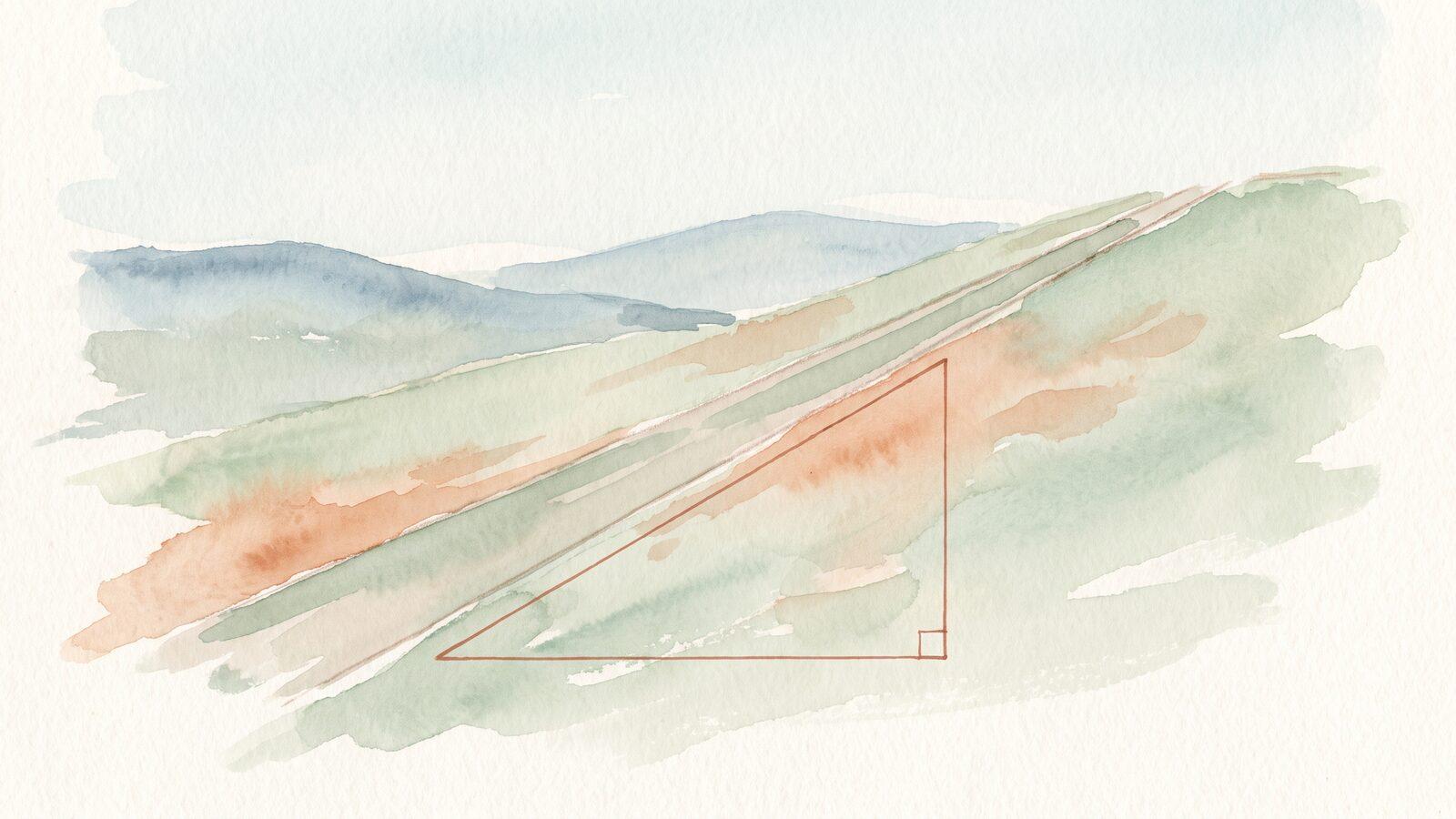
A sign on a mountain road reads 8% GRADE. The number describes the road ahead: over every 100 feet of horizontal distance, the road rises or falls 8 feet, depending on which way you are driving. Shrink the distance to a single foot and the change is 0.08 feet.
That 0.08 is a slope. It measures how much one quantity (height) changes for each one-unit step in another (horizontal distance). On a graph the quantities are and , and the question is the same: when moves one step to the right, how far does move, and in which direction?
Rise over run, the slope formula, and point-slope form are four ways of writing down that one answer.
Slope is a rate, not a shape
Slope looks like a tilt, but it is a number, and the number is a rate.
The classic definition is rise over run. Between two points on a line, the rise is the vertical change (in ) and the run is the horizontal change (in ):
Dividing by the run turns a raw change into a change per step: a rise of 6 over a run of 3 is the same slope as 2 over 1, because both mean climbs 2 for every unit of . Algebra books call this number .
Because slope divides one quantity by another, it carries units: dollars per gigabyte for a phone bill, meters per second (a speed) for distance over time. A "per" in a word problem usually signals a slope.
A slope's sign gives direction: a positive slope rises as you read left to right, and a negative slope falls. The 8% road has slope 0.08 for a driver heading uphill and for one heading down. Its size gives steepness: a slope of 5 is steeper than a slope of 2, and is steeper than , even though is the smaller number.
The picture can mislead. Stretch the y-axis and every slanted line looks steeper, yet no slope changes, because slope is measured in the units of the axes, not as an angle on the page.
Finding slope from two points
How to find slope depends on what you are given. From two points, subtract the y-coordinates for the rise and the x-coordinates for the run. That is the slope formula:
Take and as point 1 and point 2:
Read the answer back as a rate. From to is four steps, and at 2 per step should climb 8, from 3 to 11. It does.
The labels are yours to choose. Call point 1 instead and both subtractions reverse:
Both the rise and the run changed sign, so the answer survives. Switching the order in only one place breaks it: over gives , a line tilted the wrong way. Whichever point goes first on top goes first on the bottom.
Negative slopes come from the same formula. For and :
Each step to the right, falls by 2, so three steps take it from 7 down to 1.
The slope of a line is the same between any two of its points: also lies on the first line, and with it gives again. That constant rate is what makes a line straight.
Reading slope from a graph
On a graph you count instead of subtracting. Pick two lattice points (spots where the line passes exactly through a grid corner) and count from the left one to the right one: units up or down for the rise, units across for the run. Going left to right keeps the run positive, so the rise alone decides the sign.
Every line falls into one of four cases:
| Line on the graph | Example | Rise over run | Slope |
|---|---|---|---|
| Rises left to right | positive over positive | positive | |
| Falls left to right | negative over positive | negative | |
| Horizontal | 0 over any run | 0 | |
| Vertical | any rise over 0 | undefined |
The last two rows are easy to confuse because both involve a zero. On a horizontal line , every point has the same y-value, so the rise is 0, and 0 divided by a nonzero run is 0. The line has a slope, and the slope is zero.
On a vertical line , every point has the same x-value, so the run is 0, and division by zero is undefined. In rate terms, the line never takes a step in , so "change in per step of " has no answer. If you hear that a vertical line has "no slope," read it as undefined, not zero.
Slope-intercept form: y = mx + b
Slope-intercept form puts a line's two key numbers in plain view:
Here is the slope, and is the value of when , where the line crosses the y-axis. That point is the y-intercept, and in applied problems it is usually a starting amount.
Suppose a phone plan costs $15 a month plus $2 for each gigabyte of data. With gigabytes and a bill of dollars:
Use no data and you pay $15, the intercept. Each gigabyte adds $2, the slope, so 5 gigabytes cost dollars. To graph it, plot , then step right 1 and up 2, again and again.
Equations often arrive in standard form, , where the slope is hidden. Solve for and it appears:
So the slope is whenever . For , subtract from both sides and divide by 4: . The slope is and the y-intercept is 3.
The intercepts confirm it: the line passes through and , and . When , the equation is , a vertical line, which is exactly where would divide by zero.
Point-slope form: start from a point you know
Often you know the slope and one point, but not the intercept. Point-slope form uses exactly that information:
In words: from the known point , changes by for every step in . It is the slope formula rearranged: for any other point on the line, , and multiplying both sides by gives point-slope form.
Find the line with slope 3 through :
That is already a correct answer. To convert it to slope-intercept form, distribute, then add 5 to both sides:
Check with the known point: .
A line through two points takes one extra step. For and the slope is 2, as computed earlier, so , which simplifies to . The other point confirms it: .
Choose the form that matches what you know. Slope-intercept form suits graphing and any problem with a starting value, like the phone plan. Point-slope form is quickest from a point and a slope, or from two points. Standard form keeps whole-number coefficients, makes both intercepts quick to find, and lines equations up for elimination.
Parallel and perpendicular lines
Two lines with the same slope climb at the same rate, so the vertical gap between them never changes. If their intercepts differ, they are parallel and never meet: and have the same and different .
Perpendicular lines follow a less obvious rule. When neither is vertical, their slopes are negative reciprocals: flip the fraction and change the sign. Equivalently, the two slopes multiply to . Slope 2 pairs with , and pairs with .
The rule comes from turning a step. One step along a line with slope 2 is run 1, rise 2. Rotate that step a quarter turn counterclockwise and the two numbers trade places, one of them changing sign: run , rise 1. The new slope is .
So the line perpendicular to through has slope : , or . The vertical exception is real: a horizontal line and a vertical line are perpendicular, but the vertical one has no slope to multiply. OpenStax's linear functions section works through more parallel and perpendicular examples, plus more practice writing the equation of a line.
Where slope goes next
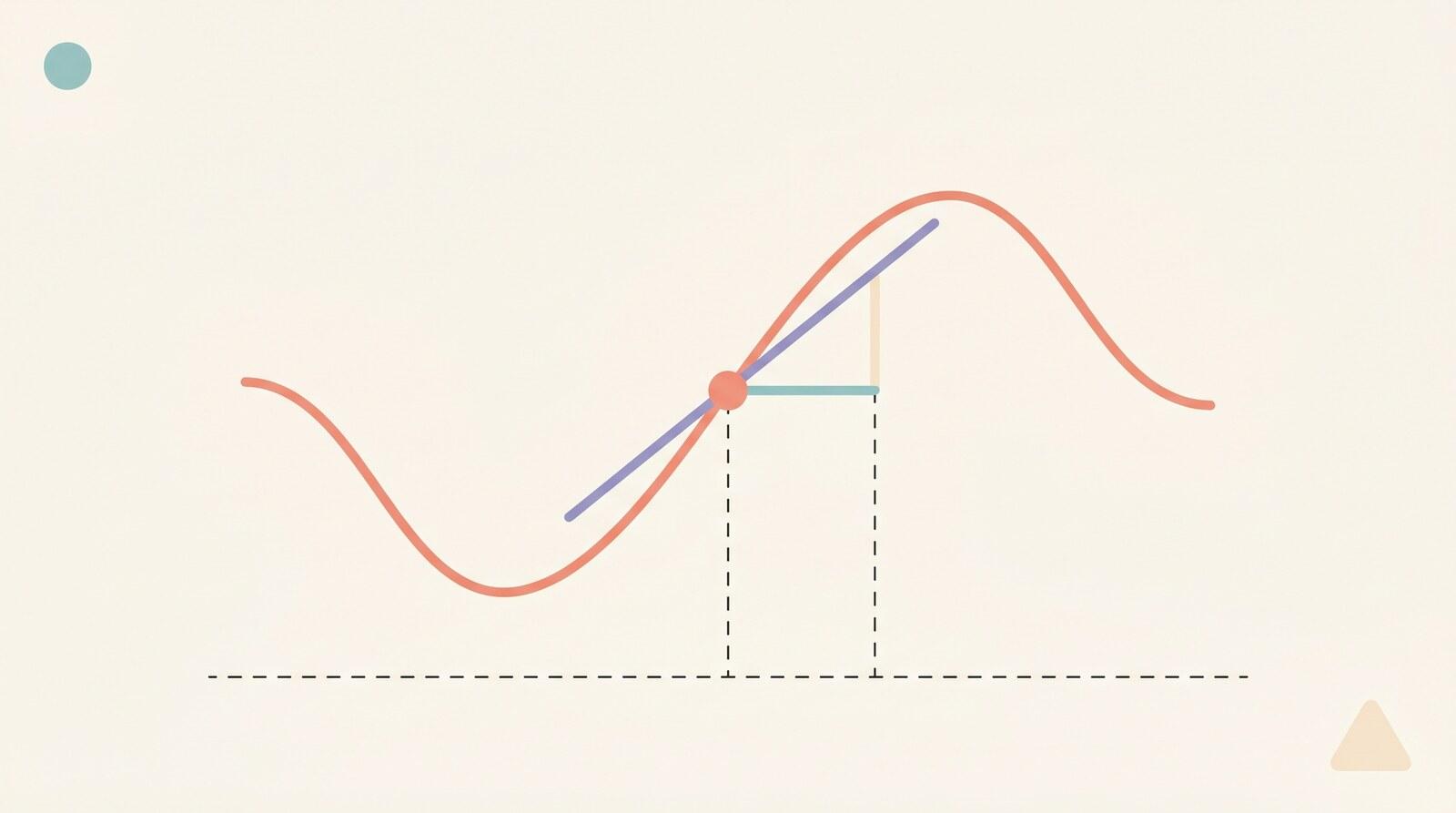
A line has the same slope everywhere; a curve does not. Rise over run between two points on a curve still works, and it gives the average rate of change: the slope of the secant line through both points. For between and :
Slide the second point toward and the average changes: 3 on the interval from 1 to 2, 2.5 from 1 to 1.5, 2.1 from 1 to 1.1. The values close in on 2, the slope of the tangent line at . That limiting slope is the derivative, and our derivatives guide builds calculus from this picture.
Closer to algebra, a constant slope is what makes a linear function linear, as our functions guide shows alongside the other common shapes. And since each linear equation in two variables draws a line, slopes predict how a system of equations behaves: different slopes cross exactly once, equal slopes with different intercepts never meet, and two equations for the same line share every point.
Common slope mistakes
- Run over rise. Dividing the horizontal change by the vertical one gives the reciprocal, instead of 2 for the first pair of points. Since changed by 8 while changed by 4, the slope had to be bigger than 1.
- Mixed point order. Starting the top and bottom subtractions with different points flips the sign. Label the points first.
- Dropped signs with negative coordinates. For and , the rise is , not 0, and the run is , so the slope is 2. Put parentheses around every negative coordinate you substitute.
- Calling a vertical line zero slope. A flat floor has zero slope. A wall has undefined slope.
- Reading the intercept as steepness. The line starts high but climbs slowly, while starts low and climbs six times as fast. The intercept moves a line up or down; only changes its steepness.
Practice switching between forms
Take one line and meet it in every form: two points, a graph, , point-slope form and standard form. Convert between them until each conversion is routine, and mix in horizontal and vertical lines so that a zero on top and a zero on the bottom stop looking alike.
Math Zen has no single slope drill, so the closest practice is spread over two topics: Graph Analysis for intercepts and reading graphs, and Algebra for solving equations and linear systems, where slopes decide whether two lines meet. Linear equations and slope also appear on the SAT, the ACT and the GED; our SAT Math guide shows where they sit in that exam.
Every formula here answers the road sign's question: how much does change when takes one step? When a formula slips your mind, ask that question of the numbers in front of you and build the formula again.
Common Questions
- What is slope in math?
- Slope measures how much y changes for each one-unit step in x. It is usually described as rise over run: the vertical change between two points on a line divided by the horizontal change. A positive slope rises from left to right, a negative slope falls, and a larger absolute value means a steeper line.
- How do you find slope from two points?
- Subtract the y-coordinates, subtract the x-coordinates in the same order, and divide: m = (y2 - y1) / (x2 - x1). For the points (2, 3) and (6, 11), that gives (11 - 3) / (6 - 2) = 8 / 4 = 2. Either point can go first, as long as it goes first in both the numerator and the denominator.
- What is the difference between slope-intercept form and point-slope form?
- Slope-intercept form, y = mx + b, shows the slope m and the y-intercept b, which is the value of y when x is 0. Point-slope form, y - y1 = m(x - x1), shows the slope and one known point on the line. Both describe the same line, and expanding point-slope form and solving for y turns it into slope-intercept form. Point-slope form is usually quicker when you know a point and the slope but not the intercept.
- What is the difference between zero slope and undefined slope?
- A horizontal line has zero slope: y never changes, so the rise is 0, and 0 divided by any nonzero run is 0. A vertical line has undefined slope: x never changes, so the run is 0, and division by zero has no value. Horizontal lines have equations like y = 4, and vertical lines have equations like x = 4.
- How are the slopes of parallel and perpendicular lines related?
- Distinct lines with the same slope are parallel: they climb at the same rate, so the gap between them never closes. Perpendicular lines, when neither is vertical, have slopes that are negative reciprocals, so the two slopes multiply to -1. A line with slope 2 is perpendicular to any line with slope -1/2. A horizontal line and a vertical line are also perpendicular, even though the vertical one has no numerical slope.