Understanding Sequences and Series Intuitively (Patterns That Add Up)

The list 2, 4, 8, 16 feels as if it is pointing somewhere. You see the first few numbers and start predicting the next one before anyone asks. That reflex, noticing a rule unfolding one step at a time, is the beginning of sequences.
Then a textbook puts subscripts on the terms, introduces a Greek capital sigma, and hands you separate formulas for arithmetic and geometric sums. A simple pattern turns into a page of notation. The formulas work, but the original picture disappears.
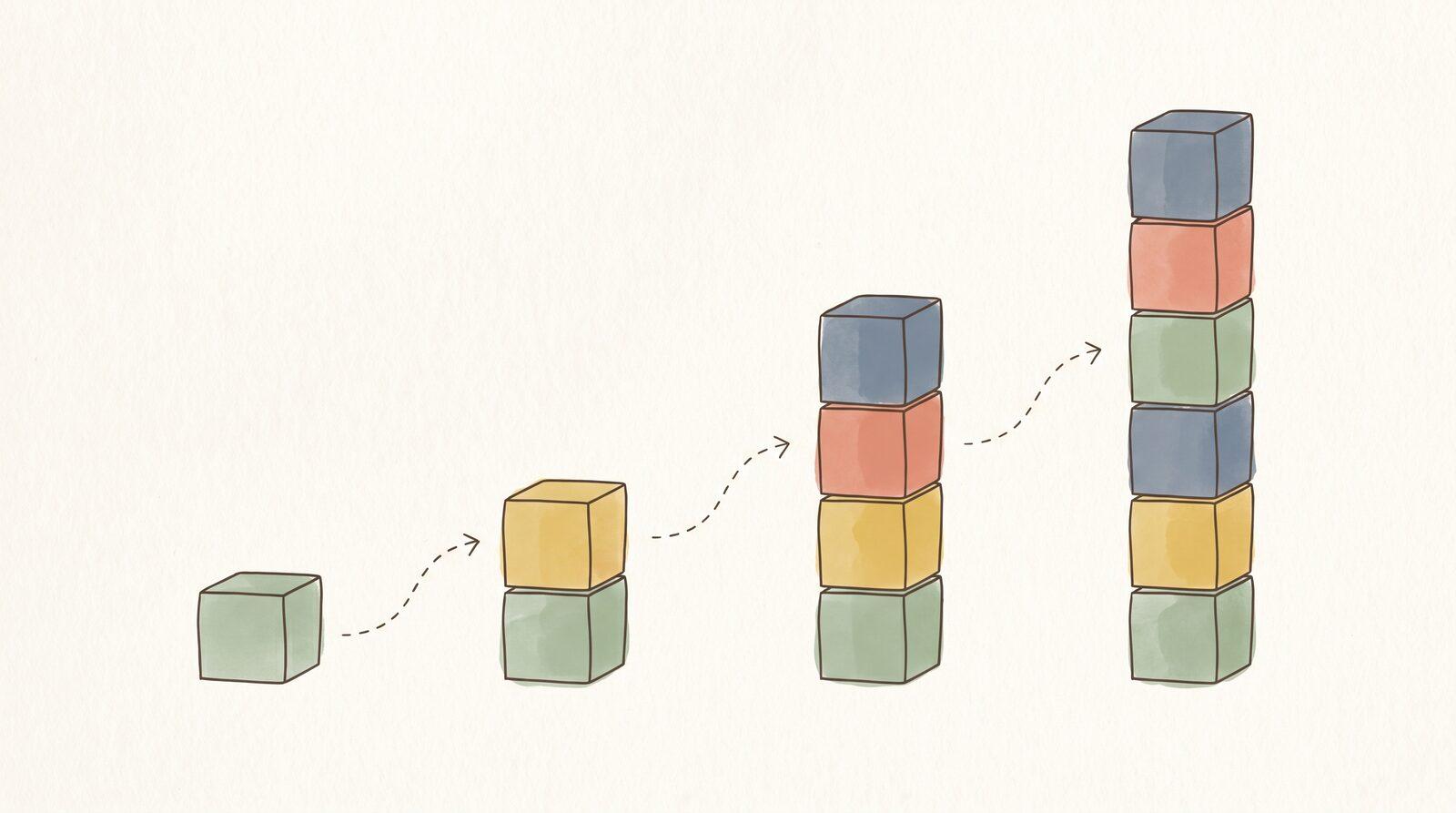
This article restores the picture. A sequence is a process that produces one number at each step. An arithmetic sequence repeats addition. A geometric sequence repeats multiplication. A series is what you get when you add the outputs, and the sum formulas are shortcuts whose shapes come directly from those two kinds of repetition.
A Sequence Is a Function with Stepping-Stone Inputs
A sequence is an ordered list of numbers. The order matters: 2, 4, 8, 16 is not the same sequence as 16, 8, 4, 2, even though both lists contain the same four numbers.
The cleanest way to understand that order is to connect sequences to functions. A function takes an input and returns an output. A sequence does the same thing, but its allowed inputs are positions: first, second, third, and so on. Feed it 1 and it returns the first term. Feed it 20 and it returns the twentieth.
That is what the notation aₙ means. The letter a names the sequence, and the small n names a position. The symbol a₅ does not mean a times 5. It means "the term sitting in position 5."
This framing separates two questions that students often mix together:
- What rule generates the terms?
- What is the value at a particular position?
The visible list helps you guess the rule. The formula lets you jump directly to any position without writing every earlier term.
Arithmetic Sequences Repeat Addition
Consider 5, 8, 11, 14, 17, ...
Each term is 3 more than the one before it. That fixed step, 3, is called the common difference. A sequence is arithmetic whenever subtracting one term from the next always gives the same result.
To reach the second term from the first, you add 3 once. To reach the third, you add it twice. To reach the nth term, you add it n minus 1 times. That gives the standard formula:
aₙ = a₁ + (n - 1)d
Here a₁ is the first term and d is the common difference. For the sequence above:
aₙ = 5 + (n - 1)3
The hundredth term is therefore 5 + 99 times 3, which is 302. The n minus 1 is not an arbitrary correction that has to be memorized. You start on the first stepping stone, so reaching stone n requires n minus 1 steps.
Arithmetic sequences model constant change. Add the same amount to a savings account every week, climb the same height with each stair, or increase a training target by the same number each session, and the values form an arithmetic sequence. Plot the term number against the term value and the points lie on a straight line, because constant addition is the discrete version of constant slope.
Geometric Sequences Repeat Multiplication
Now consider 5, 15, 45, 135, ...
The differences are not constant. They are 10, 30, and 90, so the arithmetic test fails. But each term is 3 times the previous term. That fixed multiplier, 3, is called the common ratio. A sequence is geometric whenever dividing one term by the previous term always gives the same result.
The repeated step is now multiplication. To reach the second term, multiply by 3 once. To reach the third, multiply by 3 twice. To reach the nth term, multiply by 3 exactly n minus 1 times:
aₙ = a₁r^(n - 1)
For this sequence, aₙ = 5 times 3^(n - 1). The same stepping-stone logic explains the exponent. Position 1 needs zero multiplications, position 2 needs one, and position n needs n minus 1.
Geometric sequences model proportional change. Compound interest, repeated population growth, radioactive decay, and a ball that rebounds to a fixed fraction of its previous height all work this way. The connection to exponents is exact: repeated multiplication is what an exponent records.
The common ratio can also be between -1 and 1, negative, or zero. The sequence 80, 40, 20, 10 repeatedly multiplies by 1/2 and decays toward zero. The sequence 8, -4, 2, -1 repeatedly multiplies by -1/2, so it shrinks while alternating sides of zero. "Geometric" does not mean "grows quickly." It means the ratio stays fixed.
Recursive and Explicit Rules Describe Different Views
There are two natural ways to describe the arithmetic sequence 5, 8, 11, 14, ...
The recursive rule says:
a₁ = 5, and each new term is the previous term plus 3.
The explicit rule says:
aₙ = 5 + (n - 1)3.
The recursive rule describes motion. It tells you how to take one step from wherever you are. The explicit rule describes location. It tells you where the nth stepping stone sits without forcing you to visit the earlier ones.
Neither form is more correct. Recursion is natural when the next state depends on the current one, as in account balances or computer simulations. An explicit formula is better when you want the millionth term and do not want to calculate the first 999,999.
The same distinction applies to geometric sequences. "Start at 5 and multiply the previous term by 3" is recursive. "The nth term is 5 times 3^(n - 1)" is explicit. One tells the process; the other compresses the whole process into a direct address.
Not every sequence is arithmetic or geometric. The Fibonacci sequence adds the previous two terms, so its rule is recursive but its differences and ratios are not constant. The square numbers 1, 4, 9, 16 have their own explicit rule, aₙ = n². Arithmetic and geometric sequences matter because their repetition is simple enough to produce powerful sum formulas, not because every pattern belongs to one of the two families.
A Series Is a Sequence with Plus Signs
Compare these two lines:
3, 6, 9, 12
3 + 6 + 9 + 12
The first is a sequence: four separate terms in a particular order. The second is a series: those terms added together, giving 30. Commas ask you to inspect the pattern. Plus signs ask you to total it.
When a sequence continues indefinitely, we often start with a partial sum, the total of its first n terms. The notation Sₙ means exactly that. S₁ is the first term, S₂ is the first two terms added, and S₁₀₀ is the total of the first hundred.
Sigma notation is only a compact way to write the instruction. The capital Greek letter Σ means "add." The expression beside it creates each term. The lower number tells the index where to start, and the upper number tells it where to stop. Summing 2k from k = 1 to 4 means:
2(1) + 2(2) + 2(3) + 2(4) = 2 + 4 + 6 + 8 = 20
The symbol looks advanced because it compresses an entire line into one mark. Expanding it restores the ordinary arithmetic underneath.
The Arithmetic Sum Formula Is Pairing
Take the first ten terms of the arithmetic sequence from earlier:
5 + 8 + 11 + 14 + 17 + 20 + 23 + 26 + 29 + 32
Adding from left to right works, but the pattern offers a shortcut. Pair the first term with the last: 5 + 32 = 37. Pair the second with the second-to-last: 8 + 29 = 37. Every outside pair gives the same total because moving one step inward adds 3 on the left and subtracts 3 on the right.
There are five pairs, each worth 37, so the sum is 185.
For any arithmetic series, the average term is halfway between the first and last terms. Multiply that average by the number of terms:
Sₙ = n(a₁ + aₙ) / 2
This is not a formula dropped from the sky. The expression (a₁ + aₙ) / 2 is the average of the endpoints. An evenly spaced sequence balances around that average, so its total is simply number of terms times average term.
The pairing still works when the number of terms is odd. The middle term pairs with itself, or you can think of it as one unpaired copy of the average. Either view produces the same formula.
The Geometric Sum Formula Is Cancellation
An arithmetic series stays friendly because its terms can be paired. A geometric series has a different symmetry: multiplying the entire sum by the common ratio shifts every term one place.
Start with:
Sₙ = a₁ + a₁r + a₁r² + ... + a₁r^(n - 1)
Multiply the whole line by r:
rSₙ = a₁r + a₁r² + ... + a₁r^(n - 1) + a₁rⁿ
Subtract the second line from the first. Every middle term cancels, leaving only the first term from the top and the new last term from the bottom:
(1 - r)Sₙ = a₁ - a₁rⁿ
Divide by 1 minus r:
Sₙ = a₁(1 - rⁿ) / (1 - r)
The formula looks more complicated than the arithmetic one because the underlying repetition is multiplication rather than addition. But its origin is just as concrete. Multiply, shift, subtract, and watch the middle disappear.
If r equals 1, the formula tries to divide by zero. That is not a mysterious exception. A ratio of 1 means every term is identical, so the sum is simply n times a₁. No cancellation trick is needed.
An Infinite Series Can Finish Without a Last Term
Consider:
1/2 + 1/4 + 1/8 + 1/16 + ...
After one term, the partial sum is 1/2. After two, it is 3/4. After three, 7/8. After four, 15/16. Each step fills half of the distance that remains below 1.
There is never a final fraction. But the distance to 1 becomes 1/2, then 1/4, then 1/8, and keeps shrinking toward zero. Saying the infinite series sums to 1 does not mean we completed infinitely many additions. It means the sequence of partial sums approaches 1 as closely as we want. That is the same idea developed in understanding limits intuitively.
For a geometric series, the finite formula already contains the answer:
Sₙ = a₁(1 - rⁿ) / (1 - r)
When the absolute value of r is less than 1, repeated multiplication makes rⁿ approach zero. The leftover term disappears in the limit, leaving:
S = a₁ / (1 - r)
For the series above, a₁ is 1/2 and r is 1/2, so the sum is (1/2) divided by (1 - 1/2), which is 1.
If the first term is nonzero and the absolute value of r is 1 or greater, the terms do not shrink toward zero, so the geometric series cannot settle at a finite total. The terms may grow, stay constant, or bounce back and forth. An infinite list always exists, but an infinite sum exists only when its partial sums approach a definite number.
Where the Mistakes Come From
The first common mistake is confusing a sequence with a series. The cure is visual: commas mean separate terms, plus signs mean a total. Before reaching for a formula, ask whether the problem wants one term or the sum of many terms.
The second is using n where the formula needs n minus 1. Both arithmetic and geometric nth-term formulas count the steps taken after the first term. The first term is position 1 but requires zero steps, so position n requires n minus 1.
The third is testing only the differences. If a sequence is not arithmetic, students often call it geometric without checking. Arithmetic means constant differences. Geometric means constant ratios. A sequence can be neither.
The fourth is applying the infinite geometric formula without checking the ratio. The formula a₁ divided by 1 minus r gives a finite sum only when the absolute value of r is less than 1. Write that condition beside the formula until the check becomes automatic.
The last is treating sigma notation as a new operation. It is not. Expand the first three terms, identify the pattern, and the symbol becomes an abbreviation for arithmetic you already know.
Where Math Zen Fits In
Sequences expose small gaps quickly. Weak signed arithmetic makes a negative common difference look unfamiliar. Weak fractions make a shrinking geometric sequence harder to recognize. Weak exponents turn the nth-term formula into a memorization task. The topic feels new, but most errors come from earlier operations that are not yet automatic.
Math Zen's bucket progression keeps those dependencies visible. Short sessions build signed arithmetic, fractions, ratios, functions, and exponents before mixing in pattern recognition, nth terms, and sums. Spaced practice then returns to the distinction that matters most: is this constant addition, constant multiplication, or neither? That classification is what selects the right formula, and repeated mixed problems build it more reliably than rereading a formula sheet.
The Bottom Line
A sequence is a function whose inputs are positions. An arithmetic sequence repeats addition, so its nth term follows a straight-line rule. A geometric sequence repeats multiplication, so its nth term uses an exponent. Recursive rules tell you how to take the next step; explicit rules tell you where any step is located.
A series is the sum of sequence terms. Arithmetic sums reduce to number of terms times average term because the outside values pair evenly. Geometric sums reduce through cancellation because multiplying by the common ratio shifts every term one place. When that ratio has absolute value below 1, the remaining tail shrinks to zero and even an infinite geometric series can approach a finite total.
The notation is compact, but the subject has only two engines: repeated addition and repeated multiplication. Once you see which engine is running, the formulas stop looking like separate facts and start reading like descriptions of the pattern already on the page.
Common Questions
- What is the difference between a sequence and a series?
- A sequence is an ordered list of numbers, such as 3, 6, 9, 12. A series is the result of adding the terms of a sequence, such as 3 + 6 + 9 + 12. The distinction is punctuation with a mathematical consequence: commas give you separate terms to inspect, while plus signs ask for a total. A sequence can continue without being added, and the sum of its first n terms is called a partial sum of the corresponding series.
- What is the difference between an arithmetic and a geometric sequence?
- An arithmetic sequence changes by adding the same amount each time, so consecutive terms have a constant difference. A geometric sequence changes by multiplying by the same amount each time, so consecutive terms have a constant ratio. The sequence 4, 7, 10, 13 is arithmetic because it repeatedly adds 3. The sequence 4, 12, 36, 108 is geometric because it repeatedly multiplies by 3.
- How do you find the nth term of a sequence?
- For an arithmetic sequence, start with the first term and add the common difference n minus 1 times: aₙ = a₁ + (n - 1)d. For a geometric sequence, start with the first term and multiply by the common ratio n minus 1 times: aₙ = a₁r^(n - 1). The n minus 1 appears because the first term is already present before you take any steps.
- How can an infinite series have a finite sum?
- An infinite series can have a finite sum when each new term shrinks fast enough that the remaining distance approaches zero. In 1/2 + 1/4 + 1/8 + 1/16 + ..., every term fills half of what remains, so the partial sums approach 1. For a geometric series with a nonzero first term, this happens exactly when the common ratio has absolute value less than 1, and the sum is a₁ divided by 1 minus r.
- What does sigma notation mean?
- The capital Greek letter sigma, Σ, is a compact instruction to add a sequence of terms. The expression beside it tells you what each term is, the value below it tells you where the index starts, and the value above it tells you where to stop. For example, summing 2k from k = 1 to 4 means substitute 1, 2, 3, and 4 for k, producing 2 + 4 + 6 + 8.