Understanding Modular Arithmetic Intuitively (Clock Math and Why Remainders Rule)

It is nine o'clock and a flight leaves in five hours. Nobody answers "fourteen o'clock." You say two, and you did it without thinking, because a clock face has no fourteen. The hours wrap around at twelve and start again. You have been doing modular arithmetic since you could tell time; you just never met the notation.
That is the whole subject. Pick a number to wrap around at, forget every complete lap, and keep only where you land. What makes it worth an article is that this one habit, keeping only the remainder, solves problems that look impossible head-on: the last digit of a number with seventy digits, whether a huge number is divisible by 9, why a credit card number is valid or not, and how a message can be scrambled so that only the intended reader can unscramble it.
This article is the picture: what a remainder really is, why you are allowed to reduce before you calculate, what happens with negatives and with powers, and where the one honest difficulty, division, comes from.
A Remainder Is Where You Land, Not What Is Left
The standard definition says that is the remainder when is divided by . That is correct and it is also the reason the topic feels like a chore, because "remainder" sounds like the scrap left over after a division, an afterthought.
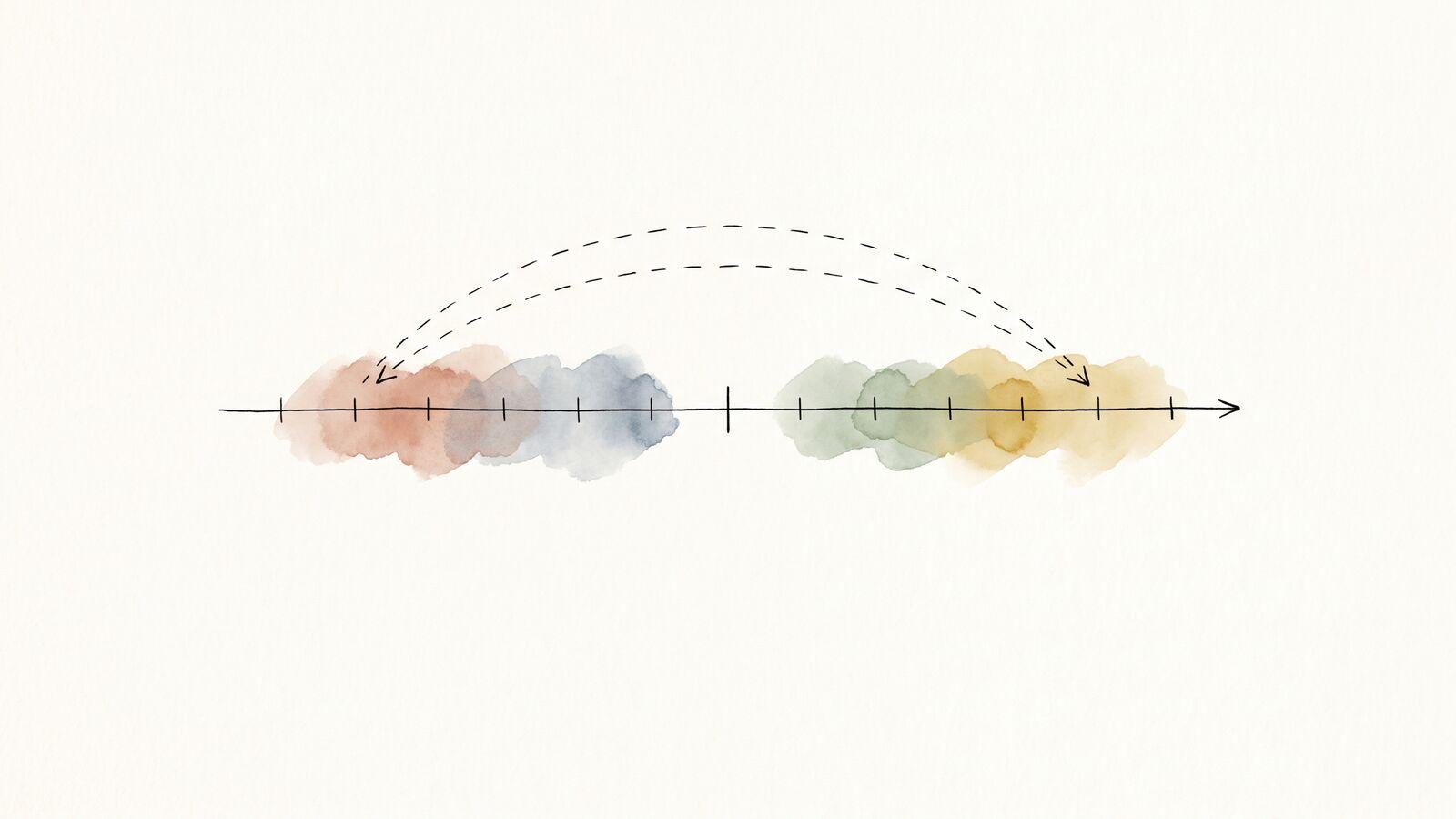
Better picture: a circular track with marks on it, numbered to . To find , start at and walk steps around the track. Where you stop is the answer. Walking 17 steps around a track with 5 marks takes you around three full times (15 steps) and then 2 more, so you stop at mark 2. Hence . The full laps are the quotient; where you land is the remainder.
This picture does two things the definition does not. It makes the remainder always land in the range to , since those are the only marks. And it explains why two numbers can be "the same" mod even when they are wildly different: , , , and all stop at mark 2 on a 5-mark track. They differ by laps, and the track does not remember laps.
Mathematicians write that idea as a congruence:
Read it as "17 lands where 2 lands, on the 5-track." The triple bar is not an equals sign, because 17 and 2 are not equal. It says they are interchangeable for any question that only cares about position on the track. The precise version: means divides , which is just saying the two numbers differ by a whole number of laps.
Adding and Multiplying Only Care About Where You Are
Here is the fact that makes modular arithmetic a tool rather than a curiosity. If you are going to add two numbers and then find the remainder, you can find the remainders first, add those, and reduce again. The answer is identical. The same holds for subtraction and multiplication.
On the track it is obvious. Adding 17 means walking 17 steps, which is three laps plus 2. The three laps bring you back to where you started and change nothing, so adding 17 has exactly the same effect as adding 2. The laps hidden inside a number are dead weight, and they stay dead weight through addition and through multiplication, because a multiple of times anything is still a multiple of .
Written out, with and :
Everything in the first bracket is laps. Only survives, so is . The remainders carry all the information the question needs.
This is why the tip in Math Zen's arithmetic topic says to reduce step by step rather than computing the full value. Suppose you want . You could multiply out to 56,088 and long-divide by 7. Or you can notice , so , and , so , and the answer is . Two small reductions replace a four-digit multiplication. The habit is: never let a number grow past if you only care about its remainder.
Negative Numbers Walk the Other Way
The track picture also handles the case that trips most people up. What is ?
Walk 3 steps backward from 0 on a 5-mark track. You pass 4, then 3, then land on 2. So . A negative number is just a walk in the other direction, the same idea as in Understanding Negative Numbers Intuitively, and the remainder is still where you land, still between and .
The shortcut: add laps until the number is positive. . For , add 15 (three laps) to get 1. Calculators and programming languages disagree about negative remainders, some returning for , so on a test always state the answer as the nonnegative mark on the track, and check your calculator's convention before trusting it.
Subtraction is the same story. is , which is exactly one lap backward, so the answer is 0. Or reduce first: , so .
The Last Digit of a Huge Power
This is the problem that convinces people the topic is worth knowing, and it is a direct consequence of the reduce-first rule.
The last digit of a number is the number mod 10, because the tens, hundreds, and everything above are multiples of 10 and land back at 0 on a 10-mark track. So "what is the last digit of " is the question "what is ," and you never have to compute .
Instead, watch the powers of 7 walk around the 10-track, reducing every time:
Once you hit 1, the cycle restarts: 7, 9, 3, 1, 7, 9, 3, 1, with period 4. Since , the hundredth power sits at the end of a complete cycle, the same spot as , and its last digit is 1.
Every base has a cycle mod 10, and most are short. Powers of 2 cycle through 2, 4, 8, 6. Powers of 3 through 3, 9, 7, 1. Powers of 5 and 6 never move. The method is always the same: find the cycle length by reducing as you go, divide the exponent by the cycle length, and the remainder of that division tells you where in the cycle you are. It is the exponents idea of repeated multiplication, run on a circular track instead of a straight line.
Why the Digit-Sum Test for 9 Works
Everyone learns that a number is divisible by 9 if its digits add up to a multiple of 9, and almost nobody learns why. Modular arithmetic makes it a one-line argument.
Ten is one lap plus one on a 9-track: . Then , and every power of 10 is congruent to 1 as well. So a number like is congruent to , and 18 is on the 9-track, so 4,527 is divisible by 9. The digit sum is not a trick. It is the number itself, seen mod 9.
The test for 3 works for the same reason, since too. The test for 11 comes from , which makes the powers of 10 alternate between and and gives the alternating digit sum. All of the divisibility rules you were told to memorize are one fact, "reduce the powers of 10," applied to different tracks.
Check Digits: Modular Arithmetic in Your Wallet
Every ISBN, every credit card number, and every barcode ends with a digit whose only job is to be a remainder.
The last digit of a 13-digit ISBN is chosen so that a weighted sum of all thirteen digits, with weights alternating 1 and 3, is congruent to . Mistype a single digit and the sum lands somewhere else on the 10-track, and the scanner rejects it. Credit cards use the Luhn algorithm, a slightly cleverer weighting that also catches most cases where two adjacent digits are swapped, again by checking a sum mod 10.
These are the humble cousins of a much bigger application. Modern encryption rests on the fact that raising a number to a power mod a very large is easy, while reversing the process without a secret key is not. The cycle-finding you did above for is the same operation, scaled up to numbers with hundreds of digits, and the reduce-as-you-go rule is the only reason it can be computed at all.
Division Is Where the Track Gets Bumpy
Addition, subtraction, and multiplication behave on a track exactly as they do on the number line. Division does not, and this is the one place the topic earns its reputation.
On the ordinary number line, dividing by 4 means multiplying by , the number which, times 4, gives 1. On a 12-track, is there a mark that, times 4, lands on 1? Try them all: , , , , and the pattern 4, 8, 0 repeats forever. It never hits 1. So on the 12-track there is no such thing as dividing by 4.
The reason is that 4 and 12 share a factor. Start with a multiple of 4, add or remove laps of 12, and you still have a multiple of 4, so you can never land 1 past a multiple of 12. Try 5 instead: , so 5 is its own inverse on the 12-track and dividing by 5 is fine. The rule: has an inverse mod exactly when and share no common factor besides 1.
That rule has a striking consequence. If is prime, nothing from to shares a factor with it, so every nonzero mark has an inverse and you can divide freely. Prime tracks are the ones where all four operations work, which is a large part of why primes, whose supply the infinitude of primes guarantees, sit at the center of number theory and of cryptography.
Where the Mistakes Come From
Modular arithmetic has few moving parts, and the errors are correspondingly specific.
The first is reducing the exponent instead of the base. In , you may reduce 7 mod 10 (it already is), and you may reduce the exponent mod the cycle length once you know it, but you may not reduce 100 mod 10 and compute . Exponents live on a different track, the one whose size is the cycle length, and mixing the two tracks is the single most common error in this topic.
The second is a negative remainder. is 1, not . Same position on the track, but only one of them is the conventional name, and answer keys want the nonnegative one.
The third is dividing without checking for an inverse. Cancelling a common factor from both sides of a congruence is legal only if that factor shares nothing with the modulus. From , which is true since both sides are 8, you cannot cancel the 4 to conclude , which is false. The laps you discard when cancelling have to be laps of the original track.
The fourth is forgetting to reduce at the end. Getting on a 7-track and writing 21 is not wrong, exactly, but it is not an answer either. The answer is a mark on the track, and 21 is three laps, so the mark is 0.
Where Math Zen Fits In
Math Zen's arithmetic topic has a dedicated bucket for modular arithmetic, and the progression is built around the reduce-first habit rather than around the notation. Early problems ask for plain remainders and congruences with small moduli, until "where do I land" is automatic. The middle buckets mix in negatives and products, where the point is to reduce every factor before multiplying and to state the nonnegative remainder. The later buckets are the last-digit and cycle-length problems, which are the ones that show up on competition papers and admissions tests and that punish anyone who tries to compute the full power.
Because the sessions are short and the problems come back at spaced intervals, as described in spaced repetition for math practice, the cycle-finding move becomes a reflex instead of a procedure you look up. Most people do not have a modular arithmetic gap that a chapter would fix. They have one picture, the track, that was never drawn for them, and about forty reps that were never done.
The Bottom Line
Modular arithmetic is arithmetic on a circular track with marks. A remainder is where you land after walking steps, complete laps are forgotten, and two numbers are congruent when they land on the same mark. Because laps contribute nothing to sums and products, you may reduce every number to its remainder before adding or multiplying, and this single permission turns impossible computations, like the last digit of , into short cycles you can trace by hand. Divisibility tests are the powers of 10 reduced mod 9, 3, or 11. Check digits are remainders that catch typos. Division works only when the number shares no factor with the track, which is why prime tracks are special.
When a modular problem stalls, draw the track. Ask where each piece lands, reduce as you go, and keep the exponent on its own track. The answer is a mark between and , and the picture will get you there before the formula does.
Common Questions
- What does mod mean in math?
- Mod is short for modulo, and a mod n is the remainder when a is divided by n. So 17 mod 5 is 2, because 17 is three fives with 2 left over. Modular arithmetic is doing addition, subtraction, and multiplication where only the remainder is kept, the way a clock keeps only the hour and forgets how many full days have passed.
- Why is modular arithmetic called clock arithmetic?
- Because a 12-hour clock is the everyday example. Nine o'clock plus five hours is two o'clock, not fourteen, since the clock wraps around every 12. Arithmetic mod 12 is exactly that wrap-around, and arithmetic mod n is a clock with n hours on the face.
- Can you reduce numbers before multiplying in modular arithmetic?
- Yes, and this is the main reason the topic is useful. If you only want the remainder of a product, you can replace each factor by its own remainder first, multiply the small numbers, and reduce again. The answer is the same because the discarded multiples of n contribute only more multiples of n.
- How do you find the last digit of a large power like 7 to the 100?
- The last digit is the number mod 10, and powers repeat mod 10 in a short cycle. Powers of 7 end in 7, 9, 3, 1 and then repeat every four. Since 100 is a multiple of 4, 7 to the 100 lands at the end of a cycle and its last digit is 1.
- Why can't you divide in modular arithmetic?
- Division means multiplying by an inverse, and mod n a number only has an inverse when it shares no factor with n. Mod 12, the number 5 has an inverse because 5 times 5 is 25, which is 1 more than 24, but 4 has none, since adding or removing laps of 12 keeps a multiple of 4 a multiple of 4, so it can never be 1 more than a multiple of 12. When n is prime, every nonzero number has an inverse.