Understanding Decimals Intuitively (Why the Decimal Point Moves)
Most adults can buy something for $7.49 and a coffee for $4.85 and know they spent $12.34, all in their head, without breaking a sweat. Hand the same person 7.49 + 4.85 written on paper, with no dollar signs, and a noticeable percentage will reach for the calculator. The arithmetic is identical. The thing that broke confidence is the dot.
Decimals get treated, even by people who use them all day, as a different kind of number with its own special rules about moving the point, lining up the point, and dropping zeros. They are not. A decimal is the most ordinary number in the world wearing a new piece of punctuation, and that punctuation does only one job. Once that job is clear, every rule about decimals stops being a rule and becomes obvious.
The One Idea: Decimals Are Just Place Value, Continued
Place value is the whole game. In 348, the 3 means three hundreds, the 4 means four tens, and the 8 means eight ones. Each column going left is worth ten times the one to its right. Or, equivalently, each column going right is worth one tenth of the one to its left.
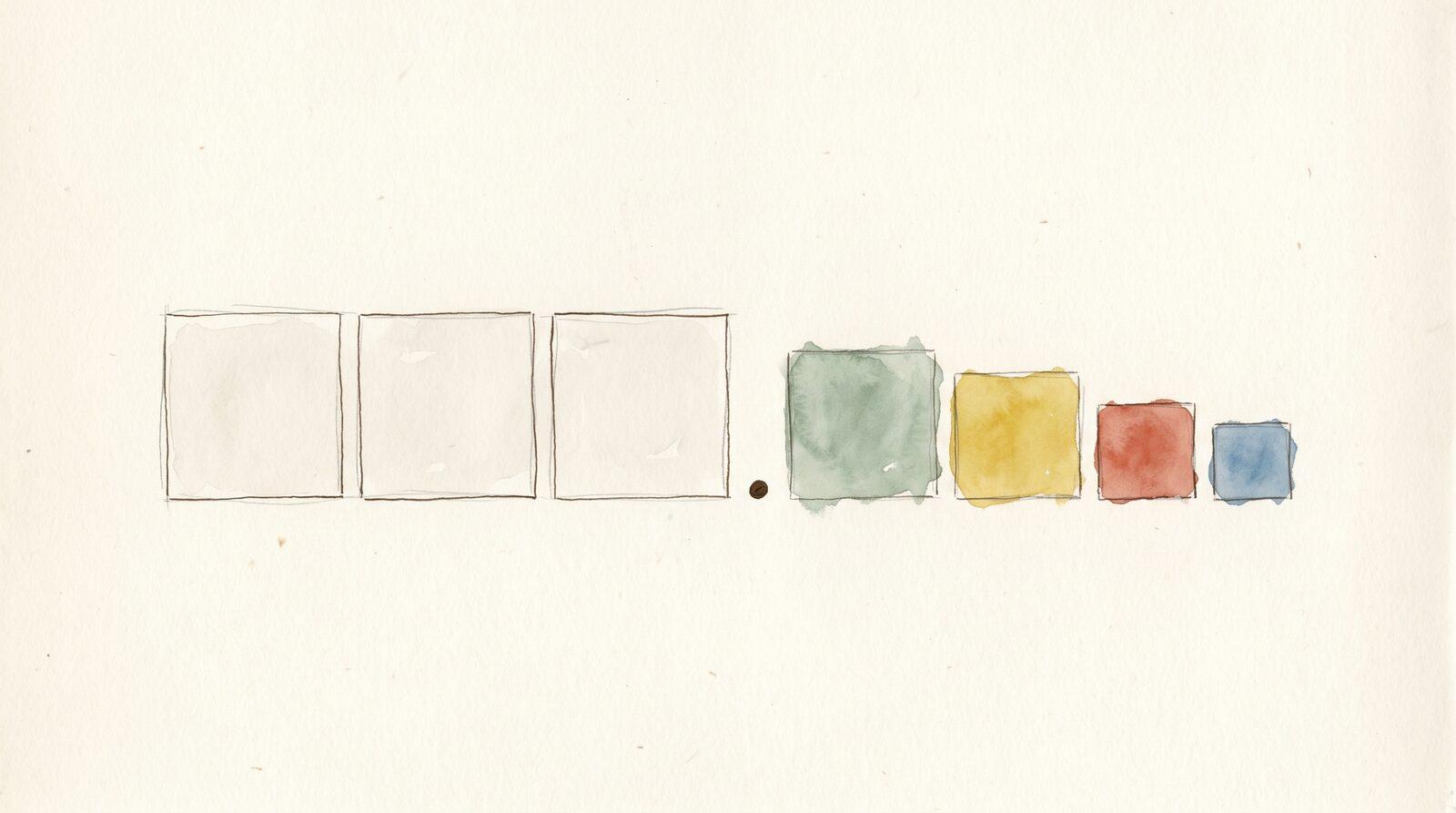
A decimal is what happens when you keep going right past the ones column. The next column is worth one tenth, the one after that is worth one hundredth, then one thousandth, and so on, forever, with each new column ten times smaller than the last. That is the entire definition. Decimals do not introduce a new kind of number. They extend the same place-value table you already trust in the other direction.
So 0.25 is two tenths plus five hundredths, which is exactly twenty-five hundredths, which is exactly 25/100. There is nothing else hiding inside the notation. As we covered in the fractions post, a fraction is a division waiting to happen, and a decimal is the result of that division written in our standard column format. The two are the same number in different costumes.
Why the Dot Is There at All
The decimal point looks important, the way a checkpoint at a border looks important. It is not, really. Its only job is to mark where the ones column ends, so you can tell which digit is worth how much. Without the dot, 25 and 2.5 and 0.25 would all look identical, and place value would collapse.
This is why every rule about lining up the decimal point or moving the decimal point is actually a rule about place value. The dot is a marker. When you move it, you are not changing the digits, you are changing what each digit means by sliding the whole number along the place-value table. Multiplying by 10 shifts every digit one column to the left, so the dot appears to move one place to the right. Dividing by 10 shifts every digit one column to the right, and the dot appears to move left. Nothing magical happened. The digits stayed put on the page; their values changed because the column they sit in changed.
Once you read the dot as a column marker rather than a special operator, the phrase "move the decimal point" stops being a trick. It is just shorthand for "rescale by a power of ten," and the direction is whichever direction keeps place value honest.
Reading Decimals Out Loud (and Why It Matters)
A small habit clears up a surprising number of decimal mistakes: read decimals the way they are actually built. The number 0.07 is "seven hundredths," not "zero point oh seven." The number 3.4 is "three and four tenths," not "three point four."
This sounds pedantic, and for casual conversation it is. But the formal name forces you to notice the place value of the last digit, and the last digit is where comparison errors happen. People routinely say 0.7 is smaller than 0.65 because 65 is bigger than 7. Read them as "seven tenths" and "sixty-five hundredths" and the confusion vanishes, because seven tenths is the same as seventy hundredths, and seventy is plainly bigger than sixty-five. The mistake was never about decimals. It was about forgetting which column you were comparing.
The trick to comparing any two decimals is the same: give them the same number of digits past the dot by padding with zeros, then compare them as if they were ordinary whole numbers. 0.7 becomes 0.70, and now 70 versus 65 is a question a child can answer. Padding zeros at the end of a decimal is always safe because it just renames the same number in a smaller unit.
Adding and Subtracting: Just Line Up the Dot
The rule everyone learns is "line up the decimal points." The reason is not a convention. It is the only way to add tenths to tenths, hundredths to hundredths, and ones to ones. The dot is a column marker, so lining up the dots lines up the columns, and adding in columns is the only way addition has ever worked.
7.49 + 4.85 is the same problem as 749 + 485 with a marker placed in the middle. The carries work identically. The dot in the answer ends up directly under the dots in the inputs because the ones column in the answer is directly under the ones column in the inputs. There is no separate "decimal addition" to learn. There is only ordinary addition with a placeholder telling you where the ones live.
The same is true for subtraction, with one common bookkeeping trick: if the two numbers have different lengths past the dot, pad the shorter one with zeros. 5.2 minus 1.473 looks awkward until you write 5.200 minus 1.473, at which point it is the same column-by-column borrow you already trust. The zeros you added did not change the value of 5.2 at all. They just gave every column in the subtraction a partner to subtract from.
Multiplying: The "Total Decimal Places" Rule, Explained
The textbook rule for multiplying decimals sounds bizarre on first contact: multiply the numbers as if the dots were not there, then count the total number of decimal places in both inputs and put that many decimal places in the answer. It feels arbitrary. It is not. It is exactly what the place-value table forces.
0.4 times 0.03 is "four tenths times three hundredths," which is "twelve thousandths," which is 0.012. The 4 and the 3 multiply to give the digits, the same way they always would. What sets the size of the answer is the units. Tenths times hundredths gives thousandths, the way meters times centimeters gives a unit smaller than either one. Counting decimal places is just counting the powers of ten in the denominator: 0.4 is 4/10, 0.03 is 3/100, multiplying them gives 12/1000, which is 0.012 written back in decimal form.
So the rule about counting decimal places is a rephrasing of "add the powers of ten in the denominators," which is itself just place-value bookkeeping. The reason it works is the same reason it has to work. Nothing about it is magic, and once you see the fraction underneath, you can do small decimal multiplications in your head by converting briefly to fractions and back, the way mental math tricks often work.
Dividing: Why You "Move the Decimal" in Long Division
Long division with decimals is where most adults bailed in school, usually at the moment a teacher said "now move the decimal over." That instruction sounds like cheating until you see what it actually is.
To divide 6.3 by 0.7, the rule is to move both decimal points the same number of places to the right until the divisor is a whole number: 63 divided by 7, which is 9. The reason this works is the most useful fraction identity you know. Multiplying the top and bottom of a fraction by the same number does not change the value. 6.3 divided by 0.7 is the fraction 6.3/0.7, and multiplying both top and bottom by 10 gives 63/7, the same number written more conveniently.
Moving the decimal in both numbers is not a trick. It is multiplying numerator and denominator by 10, the way you would simplify 50/100 to 1/2. The reason you do it is that dividing by a whole number is easier than dividing by a fraction. Nothing about the value changed. You just put on a less awkward outfit.
Three Costumes, One Number
Fractions, decimals, and percents are the three standard ways to write the same kind of quantity. 1/2 and 0.5 and 50% are the same number, exactly. Each form has a job it is best at.
- Fractions are best when the denominator is small and meaningful: 2/3 of the class, 3/4 of a tank.
- Decimals are best when you need to compute, especially across many values: money, measurement, statistics.
- Percents are best when you are comparing two things relative to a whole: a 23% chance of rain, a 12% raise.
Switching between them is a single conversion in each direction. A fraction becomes a decimal by doing the division the fraction is asking you to do; . A decimal becomes a percent by multiplying by 100, which is the same as moving the dot two columns to the right, because that is what multiplying by 100 always does. As we covered in the percentages post, percent literally means "per hundred," so the "move the dot two places" rule is just the place-value consequence of multiplying by a hundred. Three costumes, one number, freely interchangeable.
Where the Real Mistakes Happen
If decimals are this orderly, why do they keep tripping people up? The errors cluster in a few honest places, and naming them is most of the cure.
The first is misreading place value when there are leading zeros. 0.004 looks small, and it is, but people often cannot say whether it is bigger or smaller than 0.01 without thinking. Reading them as "four thousandths" and "one hundredth" makes the answer immediate: one hundredth is ten thousandths, which is bigger than four thousandths.
The second is misplacing the decimal in a multiplication or division answer by one column. The digits are right and the size is off by a factor of ten. The remedy is the estimate. Before you finalize an answer, ask the question once in round numbers. 0.4 times 0.03 should be roughly half of a hundredth, so an answer of 0.12 should immediately feel ten times too big. A sanity check that takes a second prevents most decimal-place errors.
The third is mishandling repeating decimals like by rounding too early. If a problem will multiply that result by something large, the rounding error compounds. The fix is to carry the fraction as a fraction for as long as the problem will let you, and only convert to a decimal at the final step. This is the same discipline that keeps mental arithmetic accurate: exact at every step beats slightly wrong at every step.
Where Math Zen Fits In
Math Zen's bucket progression is built for exactly the topic where one weak place-value habit poisons everything else, and decimals are a textbook case of that. The early buckets drill reading decimals out loud and converting between fractions and decimals until the three forms feel like the same number in different fonts. The middle buckets move into adding, subtracting, and multiplying decimals in short, mixed sets, so the lining-up-the-dot habit becomes automatic and the place-value sanity check becomes reflexive instead of optional. The later buckets fold decimal arithmetic into percentages, ratios, and word problems, where the test of mastery is whether decimals survive a longer chain of operations, not whether you can compute one in isolation.
Because the practice is short and spaced, the column discipline becomes muscle memory the same way single-digit multiplication eventually did, which is the entire point of practicing in small spaced sessions rather than one long cram. Most learners do not have a decimals gap that needs a thicker textbook. They have one missing picture and a few unpracticed reps.
The Bottom Line
A decimal is an ordinary number written in our usual place-value table, with the table extended past the ones column into tenths, hundredths, thousandths, and beyond. The dot is a marker that says where the ones column ends, nothing more. Every rule about decimals, lining up the point to add, counting decimal places when multiplying, moving the point when dividing, is a direct consequence of that one fact about place value.
When a decimal question stumps you, do not reach for the rule. Find the ones column, name the place value of each digit out loud, and the right next step usually walks itself onto the page. The dot is not a trap. It is a label, and labels do not get in your way once you know what they mean.