Understanding Calculus Intuitively: The Big Picture

Calculus has a fearsome reputation. For a lot of people it is the wall where math stopped, a fog of strange symbols, limits, and rules that seemed to arrive from nowhere. But that reputation is mostly an accident of how the subject is taught. Underneath the notation, calculus is built on a single, almost obvious idea, and once you see it, the whole subject reorganizes itself around one clear picture.
This article is the map. It will not teach you every rule, and it will not hand you shortcuts to memorize. Instead it shows you what calculus is actually about, how its two halves fit together, and where the famous pieces (limits, derivatives, integrals) sit in the bigger picture. Think of it as the guided tour you take before you start walking the streets yourself.
What Calculus Is Really About
Almost all the math you learned before calculus deals with things that hold still. The area of a rectangle. The solution to an equation. The average speed of a trip. These are static questions, and static math handles them well.
But the world does not hold still. A car speeds up and slows down. A population grows. A tumor shrinks under treatment. Water fills a tank at a changing rate. The moment quantities start moving, ordinary algebra runs out of room, and you need a mathematics built for change itself.
That is calculus. It is the mathematics of things that change, and it answers two deep questions about any changing quantity:
- How fast is it changing right now? This is the question of differential calculus.
- How much has accumulated so far? This is the question of integral calculus.
Remarkably, these two questions turn out to be mirror images of each other. That surprising connection is the heart of the subject, and we will get to it. First, the one idea everything rests on.
The One Idea Underneath It All
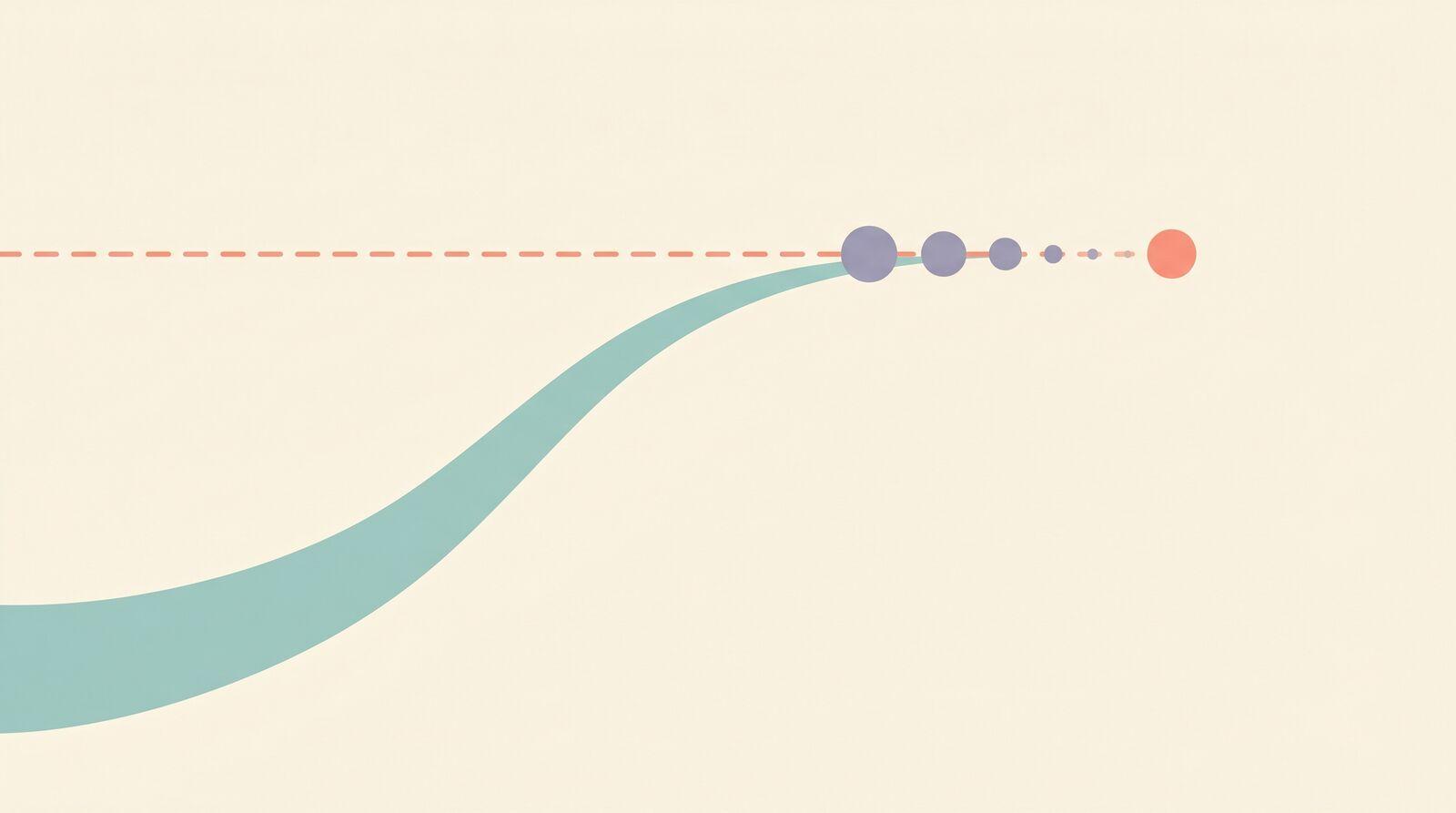
Here is the whole subject in a sentence: calculus works by looking at what happens as something gets infinitely small.
That is it. Every hard part of calculus, every derivative and integral, is really a clever way of asking what a quantity approaches as a step shrinks toward zero. The tool for making that precise is the limit, and a limit is nothing more exotic than the value a process heads toward as you push it to an extreme.
Why does shrinking help? Because complicated things become simple when you zoom in far enough. Zoom in on any smooth curve and it starts to look like a straight line. Slice any curved region into thin enough strips and each strip is almost a rectangle. Calculus takes hard, curvy, changing problems and, by looking at the infinitely small, turns them into easy, straight, constant ones, then adds the pieces back up.
Hold onto that image of zooming in. Both halves of calculus are the same trick applied to opposite ends of the same question.
The First Half: Derivatives Answer "How Fast?"
The first question is about speed of change. When your speedometer reads 100 km/h, it is telling you how fast your position is changing at this exact instant, not over the whole trip. That instantaneous rate of change is a derivative.
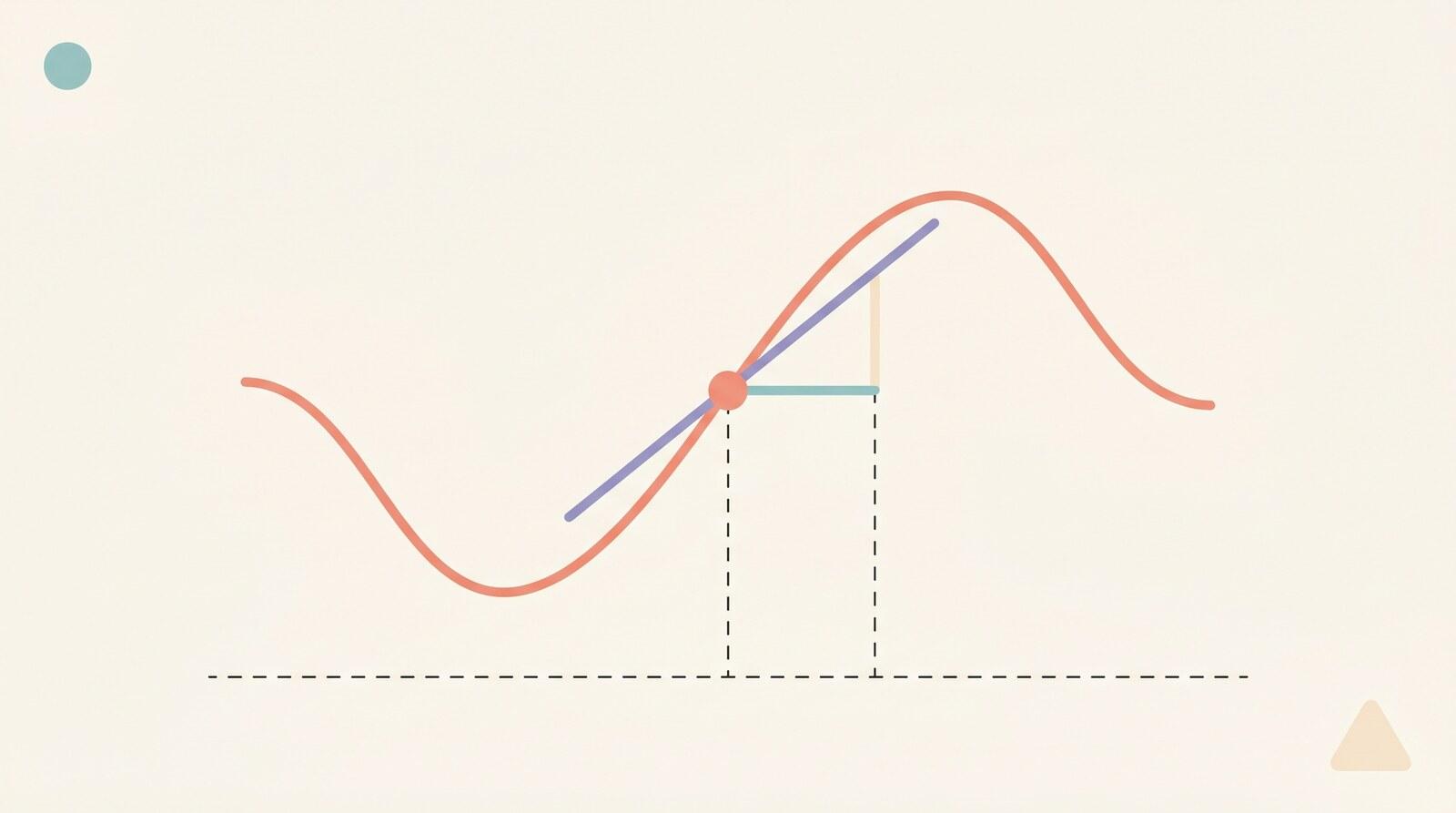
Getting an instantaneous rate sounds impossible at first. Speed is distance divided by time, but at a single instant no time passes and no distance is covered. This is exactly where the zooming-in trick earns its keep. You measure the average rate of change over a small interval, then let that interval shrink toward zero. The average rate homes in on a single value, and that value is the instantaneous rate: the derivative.
Geometrically, the derivative is the slope of the curve at one point, found by zooming in until the curve looks straight and reading off the slope of that line. The familiar rules (the power rule, the chain rule, the product rule) are not arbitrary spells. Each is a packaged shortcut for the same limit, so you do not have to recompute it every time. Once you know that, the rules stop being a list to memorize and become consequences of one idea.
The Second Half: Integrals Answer "How Much?"
The second question runs the other direction. Instead of asking how fast a quantity is changing, it asks how much of it piles up over an interval. If you know your speed at every instant of a trip, how far did you actually travel? Adding up a changing quantity over a stretch is the job of the integral.
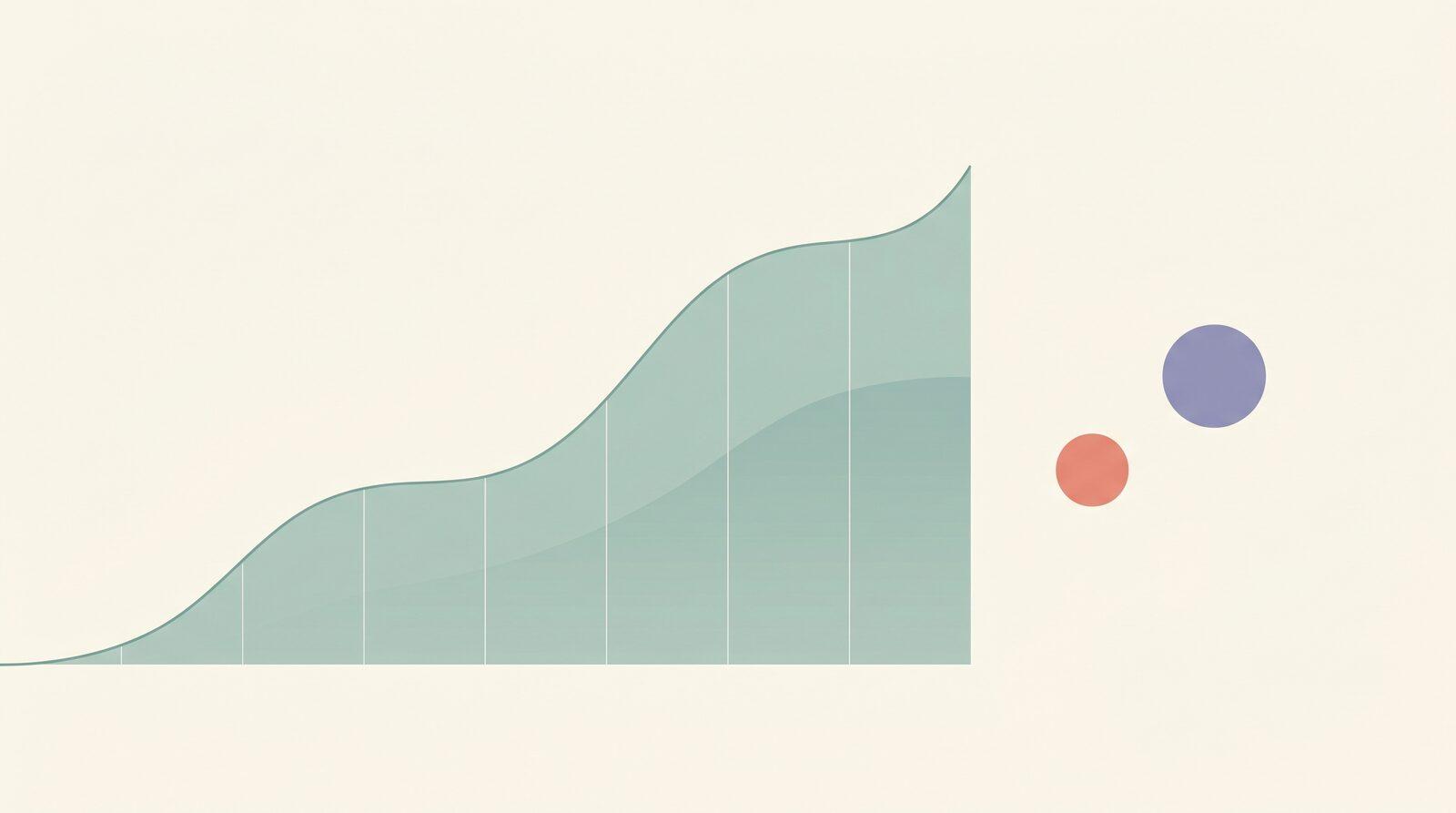
The picture here is area. If you graph your speed against time, the distance you traveled is the area under that curve. But the curve is not a neat rectangle, so how do you find the area of a lumpy, curved region? Same trick, opposite direction. Slice the region into thin vertical strips. Each strip is so narrow that it is essentially a rectangle, and rectangle area is easy. Add up all the strips, then let their width shrink toward zero so the approximation becomes exact. That limit of a sum is the integral.
So the derivative pulls a changing quantity apart to see its rate at each instant, and the integral glues rates back together to see the total. Which raises an obvious question: if one takes apart what the other puts together, are they related?
The Bridge That Ties It All Together
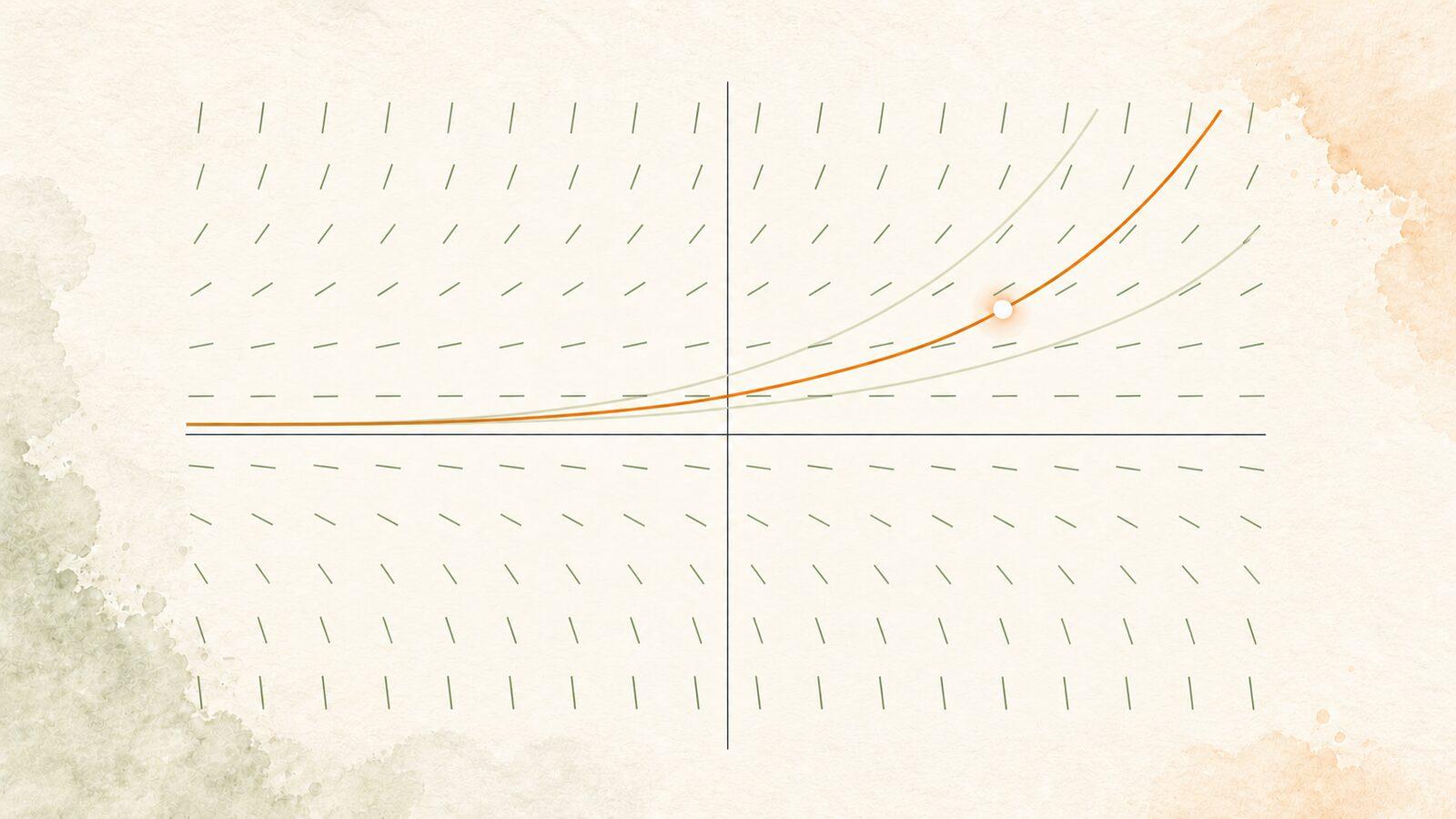
They are, and the connection is one of the most beautiful results in mathematics. It is called the fundamental theorem of calculus, and in plain words it says this: differentiation and integration are inverse operations. They undo each other, the way addition undoes subtraction or squaring undoes a square root.
Think about the trip again. Start with your position over time. Take the derivative and you get your speed at every instant. Now integrate that speed back up over the trip and you recover how far your position changed. You went out and came straight back. The accumulation of all your instantaneous rates of change rebuilds the original quantity.
This is the "zen" of calculus, the moment the two halves click into one. It is also intensely practical. Adding up infinitely many infinitely thin strips directly is a nightmare. But because integration is just differentiation in reverse, you can compute an integral by asking a much friendlier question: what function has this as its derivative? The fundamental theorem turns an impossible-looking sum into a solvable puzzle, and it is the reason calculus is a tool people can actually use rather than a curiosity.
Where Calculus Actually Lives
Once you see calculus as the study of change and accumulation, you start noticing it everywhere:
- Physics runs on it. Velocity is the derivative of position, acceleration is the derivative of velocity, and the distance covered is the integral of velocity. Newton essentially invented calculus to describe motion.
- Economics uses marginal cost and marginal revenue, which are derivatives, to decide how much to produce, and integrals to total up quantities over time.
- Medicine and biology model how drug concentrations rise and fall, how populations grow, and how tumors respond, all in the language of rates and accumulation.
- Engineering and machine learning lean on derivatives constantly. Training a neural network is, at bottom, using derivatives to nudge millions of numbers in the direction that reduces error.
In every one of these, calculus is answering the same two questions from the top of this article: how fast, and how much.
Why Calculus Feels Hard (and How to Fix It)
If calculus rests on one simple idea, why does it break so many students? Almost always for the same reason: it gets taught as a pile of disconnected procedures. Memorize the power rule. Memorize integration by parts. Memorize forty formulas and hope the right one surfaces on the exam. Learned that way, calculus is a memory test with no story, and memory tests are miserable and fragile.
The fix is to keep the big picture in view while you practice the details. Every time you apply a rule, connect it back to the idea it came from. A derivative is always a rate of change. An integral is always an accumulation. Limits are always the zooming-in that makes both precise. When the machinery is anchored to meaning, you can rebuild a forgotten formula from the idea instead of hoping you memorized it correctly.
This is exactly how Math Zen approaches calculus. Instead of front-loading a wall of formulas, it has you solve short problems that build the intuition first, then layer the rules on top of a picture that already makes sense. The adaptive practice keeps you working just below your ceiling and quietly resurfaces the limit, derivative, and integral ideas until they are permanent rather than crammed. Because the sessions are short and you learn by doing rather than watching, the daily practice that calculus genuinely requires actually fits into a real schedule. Calculus rewards steady, connected practice more than almost any other subject, and steady practice is the whole design.
The Bottom Line
Calculus is not a fog of symbols. It is the mathematics of change, built from a single move: look at what happens as a step shrinks to nothing. That one move gives you derivatives, which measure how fast a quantity is changing at an instant, and integrals, which measure how much accumulates over an interval. The fundamental theorem of calculus reveals that these two are inverses, and that single connection is what makes the whole subject work.
Hold that map in your head and the pieces stop being separate. Start with limits, which are the zooming-in itself. Move to derivatives for the "how fast," then to integrals for the "how much," and let the fundamental theorem tie the two together. Calculus was never a wall. It is one clear idea, wearing a lot of notation.
Common Questions
- What is calculus in simple terms?
- Calculus is the mathematics of change and accumulation. It gives you two tools. The derivative measures how fast something is changing at a single instant, like a speedometer reading. The integral measures how much has accumulated over an interval, like the total distance traveled. Almost everything in calculus is built from these two ideas and the way they connect.
- What are the two main branches of calculus?
- Differential calculus and integral calculus. Differential calculus is about rates of change and slopes, and its central object is the derivative. Integral calculus is about accumulation and area, and its central object is the integral. The fundamental theorem of calculus shows that these two branches are really two sides of one coin.
- Do I need to be good at algebra before calculus?
- Yes, comfortable algebra makes calculus far easier, because most of the actual work in a calculus problem is algebra. You need to be fluent with functions, exponents, fractions, and manipulating equations. If those feel shaky, shore them up first. The calculus ideas themselves are more intuitive than the algebra used to carry them out.
- Is calculus really that hard?
- The core ideas are surprisingly simple, and most of the difficulty comes from learning them as disconnected rules instead of one connected picture. Students who see why the rules exist tend to find calculus much easier than students who only memorize them. The reputation for difficulty says more about how calculus is usually taught than about the subject itself.
- What is the fundamental theorem of calculus?
- It is the result that ties the whole subject together by proving that derivatives and integrals are inverse operations. Differentiation breaks a quantity down into its instantaneous rate of change, and integration builds it back up by accumulating those rates. Because the two undo each other, you can solve accumulation problems using the rules of differentiation in reverse.