Absolute Value Equations: Solve Them by Thinking in Distance

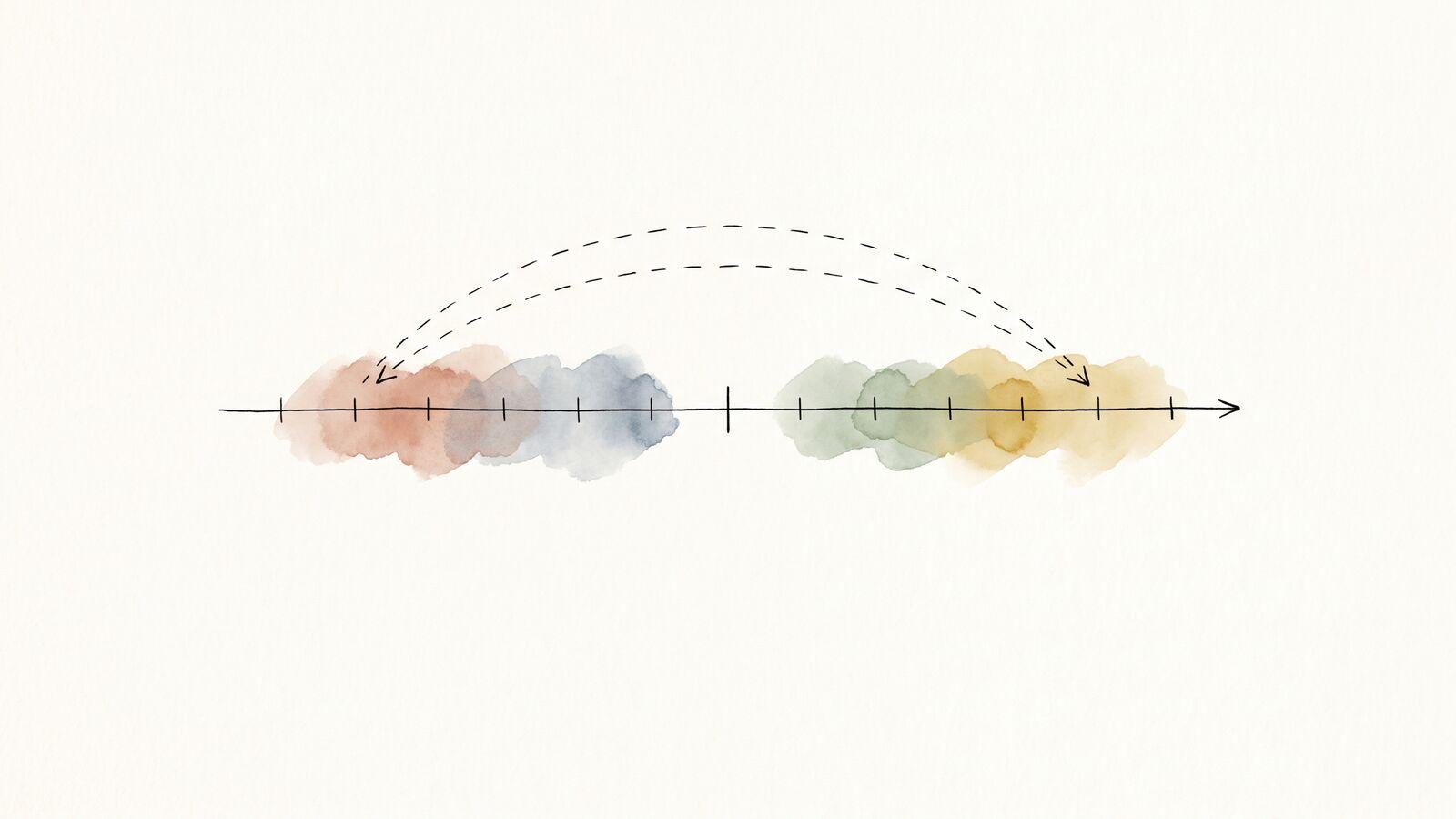
The two bars in often look like another instruction to memorize. Read them as a question instead: how far is this number from zero?
Five is five steps from zero. Negative five is also five steps from zero, just in the other direction. That is why and . Absolute value keeps the distance and drops the direction.
Once that picture is clear, solving an absolute value equation becomes a search for positions at a specified distance. The familiar two cases are a consequence of the number line, not a trick added to algebra.
Distance can be zero, but it cannot be negative
Absolute value gives a nonnegative result. "Nonnegative" matters: zero is allowed, so saying it always makes a number positive is slightly wrong.
For a real number , the definition is:
The second line does not say the answer is negative. If , then . The minus sign reverses the direction of an already negative number. Our negative numbers guide explains that reversal in more detail.
Evaluate the expression inside the bars before applying absolute value:
You cannot generally distribute the bars over subtraction. Here , which is different. The bars surround one complete expression, and its value is what becomes a distance.
Why two answers appear
Consider:
Which points are six units from zero? There are two: and . Both satisfy the equation, and neither is more correct than the other.
Now move the reference point:
The expression measures the signed difference between and 4. Taking its absolute value gives the distance between those two points. Starting at 4, move six units right or six units left:
Check both directly: and .
The reference point need not be positive. In , rewrite the inside mentally as . The center is -3, so the solutions are -1 and -5.
Isolate the bars before splitting
The basic rule for a positive constant is:
Here means the whole expression inside the bars. Before using the rule, isolate that absolute value with the same balance-preserving operations used in ordinary algebra.
Solve this example:
Subtract 4:
Divide by 3:
Now split into two equations:
The first gives , so . The second gives , so .
Checking in the original equation gives and . Both work.
Do not split the original equation by simply changing 25 to -25. The absolute value rule changes the sign of the isolated distance, not the sign of every term in the problem. Paul's Online Math Notes also emphasizes isolation and checking in its treatment of these equations.
Check for no solution before doing more algebra
Suppose the equation is:
Subtracting 5 and dividing by 2 gives:
Stop. No real number has a distance of negative two. Splitting into and would manufacture answers to a different question.
Zero is a separate case:
The inside must be zero, so and . Writing positive zero and negative zero gives the same answer twice.
For an isolated absolute value of a nonconstant linear expression, a positive constant gives two solutions, zero gives one, and a negative constant gives none. Do not extend that shortcut to every possible absolute value equation: the inside might be quadratic, or the right-hand side might contain a variable.
A variable on the right needs a sign check
Now solve:
The left side cannot be negative, so a solution must satisfy , or .
Use the two candidate equations:
The first gives . It fails the sign restriction. Checking the original equation makes the problem visible: the left side is 5, while the right side is -5.
The second gives , so . Substitution gives on both sides. This is the only solution.
Checking is especially useful when an operation can introduce candidates that do not satisfy the original equation. Squaring both sides can do that too: it erases the distinction between a positive and a negative right-hand side.
Two absolute values compare two distances
An equation with bars on both sides can still be simple:
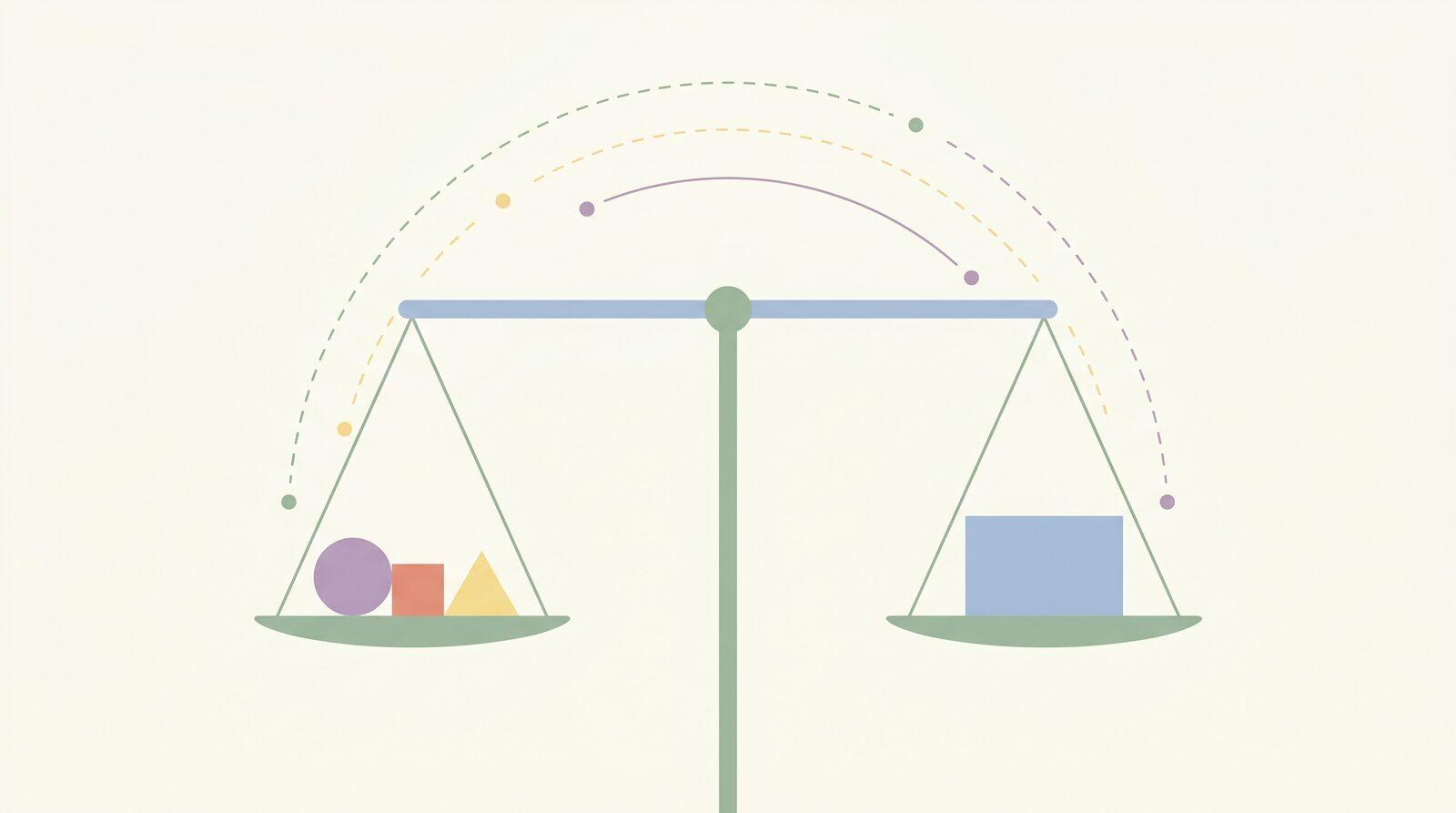
This asks for the point equally far from 1 and -5. On the number line, that point is their midpoint, .
Algebra reaches the same answer. Equal absolute values mean the insides are equal or opposite:
The first equation reduces to , so it has no solution. The second becomes , giving . Its distance from each reference point is 3.
This is different from an equation containing a sum such as . You cannot remove all the bars with one two-case split. Such problems usually need intervals based on where each inside changes sign.
The graph makes the solution count visible
The graph of is a V. To the right of zero it follows . To the left it follows . The point of the V is the vertex.
For , the vertex moves to . Solving means finding where that V meets the horizontal line . There are two intersections, at and .
A horizontal line at zero touches the vertex once. A horizontal line below zero misses the graph entirely. That is the two, one, or zero pattern drawn on a page.
Changing the equality to an inequality asks for a region rather than just intersection points. For example, means the distance from 4 is less than 6, so . Our inequalities guide develops that next step.
A short solving routine
First evaluate anything numerical inside the bars. Then isolate one absolute value, inspect the sign of the other side, and split only when that sign permits it. Solve each case and substitute every candidate into the original equation.
Practice the process in Math Zen's Algebra topic, which includes Absolute Value. Begin with the distance picture before reaching for the two-case rule. If you can explain where the reference point is and what distance the equation demands, the algebra has a clear job to do.
Common Questions
- What does absolute value mean?
- For a real number, absolute value is its distance from zero on the number line. Distance is never negative, so both 5 and -5 have absolute value 5. Zero has absolute value zero.
- Do absolute value equations always have two solutions?
- No. An equation such as |x| = 5 has two solutions, |x| = 0 has one, and |x| = -5 has none. More complicated expressions inside or outside the bars can produce other solution counts.
- Why must I isolate the absolute value first?
- The two-case rule applies to the expression inside one isolated pair of bars. In 2|x - 3| + 1 = 9, first subtract 1 and divide by 2 to obtain |x - 3| = 4. Only then write x - 3 = 4 or x - 3 = -4.