The Monty Hall Problem: Why Switching Doors Doubles Your Chances
In 1990, a reader asked Marilyn vos Savant's magazine column a short question about a game show. Her answer, that you should switch doors, provoked roughly ten thousand letters of protest, close to a thousand of them signed by PhDs, many insisting that a columnist had no business getting basic probability wrong. She was not wrong. They were.
That is what makes the Monty Hall problem worth your time. It is not a trick question, and it does not hinge on fine print. It is a completely fair puzzle with a three-line setup, and it reliably defeats the intuition of intelligent people, including professional mathematicians, until they see the one asymmetry they missed. Once you see it, the answer stops feeling paradoxical and starts feeling inevitable.
The Rules of the Game
The puzzle is modeled on the game show Let's Make a Deal, whose original host, Monty Hall, gave it its name. The setup:
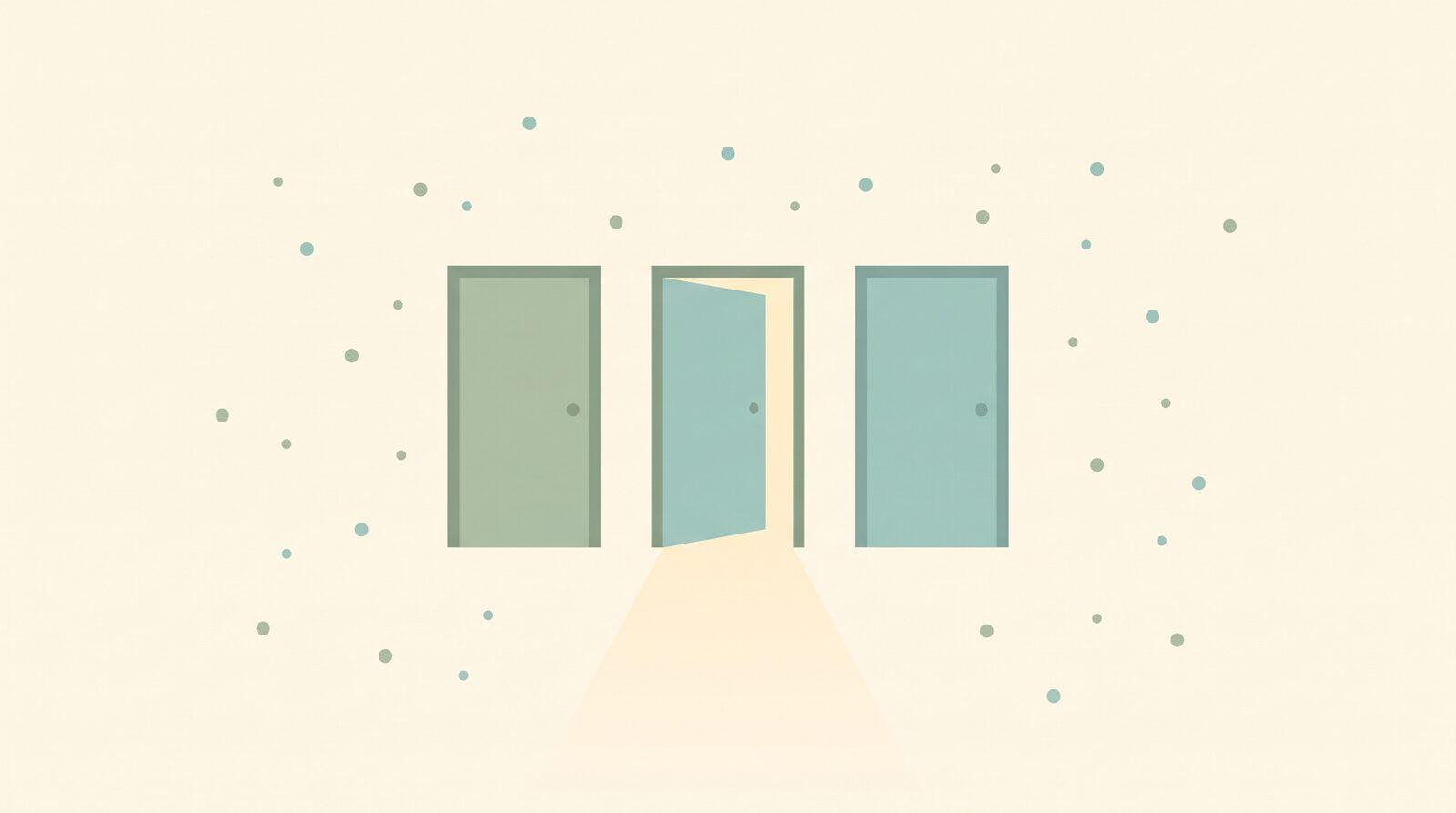
There are three closed doors. Behind one is a car. Behind the other two are goats. The car was placed randomly, so before anything happens, each door has a chance of hiding it.
You pick a door, say door 1. It stays closed.
The host, who knows exactly where the car is, opens one of the two doors you did not pick, and he always opens one with a goat. Say he opens door 3 and a goat looks back at you.
Now two doors remain closed: your door 1 and the untouched door 2. The host offers you a choice. Stay with door 1, or switch to door 2.
Almost everyone's gut says the same thing: two doors, one car, 50/50, so it does not matter. The gut is wrong. Staying wins of the time. Switching wins of the time. The switch literally doubles your chances, and the whole puzzle is understanding where that extra probability comes from.
The Proof Is Just Counting
The cleanest way to see the answer is to notice that the entire game is decided by one event: whether your first pick was right.
Your first pick is right 1/3 of the time, wrong 2/3 of the time
When you chose door 1, the car was equally likely to be anywhere. So with probability the car is behind your door, and with probability it is behind one of the other two. Nothing about this is controversial, and it is the only randomness in the whole game.
Staying wins exactly when your first pick was right
If you stay with door 1, you win the car if and only if the car was behind door 1 all along. That happens with probability . The host's reveal does not move the car, and it does not retroactively improve a guess you made before he did anything.
Switching wins exactly when your first pick was wrong
Suppose your first pick was wrong, which happens of the time. Then the car is behind one of the two doors you did not pick, and the host, who must open a goat door and cannot open yours, has no freedom at all: he is forced to open the one non-car door left, and the door he leaves closed is the car. Switch, and you win. So switching wins in every single case where your first guess was wrong: probability .
That is the entire proof. Staying bets that your blind first guess was right, a event. Switching bets that it was wrong, a event. Those are the only two options, and they are not close.
If you prefer to see every case laid out, fix your choice as door 1 and let the car vary. Car behind door 1: the host opens door 2 or 3, staying wins, switching loses. Car behind door 2: the host must open door 3, staying loses, switching wins. Car behind door 3: the host must open door 2, staying loses, switching wins. Three equally likely worlds, and switching wins in two of them. The count is the proof.
Where the Extra Probability Comes From
The 50/50 instinct comes from a rule of thumb that usually serves you well: two unknowns, no reason to prefer one, so split the probability evenly. The rule is fine. The mistake is thinking the two closed doors are symmetric. They are not, because they had very different histories.
Your door was chosen by you, blindly, before anything was revealed. Nothing that happened afterward involved your door at all: the host was not allowed to touch it, whether it hid the car or not. So no information about your door was ever produced, and its probability stays where it started, at .
The other closed door survived something. The host looked at the two doors you did not pick, at least one of which had a goat, and deliberately eliminated a goat from that pair. The door he left closed is either random junk (in the world where your pick was right) or the car itself (in the world where your pick was wrong). His choice was constrained by the truth, and the constraint leaks information. All of the probability that the pair started with collapses onto its one surviving member.
The 100-Door Version, for the Unconvinced
If the three-door argument still feels slippery, scale it up. Same rules, 100 doors, one car, 99 goats. You pick door 1. The host, who knows where the car is, opens 98 of the remaining doors, every one of them a goat, and leaves exactly one other door closed. Stay or switch?
Your first pick was right 1 time in 100. In the other 99 cases, the car is somewhere in the doors you did not pick, and the host's 98 reveals were forced around it: he opened everything except the car. The single door he left closed is not a random survivor. It is where the car has to be, 99 times out of 100.
Nobody stays in the 100-door game. But the three-door game is the same game. The host's reveal was forced around the car in exactly the same way; there was just less of it to watch. If switching is obviously right at 100 doors, the burden of proof is on whoever claims three doors are different, and the case count above shows they are not.
The Fine Print That Makes the Answer Honest
Here is the part popular retellings usually skip, and it is the difference between knowing the answer and understanding it. The result depends on the host's behavior, not just on what you saw.
The standard rules assume the host always opens a door, always opens a goat, and always offers the switch. Change those rules and the answer changes. The classic variant is sometimes called Monty Fall: the host slips, opens one of the two unpicked doors completely at random, and it just happens to reveal a goat. Same doors, same goat, same picture on your screen. But now switching wins only of the time.
Why the difference? In the standard game, the host reveals a goat in every world, so the reveal does not tell you anything about whether your pick was right, and your door stays at . In Monty Fall, a random host sometimes exposes the car by accident. Seeing a goat is now itself evidence, and it is evidence in favor of your original pick, because worlds where your pick was right could never produce an exposed car. Run the numbers and the two closed doors genuinely end up at each.
Try It, Because Everyone Should Once
The Monty Hall problem has one great mercy: it is cheap to test. Take three cups and a coin, and recruit a friend to be the host, or simulate it yourself with a few lines of code, or on paper with a die to place the car. Play thirty rounds always staying, then thirty rounds always switching.
The result is strangely persuasive in a way arguments are not. Stayers converge to winning about a third of the time, switchers to about two thirds, and after enough rounds the pattern stops feeling like a paradox and starts feeling like the obvious consequence of step 1 above: your first blind pick is usually wrong, and switching cashes in on exactly that. Averages computed over many trials are also where probability statements get their meaning in the first place, a point explored in understanding statistics intuitively.
This is also, historically, how the argument was settled. After the vos Savant firestorm, classrooms across the country ran the experiment, and simulations confirmed to as many decimal places as anyone cared to run. Many of the mathematicians who had written angry letters wrote second, more sheepish ones.
The Zen of It
The Monty Hall problem endures because it is a perfect miniature of how probability actually works and how human intuition actually fails. The instinct it defeats, symmetric ignorance about two closed doors, is a good instinct. It just does not survive contact with an asymmetric history, and the puzzle hides the asymmetry in plain sight: one door was protected by your choice, the other was selected by someone who knew the answer.
Notice what resolved the confusion. Not a formula, and not authority. Counting. Three equally likely worlds, an honest tally of what happens in each, and the willingness to trust the tally over the feeling. That move, enumerate the possibilities and count them, is most of what probability is, and it is learnable.
The next time two options feel obviously 50/50, it is worth asking the Monty Hall question: did these two possibilities get here the same way? Sometimes they did, and the coin flip is real. And sometimes one of them was left standing by a process that knew something, and the odds are quietly, decisively lopsided.
The doors do not remember. The procedure does.
Common Questions
- What is the Monty Hall problem?
- It is a probability puzzle based on the game show Let's Make a Deal. A car hides behind one of three doors, goats behind the other two. You pick a door, the host, who knows where the car is, opens a different door to reveal a goat, and then offers to let you switch to the remaining closed door. The question is whether switching helps. It does: switching wins the car 2/3 of the time, staying wins only 1/3.
- Why is switching better if only two doors are left?
- Because the two remaining doors did not earn their probabilities the same way. Your original door was chosen before any information appeared, so it keeps its original 1/3 chance. The host then deliberately avoided the car when opening a door, which funnels the other 2/3 of the probability onto the one closed door he chose not to open. Two doors remaining does not mean two equally likely doors.
- Does it matter that the host knows where the car is?
- It matters completely. The 2/3 answer depends on the host always opening a door he knows hides a goat. If the host opens a random unpicked door and just happens to reveal a goat, the calculation changes and switching wins only 1/2 of the time. The host's knowledge is what pumps extra probability into the switch, so any version of the puzzle that drops this rule has a different answer.
- What is the 100-door version of the Monty Hall problem?
- Imagine 100 doors with one car. You pick a door, and the host, knowing where the car is, opens 98 of the other doors, all goats, leaving your door and one other closed. Your first pick was right 1 time in 100, so the car is behind the other closed door 99 times in 100. Switching is obviously correct at this scale, and the three-door game is the same situation with smaller numbers.
- Has the Monty Hall answer actually been tested?
- Many times. When Marilyn vos Savant published the 2/3 answer in Parade magazine in 1990, thousands of readers, including mathematicians with PhDs, wrote in to insist the answer was 1/2. Computer simulations, classroom experiments with cards and cups, and straightforward case counting all confirm the same result: over many games, switchers win about twice as often as stayers.
Put This Into Practice
Enjoyed thinking this through?
Math Zen turns this kind of intuition into daily practice, with adaptive problems across 24 math topics.