Understanding the Pythagorean Theorem Intuitively (Why a²+b²=c²)

Most people can recite "" long after they have forgotten what it means. The formula gets memorized for a test, used to plug in two numbers, and then filed away as a piece of trivia about triangles. That is a shame, because the Pythagorean theorem is one of the most quietly useful ideas in all of mathematics, and the picture behind it is far more memorable than the symbols.
This article is not about memorizing the formula faster. It is about seeing what the theorem is actually claiming, why that claim has to be true, and why once you understand it you stop needing to memorize it at all. Distance on a map, the diagonal of a TV screen, whether a corner is truly square: they all run on the same single idea.
The Squares Are Real Squares
The first thing that unlocks the theorem is realizing that the "squared" in a squared is not just a mathematical operation. It is a literal square.
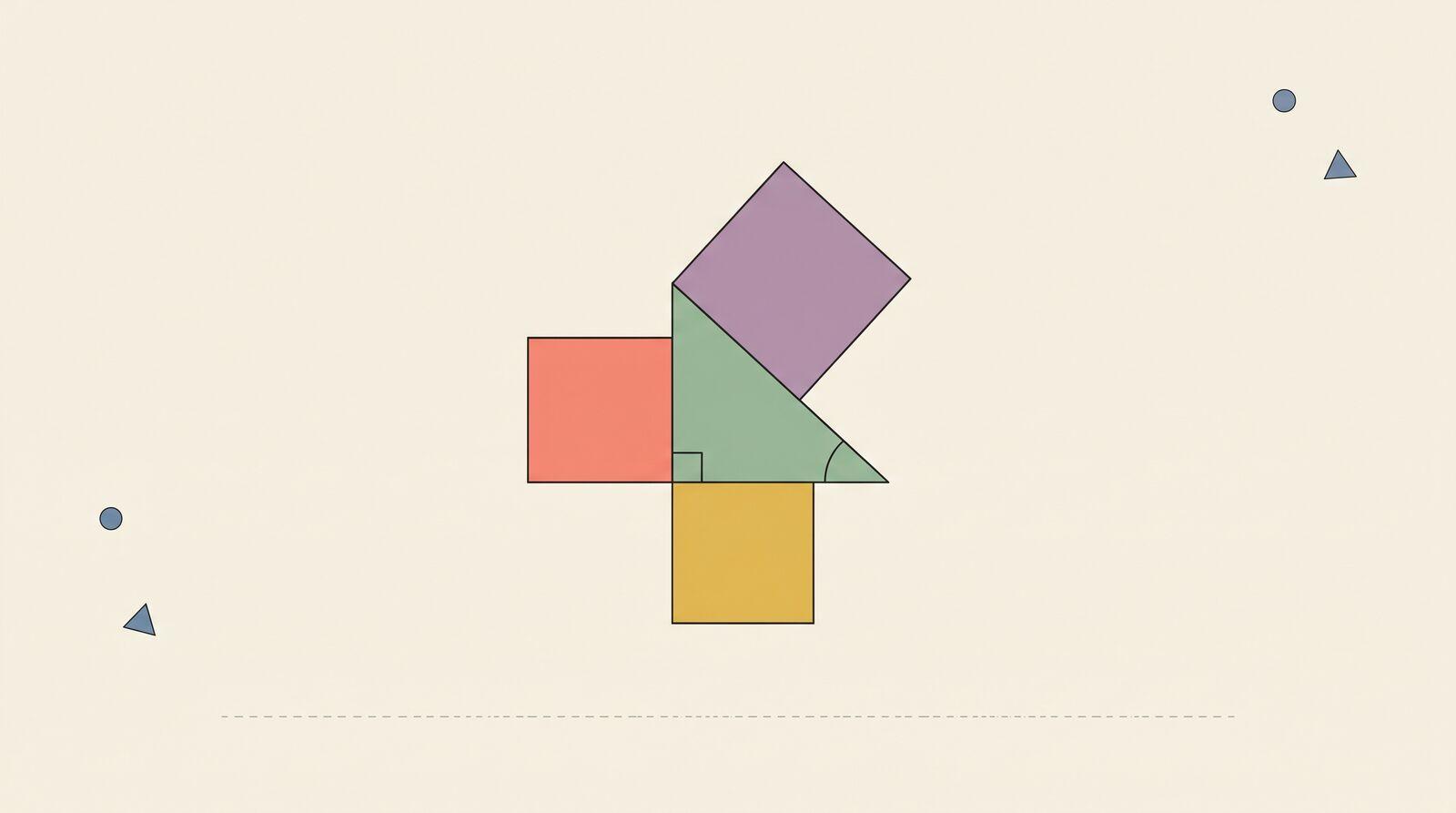
Take a right triangle, a triangle with one 90 degree corner. Now draw an actual square on each of its three sides, using each side as one edge of a square. You end up with three squares of different sizes. The two smaller ones sit on the two short sides (the legs), and the biggest one sits on the longest side (the hypotenuse, the side across from the right angle).
The Pythagorean theorem makes a claim about area: the area of the big square equals the combined area of the two smaller squares. That is the whole theorem, stated without a single variable. When you write it as , each term is just the area of one of those squares, because the area of a square is its side length times itself. Understanding why we square each side, rather than just adding the lengths, comes straight from how exponents really work: squaring a length gives you an area, and it is the areas that add up, not the lengths.
Why the Theorem Is True (A Picture, Not a Proof to Memorize)
Here is a way to see the truth of it without algebra. Imagine a large square and place four identical right triangles inside it, arranged so they leave an empty tilted square in the middle. The empty middle square has area c squared, where c is the hypotenuse of each triangle.
Now slide those same four triangles into a different arrangement inside the same large square. This time they cluster into two corners and leave two empty squares behind, one of area a squared and one of area b squared. The outer square never changed size, and the four triangles never changed size, so the empty space must be identical in both arrangements. In the first it was c squared. In the second it was a squared plus b squared. They are the same leftover space, so a squared plus b squared must equal c squared.
That rearrangement is the heart of it. You are not asked to trust a formula handed down from a textbook; you are watching the same area get counted two different ways. This is the kind of "why" that makes a result stick, the same way understanding the reasoning behind a geometric rule beats memorizing it, a theme we return to throughout our intuitive geometry guide.
It Only Works for Right Triangles
A crucial detail that often gets lost: the theorem is true only when the triangle has a right angle. The 90 degree corner is not a side condition, it is the whole reason the squares balance.
If you take a triangle with no right angle and try , it simply will not hold. Open the angle wider than 90 degrees and the longest side grows faster than the formula predicts; pinch it narrower and the longest side falls short. The general fix is the law of cosines, which is just the Pythagorean theorem with an extra term that corrects for how far the angle is from 90 degrees. When the angle is exactly 90, that correction term vanishes and you are back to the clean version. So the Pythagorean theorem is not a separate rule from the rest of triangle math; it is the special, tidy case at the center of it.
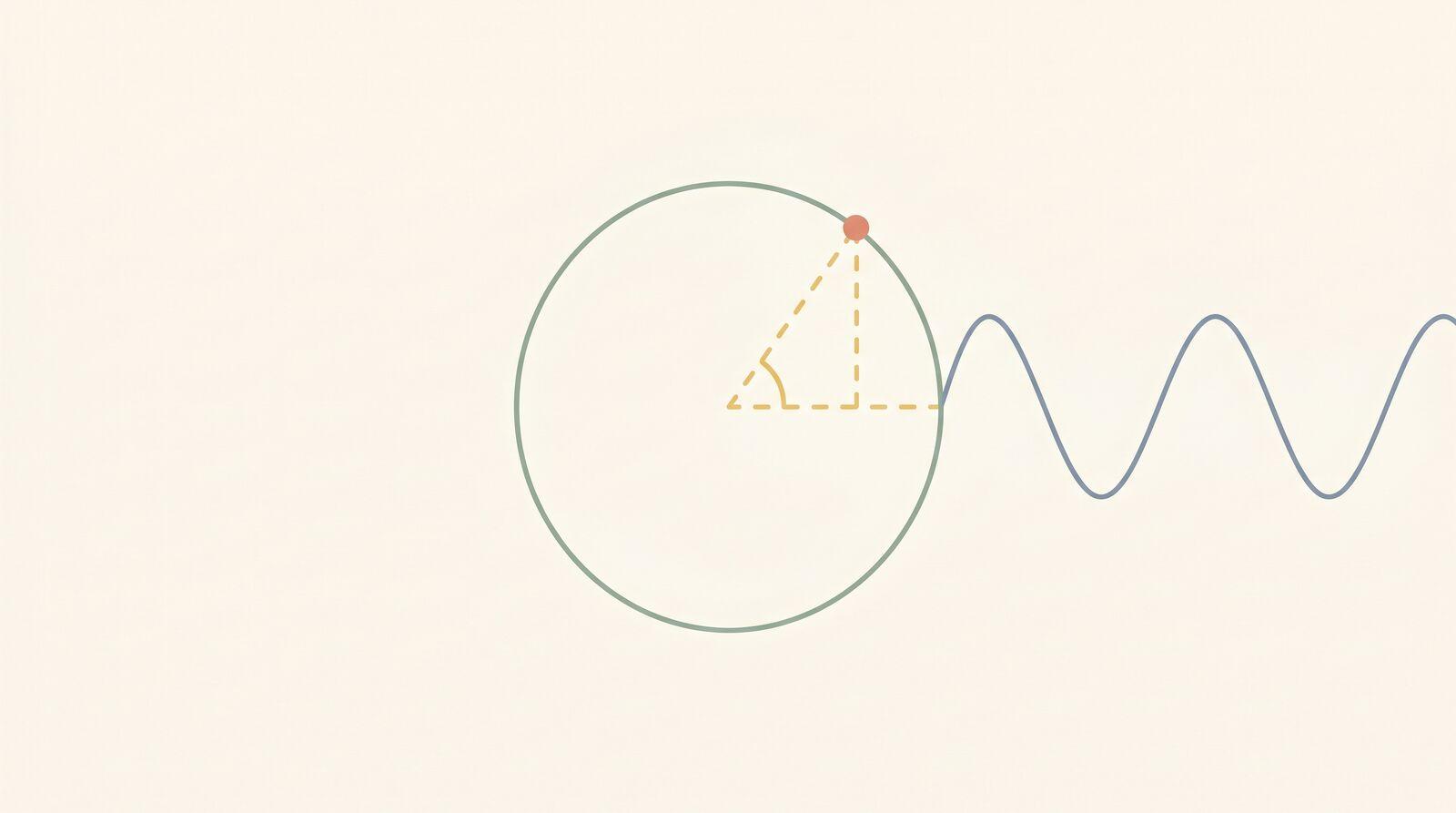
This is also the bridge to trigonometry. The sine and cosine of an angle are defined using the sides of a right triangle, and the identity is the Pythagorean theorem applied to a triangle whose hypotenuse is 1. The theorem you learn for measuring fences turns out to be the same one running underneath the trig you meet years later.
Reading the Formula Both Directions (Finding Any Side)
Once you see the theorem as a balance of areas, using it stops being about remembering a procedure and becomes about keeping the balance.
To find the hypotenuse, you have the two legs and you want the long side. Square both legs, add them, and take the square root. A triangle with legs 3 and 4 gives 9 plus 16, which is 25, and the square root of 25 is 5. The famous 3, 4, 5 triangle.
To find a leg, you already have the hypotenuse and one leg, and you want the other. Now you subtract instead of add: take the hypotenuse squared and remove the known leg squared, then take the square root. If the hypotenuse is 13 and one leg is 5, then 169 minus 25 is 144, and the square root of 144 is 12. The move is identical; you are just solving for a different square in the same balanced equation. Take the square root last, after you have isolated the unknown square, and the direction of the problem never trips you up.
Where the Theorem Shows Up in Real Life
The reason this theorem has survived for thousands of years is that right angles are everywhere, so a tool for measuring across them is endlessly handy.
Builders check whether a corner is truly square by measuring 3 feet along one wall and 4 feet along the other; if the diagonal between those marks is exactly 5 feet, the corner is a perfect right angle. A 55 inch television is measured along its diagonal, which is the hypotenuse of the rectangle its screen forms. A ladder leaning against a wall, the shortest walking path across a rectangular park, the straight line distance between two points on a map: each is a right triangle waiting for the same formula. Once you start noticing right angles, you start noticing places the theorem quietly applies.
Connecting It to Distance, Coordinates, and Trig
One of the most important appearances of the theorem is the distance formula on a coordinate grid. To find the straight line distance between two points, you look at how far apart they are horizontally and how far apart they are vertically. Those two gaps are the legs of a right triangle, and the distance you want is the hypotenuse. So the distance formula is not a new thing to memorize; it is the Pythagorean theorem written for points on a grid.
This is why the theorem keeps reappearing as math gets more advanced. Vectors, the equation of a circle, the magnitude of a complex number, the length of a curve in calculus: all of them lean on the same "square the parts, add them, take the root" pattern. Learning it well now pays off many times over, because so much later mathematics is this one idea in new clothing.
Where People Get Stuck
A few predictable confusions cause most Pythagorean mistakes, and naming them defuses them.
The most common is adding the lengths instead of the areas. Lengths 3 and 4 do not make a hypotenuse of 7; the areas 9 and 16 make 25, and the hypotenuse is 5. The squaring is the entire point, so skipping it is the fastest way to a wrong answer.
The second is mixing up which side is the hypotenuse. The hypotenuse is always the longest side and always sits directly across from the right angle. If you label the wrong side as c, the balance breaks. A quick sanity check: the hypotenuse must be longer than either leg, never shorter.
The third is forgetting to take the square root at the end. Students find a squared plus b squared, get 25, and write 25 as the answer instead of 5. The squared terms are areas; the side length is the square root of that area, so the root is the final, non-optional step.
Practicing Until It Is Automatic
Reading the explanation gives you the picture. Making the theorem automatic is a separate job, and it rewards short, repeated practice far more than one long session.
Recognize the right triangle first. Before reaching for the formula, find the 90 degree angle and identify the hypotenuse across from it. Half of getting these problems right is correct setup, not arithmetic.
Mix the directions. Do not solve ten "find the hypotenuse" problems in a row. Alternate between finding the long side and finding a leg so your brain learns to decide whether to add or subtract. As we cover in the spaced repetition post, this kind of mixing builds recall that actually lasts.
Learn a few Pythagorean triples. Whole number triangles like 3, 4, 5 and 5, 12, 13 and 8, 15, 17 show up constantly. Recognizing them lets you check answers instantly and spot when a problem is built from a familiar pattern.
Where Math Zen Fits In
Math Zen's bucket progression is built for exactly this kind of "understand it, then make it automatic" topic. Early buckets anchor the meaning, that the squares are real areas and the areas are what balance. Middle buckets drill clean triples and simple find-the-side problems with friendly numbers, mixing the two directions so you practice deciding, not just computing. Later buckets bring in the distance formula, coordinate problems, and word problems that test whether the intuition has truly taken hold.
Because the practice is short and spaced, you build the pattern recognition that turns the Pythagorean theorem from a formula you half remember into a tool you reach for without thinking, and you do it without the cram-and-forget cycle that convinces so many people they are "not a math person."
The Bottom Line
The Pythagorean theorem says that for a right triangle, the square on the longest side equals the two squares on the shorter sides added together. The squared terms are real areas, which is why you square the sides instead of just adding their lengths, and the theorem is true because the same leftover area can be counted two different ways. It works only for right triangles, the hypotenuse is always the longest side across from the right angle, and the square root is always the last step.
Get the picture of the three squares fixed in your mind and you will never again need to memorize . You will simply see it, on a TV screen, a map, a leaning ladder, or a coordinate grid, and know exactly what to do.
Common Questions
- What does the Pythagorean theorem actually say?
- It says that in any right triangle, the area of the square built on the longest side equals the combined area of the squares built on the other two sides. Written with side lengths, that is $$a^{2} + b^{2} = c^{2}$$, where c is the hypotenuse, the side opposite the right angle.
- Why is it a squared and b squared, not just a and b?
- Because the relationship is about areas, not lengths. The squared terms are literally the areas of squares drawn on each side. The lengths a and b do not add up to c, but the areas do, which is why the theorem only works once you square each side.
- Does the Pythagorean theorem work for all triangles?
- No. It only holds for right triangles, meaning triangles with one 90 degree angle. For triangles without a right angle, the relationship breaks, and you need the law of cosines instead, which is the Pythagorean theorem with a correction term added.
- How do I find the hypotenuse versus a shorter side?
- To find the hypotenuse, add the squares of the two shorter sides and take the square root. To find a shorter side, subtract the known short side squared from the hypotenuse squared, then take the square root. The structure is the same; you just rearrange before taking the root.
- What is the distance formula and how is it related?
- The distance formula measures the straight line between two points on a grid. It is the Pythagorean theorem in disguise: the horizontal gap and vertical gap between the points are the two legs of a right triangle, and the distance is the hypotenuse.