Trigonometry Practice Problems: Triangles, Circles, and Angles
 Ivan Terekhin

A right triangle has legs of 5 and 12. Which one is opposite the angle in the question? Without that label, a correct Pythagorean calculation can still lead to the wrong sine. In the unit circle, a familiar reference angle can fail for a different reason: the magnitude is right but the quadrant sign is wrong. These are errors you can catch before a calculator gives you a plausible answer.
This is a practice set, not another introduction to sine and cosine. Try each question before reading the solution. The five worked problems progress from side ratios to unit-circle coordinates, angle units, an inverse-trig quadrant and a simple measurement. A diagnostic table and two self-checks let you identify which step went wrong. If the picture is still unclear, first read trigonometry explained intuitively. For non-right triangles with missing sides or angles, use the separate law of sines and cosines guide.
A three-line setup before each problem
Write down three things: the angle and its quadrant; the unit, degrees or radians; and the known sides or coordinates. In a right triangle, label opposite, adjacent and hypotenuse relative to the specified acute angle. The OpenStax right-triangle definitions give , and .
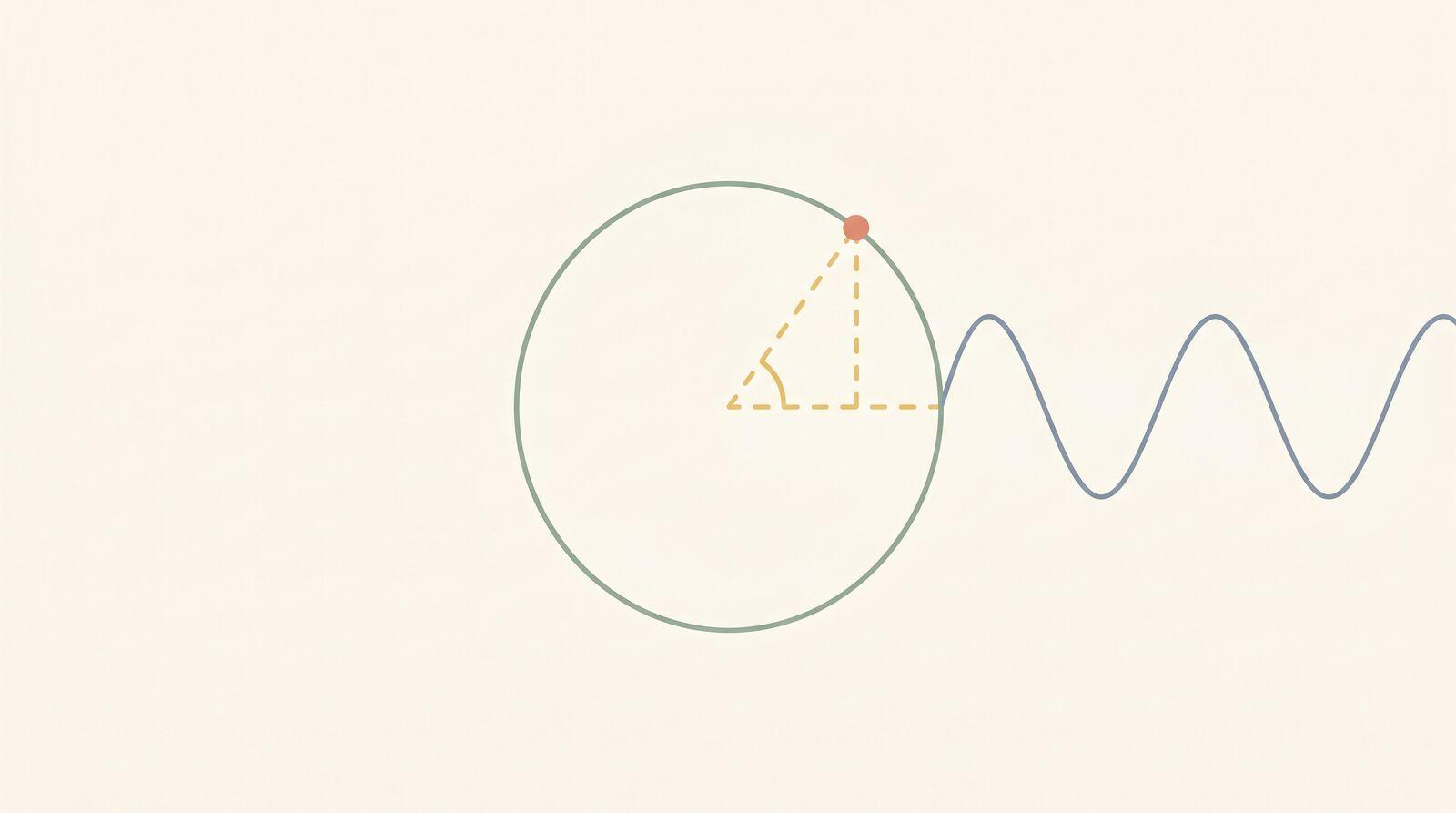
On the unit circle, is the horizontal coordinate and is the vertical coordinate. The OpenStax unit-circle section uses those coordinates to find exact values and signs in different quadrants. A reference triangle gives the size of a value; the quadrant supplies its sign.
Do not switch between degrees and radians halfway through a calculation. The identity is enough to convert either way. The choice of unit matters especially when you use an inverse-trig button on a calculator: a degree-mode answer is in degrees, while a radian-mode answer is in radians.
Problem 1: label a right triangle before taking ratios
A right triangle has legs of length 5 and 12. Let be the acute angle opposite the side of length 5. Find , and exactly. Then check one result.
First find the hypotenuse from the Pythagorean theorem:
Relative to , the opposite side is 5, the adjacent side is 12, and the hypotenuse is 13. Apply the three ratios:
Check that . If you got for sine, you labelled the angle at the other acute corner. The side lengths were fine; the angle label was not. Both acute angles belong to this triangle, but they produce different ratios.
Problem 2: a reference angle does not determine the sign
Find the exact values of , and . Give the sign before the magnitude.
The angle is , in quadrant II. Its reference angle is , or . The reference triangle gives magnitudes for sine and for cosine. In quadrant II, the vertical coordinate is positive and the horizontal coordinate is negative, as in the OpenStax unit-circle construction. Therefore:
The tangent sign is negative because sine and cosine have opposite signs. A positive for cosine is the value at the reference angle, not at . A quick coordinate sketch in quadrant II catches the error without memorizing another row of a chart.
Problem 3: convert the unit, then locate the quadrant
Convert to radians and find its unit-circle coordinates, sine and cosine. This problem uses the same circle as Problem 2 but tests a different failure point: unit conversion before choosing signs.
Multiply degrees by and simplify:
Since , the terminal side lies in quadrant III and the reference angle is . Both coordinates are negative. Thus the point is , giving
Check: is greater than and less than , also quadrant III. If a calculator returns a different-looking decimal, check its angle mode before changing the exact answer. The OpenStax unit-circle guide relates these radian angles to coordinates.
Problem 4: inverse sine gives a reference, not every angle
Suppose , is in quadrant II, and . Find to two decimal places, then find exact and .
A calculator in degree mode gives the principal inverse-sine value . But that is in quadrant I. The requested angle is in quadrant II, where sine is still positive:
The reference triangle has opposite side 3 and hypotenuse 5. The other leg is . Quadrant II makes cosine negative, so
Check that and that is indeed in quadrant II. The OpenStax inverse-trig section explains why returns a principal value from a restricted range. The calculator has not found the wrong reference angle; it has answered a narrower question than the one asked here.
Problem 5: use a triangle to measure a ramp
A straight ramp rises 1.5 m vertically and makes an angle of with level ground. Assume it forms a right triangle. Find the ramp length and horizontal run. These are geometric lengths, not design recommendations for a usable or accessible ramp.
The rise is opposite the given angle; the ramp is the hypotenuse. Start with sine:
Then use cosine for the horizontal run :
The Pythagorean check is . Dividing the rise by cosine would mix up opposite and adjacent. If the question had supplied a non-right triangle, this ratio method would no longer be sufficient; see the law-of-sines and law-of-cosines examples.
Diagnose the wrong answer
| Answer or habit | What went wrong | One check that splits the possibilities |
|---|---|---|
| Sine is in Problem 1 | Opposite and adjacent were swapped | Point to the angle opposite side 5 before taking a ratio |
| Cosine is in Problem 2 | Reference-angle magnitude was used without quadrant sign | Sketch quadrant II and mark the horizontal coordinate negative |
| became | Degrees-to-radians factor or simplification failed | Compare with and |
| Problem 4 ends at | Principal value was mistaken for the required quadrant-II angle | Check the stated quadrant before accepting the calculator result |
| Ramp length is less than its horizontal run | Hypotenuse or ratio was misidentified | The hypotenuse must be the longest side |
The table gives a specific repair, not just a red mark. Check the angle label first, then the unit, then the quadrant and ratio. That order isolates the source of a wrong answer faster than re-entering the same numbers. The intuitive trigonometry guide remains the place to rebuild the picture if every row feels unfamiliar.
Try two more before reading the solutions
Exercise A. In quadrant II, . Find exact and .
Solution. On a unit circle, . Sine is positive in quadrant II, so . Then . Choosing a negative sine would put the point in a different quadrant.
Exercise B. Convert to degrees and find exact sine and cosine.
Solution. . Its reference angle is , and quadrant III makes both coordinates negative: and . The angle is greater than but less than , which confirms the quadrant.
After checking your working, continue with trigonometry practice in Math Zen. Note the error type beside each problem: side label, unit, quadrant, inverse-function range, or arithmetic. Repeating the type you missed is more useful than doing five more copies of a problem you already solve reliably.
Edited by Ivan Terekhin, drafted with AI tools.