Partial Derivatives: Practice Problems with Worked Solutions
 Ivan Terekhin

Find both partial derivatives of . If your answers are and , you have thrown away a coefficient and an entire term. Holding a variable constant means treating it like a number, not deleting everything containing it. The correct pair is and .
This practice set starts with that mistake and builds toward products, nested functions, mixed partials and numerical checks. Try each problem before reading its solution. Write the variable you are holding fixed beside your first line; that small annotation makes many wrong answers easier to spot.
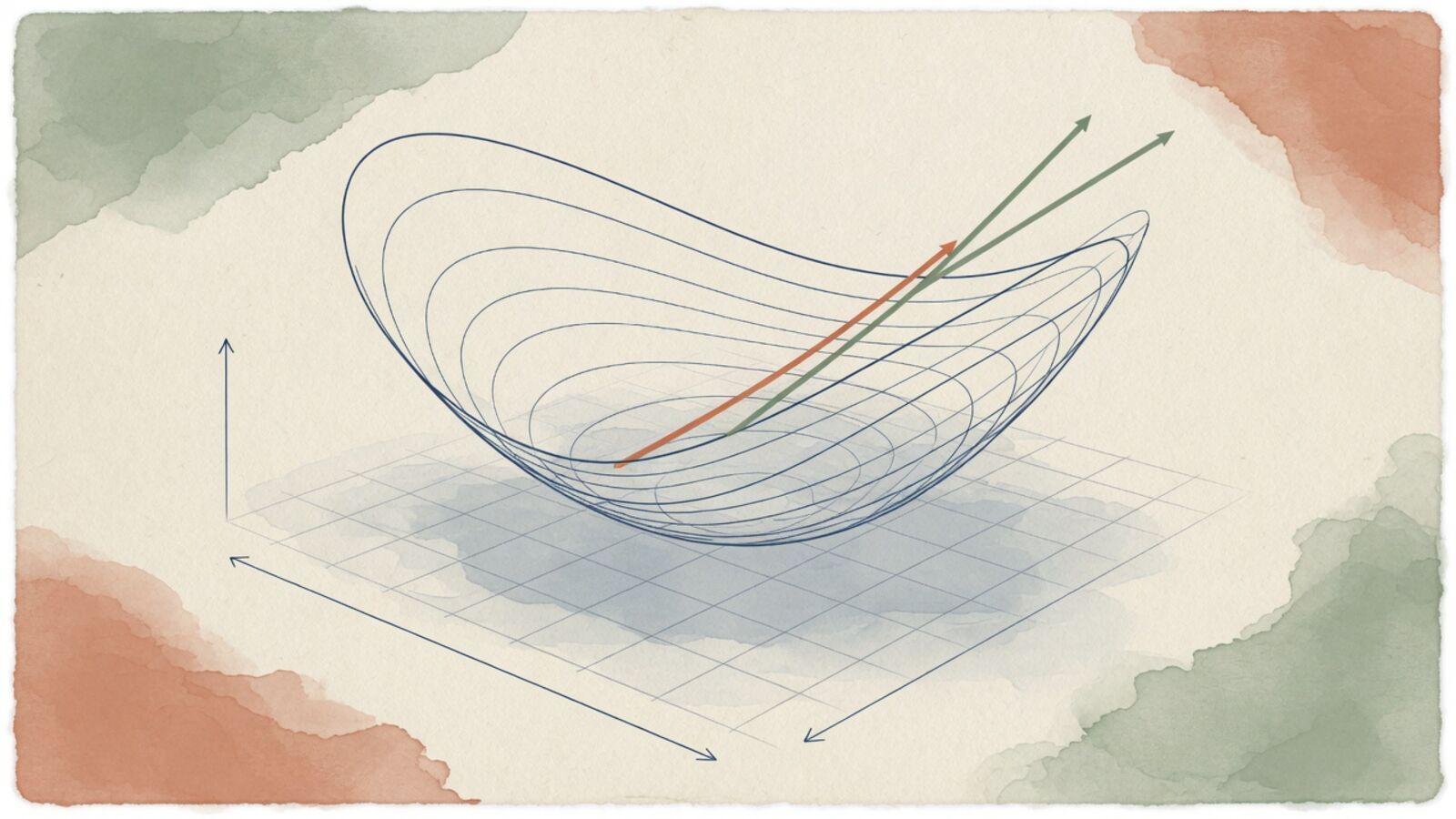
For the picture behind the calculation, use the intuitive partial-derivatives guide. Here the emphasis is on doing the algebra and checking the result, rather than introducing surfaces and gradients again.
The rule to write above your working
For , differentiate with respect to while treating as a constant. For , reverse those roles. The OpenStax definition of partial derivatives makes the fixed input explicit in the difference quotient. Ordinary differentiation rules then apply to the variable that is changing.
For example, when is fixed, is a constant, but is a constant multiplied by . Their derivatives with respect to are therefore different:
Do not substitute both coordinates before differentiating. Substituting a whole point turns the expression into a number and loses the nearby variation you need. Differentiate first, then evaluate. Substituting only the fixed coordinate is fine and gives a useful independent check.
Problem 1: a polynomial with two independent inputs
Find and for
then evaluate both at .
With respect to x: hold still. The coefficients of and are and . The final term does not change:
With respect to y: hold still. The first term is linear in , the second is quadratic, and the third is linear:
At the requested point,
Both derivatives are negative there. Their signs alone do not tell you the function value: height and slope are different quantities. To check the first answer independently, set in the original function. You get , whose ordinary derivative is . At it is again .
Problem 2: a product and an exponential
Find both partial derivatives of
For , both factors depend on , so apply the product rule. The exponential also needs the chain rule: with fixed, the derivative of is .
For , the factor is constant. Only the exponential changes, and the derivative of its exponent with respect to is :
At , these become and . A common wrong answer is . It differentiates the first factor and forgets that the second factor also depends on . Another wrong answer replaces the inner derivative by 1 in both calculations, losing the distinction between and .
If you need more practice identifying an inner function, the chain-rule examples separate each layer before recombining the factors.
Problem 3: logarithms, fractions and the domain
Let
The logarithm requires , so the origin is excluded. Everywhere else, differentiate the inside and divide by the inside:
At the denominator is 6, so both derivatives equal . That equality is specific to this point. It does not mean the two derivative functions are identical.
The denominator is a useful warning. Neither the original function nor these formulas has a value at . A calculation that returns zero there has substituted into an undefined fraction. Check the domain before evaluating, especially when an exercise combines roots, logarithms and quotients.
Problem 4: mixed partials in both orders
Take
In this guide, means differentiate first with respect to , then with respect to . Write the intermediate derivative to make the order unambiguous:
Now differentiate that expression with respect to . The second term needs a product rule:
Reverse the calculation:
The answers agree. Here all the relevant derivatives are continuous, so the equality is also expected from the mixed-partial theorem described in OpenStax. Do not treat agreement as an unconditional rule for every imaginable function. In an ordinary smooth exercise it is an excellent check; at a point where regularity fails, the theorem's assumptions matter.
Problem 5: a third variable is another fixed input
For
find all three first partial derivatives. Keeping two inputs fixed gives
At the values are 4, 0 and 1. The zero in the middle is not a statement that the function never depends on . It says the first-order rate in that direction is zero at this particular point. Substituting into the original expression confirms that the slice is simply when .
A numerical check that catches a missing factor
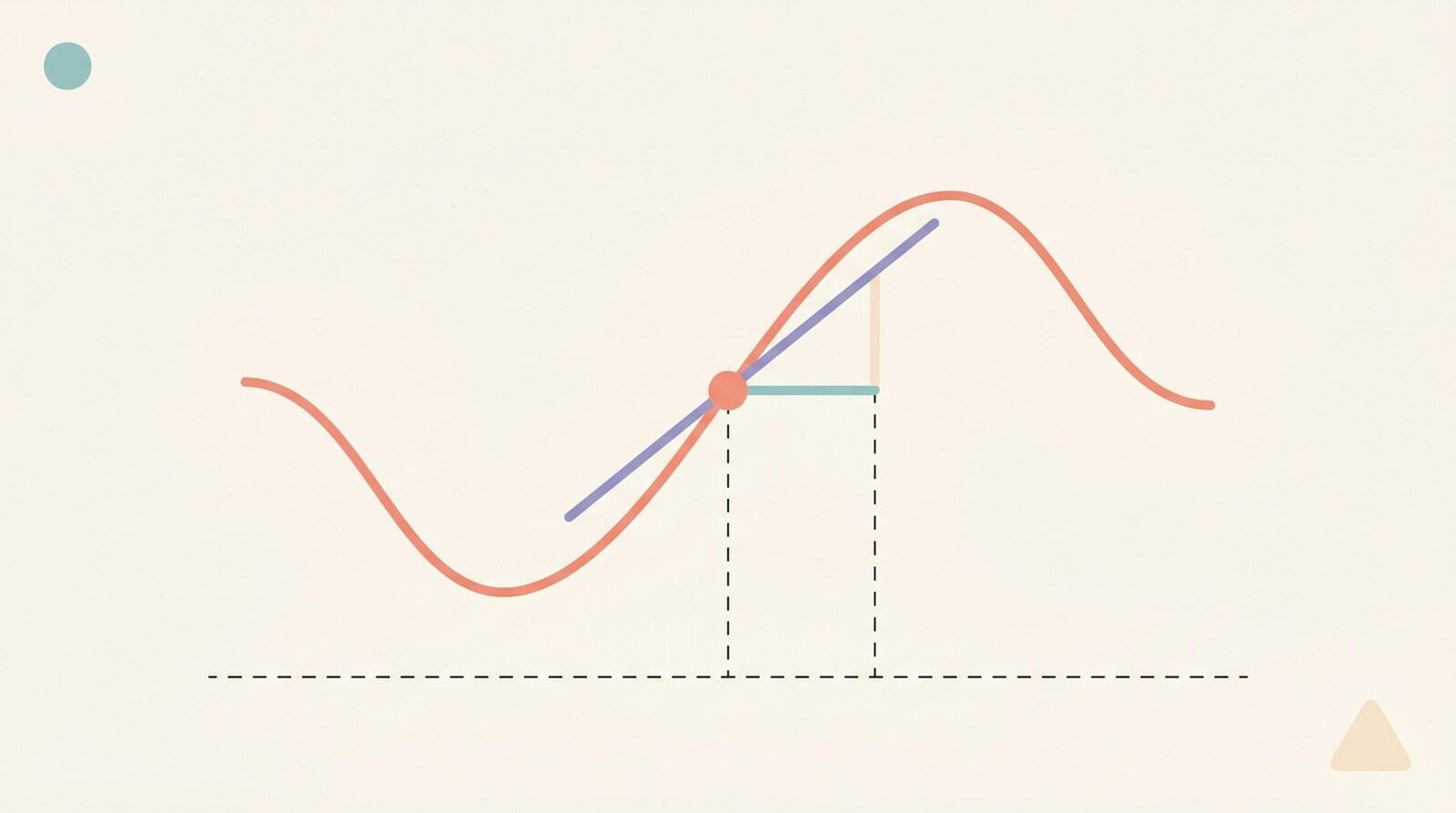
Return to Problem 1 at . Keep , take a small positive number , and calculate the centred difference
For this polynomial, expanding the numerator gives exactly . The resulting checks are:
| Step s | Numerical slope | Exact partial derivative |
|---|---|---|
| 0.1 | -7.96 | -8 |
| 0.01 | -7.9996 | -8 |
| 0.001 | -7.999996 | -8 |
This is a check on a symbolic answer, not a proof of a derivative formula. It also checks only the chosen point. If you accidentally change both coordinates in the numerator, you are measuring change along a different path. With floating-point arithmetic, an extremely tiny step can introduce cancellation error, so do not assume that more zeroes always improve the test.
Diagnose the wrong answer before starting over
| Your result | Likely missed step | One useful check |
|---|---|---|
| A coefficient containing y vanished from f_x | A fixed variable was treated as zero | Replace y by 2 and differentiate the slice |
| Only one term appears in g_x | Product rule omitted | Mark both x-dependent factors |
| h_y has 2y in its numerator | Inner derivative of 2y² lost a factor | Differentiate that expression on its own |
| Mixed partials disagree for the smooth p above | Product or chain rule missed on the second pass | Keep the intermediate first derivative visible |
| Every evaluated derivative is zero | Both coordinates were substituted too early | Differentiate the function before inserting the point |
Use the table to correct the specific step rather than rewriting all the algebra. If ordinary derivative rules still cause mistakes, the derivatives introduction is the prerequisite to revisit.
Try two more, then compare your working
Exercise A. Find and for and evaluate at .
The derivatives are and . At the point, they are and . The term disappears only from the x-derivative. In the y-derivative, it contributes .
Exercise B. Find both first partials of and evaluate at .
The chain rule gives and . The positive sign in the second answer comes from two negatives: differentiating cosine gives one, and differentiating with respect to gives another. Both values at the origin are zero, even though their formulas differ.
Once these calculations are comfortable, continue with partial-derivative practice. Keep a short record of the error type you corrected: fixed input, product rule, inner derivative, or premature substitution. That record tells you which kind of problem to repeat next.
Edited by Ivan Terekhin, drafted with AI tools.