Implicit Differentiation: Worked Examples and Tangent Checks
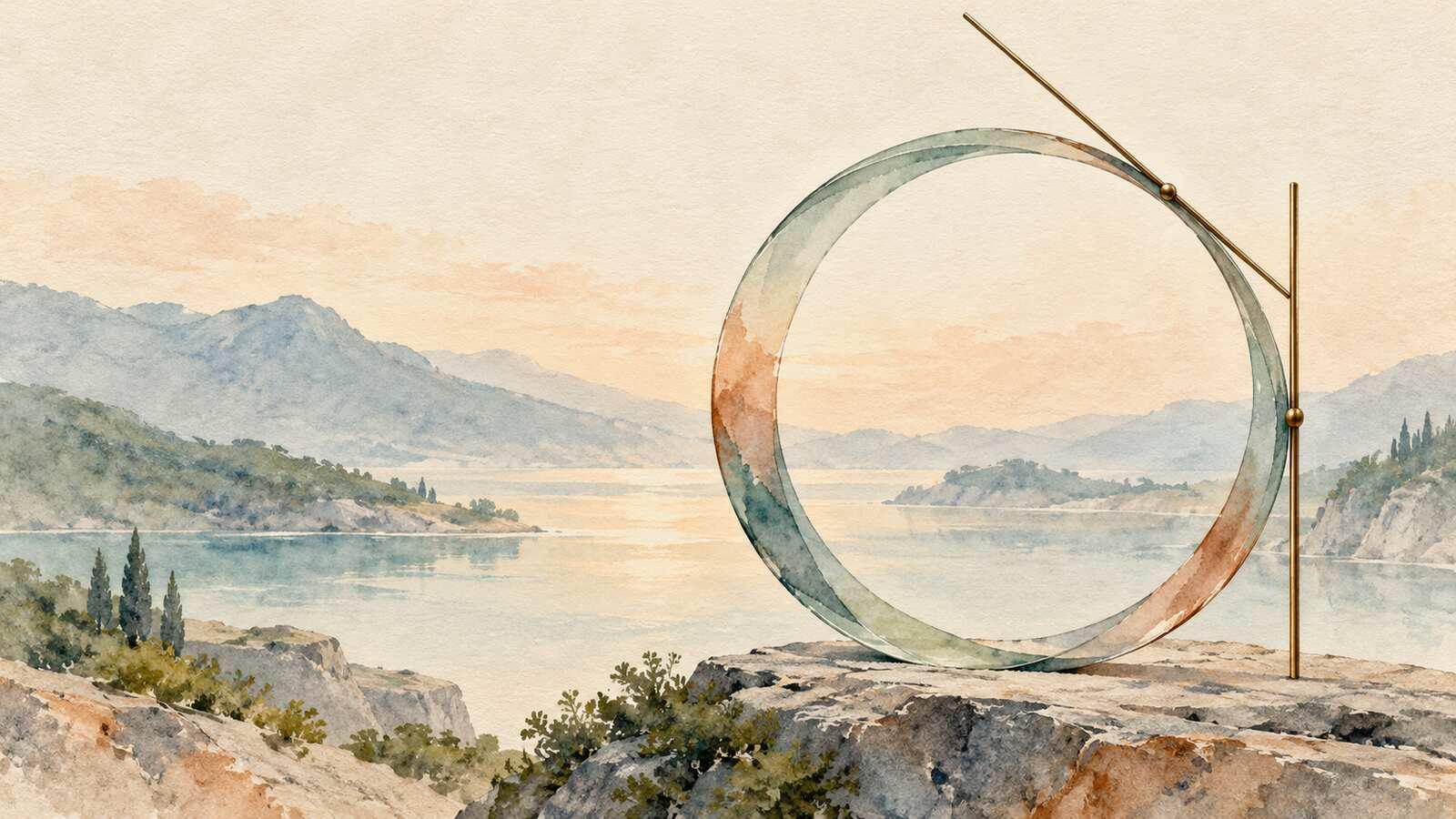
The equation describes a circle. It does not present as one formula in : its upper and lower halves give different values of for most . Yet you can still find the slope at a point on either half. Implicit differentiation differentiates the relation itself, while treating locally as a function of . This guide works through the calculation, checks each answer against its original equation, and shows exactly where the usual slope formula stops working.
If you need the idea of slope first, read what a derivative measures. The chain-rule examples explain why differentiating an expression in produces an extra factor. Here we use those rules on equations containing both variables.
What changes when y is not isolated?
For an explicit function such as , differentiating gives . For a relation such as , a point can move along the curve while both coordinates change. Locally, where the curve can be written as , the term means . The chain rule therefore gives
That factor is the step most often missed. It is not an arbitrary decoration: the square changes as its input changes, and changes as changes. The same reasoning gives and . A mixed term needs the product rule as well: . Paul Garrett's Math Insight refresher works through that combination of rules.
The method is consistent across examples:
- Check that the requested point satisfies the original equation. A slope at a point outside the curve has no meaning.
- Differentiate every term with respect to . Attach whenever a differentiated term depends on .
- Gather the terms, factor, and divide only if the factor is nonzero.
- Substitute the point and check the slope against the local shape, another branch, or the tangent equation.
Do not substitute a point before differentiating. Doing so turns the coordinate values into constants and erases the very changes you want to measure. Also keep the undivided derivative equation: it can reveal a vertical tangent when the divided formula has a zero denominator.
Example 1: circle, ordinary tangent
Find the slope of at . First check membership: . The point is on the circle. Differentiate both sides, treating as :
Move and divide by , provided :
At , the slope is . The tangent line through the point is . For a small move to the right on the upper half, the height decreases, so the negative sign is sensible. You can check without trusting the symbolic steps: the upper branch is for , whose derivative is . At , that also gives . The lower branch has a different and hence a different slope at the same .
The branch check matters because the relation is not one global function . Implicit differentiation gives the slope of the local branch through the specified point. The coordinate cannot be discarded when several points share one value.
One curve, two kinds of tangent
Now keep the same circle but move to . It lies on the curve because . Substituting into would divide by zero. It would be a mistake to report a numerical slope or to say that the curve has no tangent. Return to the equation before division:
At , this would demand if a finite existed. No finite value can satisfy it. Geometrically the circle reaches its rightmost point and turns back. Its tangent there is the vertical line , with undefined . The relation remains smooth as a curve; it simply cannot be expressed locally as a differentiable function of at that point.
| Same curve | Equation check | Divided formula | Tangent |
|---|---|---|---|
| since | |||
| Not allowed: | Vertical line |
There is a complementary way to check. Treat as a local function of : , so when . At , . As changes slightly, changes only to higher order, exactly the picture of a vertical tangent. At the roles reverse: , so the tangent is horizontal. These statements concern ordinary tangent geometry, not a license to divide by zero in either formula.
Example 2: a mixed product and three terms
Find for at . The point check gives . Differentiate term by term. The first derivative is ; the product contributes ; and contributes :
Collect the derivative terms and factor them:
At , the numerator is and the denominator is , so the slope is . The tangent line is . Check the differentiated equation directly at the point: . This substitution tests both the product-rule contribution and the final fraction. If you had differentiated as just , you would miss the standalone and obtain the wrong slope.
The division condition is part of the result, even when your requested point satisfies it. A denominator that vanishes elsewhere requires separate analysis from the undivided equation, as in the circle example. A single symbolic fraction never answers every tangent question on its own.
Example 3: a cubic relation
Consider at . Check: . Differentiate, using the chain rule on the cube and product rule on :
After factoring,
At this gives , so the tangent is . Put the answer back in the differentiated equation: . This quick residual check catches a missing factor of three or a sign error. It does not prove the entire derivation by itself, but it is a useful final filter.
Diagnose the missing-factor error
Suppose someone differentiates as . That is not an equation for the tangent slope. It treats as if , even though the circle determines how responds to . At it says , an immediate contradiction. The correct derivative instead gives .
A second trap is to divide first and ask questions later. The formula is valid where ; it does not declare the endpoints nonexistent. Keep the original relation, point check, and undivided derivative together. That three-part record tells you what happens where the formula is undefined.
If a problem changes with time rather than with , the same chain-rule idea becomes related rates: replace by the appropriate time derivatives and track units. To practice the derivative rules underneath this method, use Math Zen's derivatives topic. A good self-test is to redo Example 2 with a different valid point, then verify that the point satisfies the equation before evaluating your slope.
Frequently asked questions
Why does every derivative of need ? Because changes with along the local branch. The chain rule multiplies the derivative with respect to by . For example, .
Can I solve for first? Yes, if doing so is convenient and you choose the correct branch and domain. The circle's upper branch gives the same slope as implicit differentiation at . Solving explicitly can be difficult or introduce multiple branches, which is why differentiating the relation is useful.
Does an undefined always mean a vertical tangent? No. An undefined fraction is a prompt to inspect the original curve and undivided derivative. At on this circle, a vertical tangent is confirmed geometrically and by . Singular points on other curves may behave differently.
What is the fastest check after solving? Confirm the point is on the original curve, substitute your slope into the undivided differentiated equation, and check any denominator used to isolate . Those three checks catch different errors.