How to Relearn Math as an Adult: A No-Shame Starting Guide
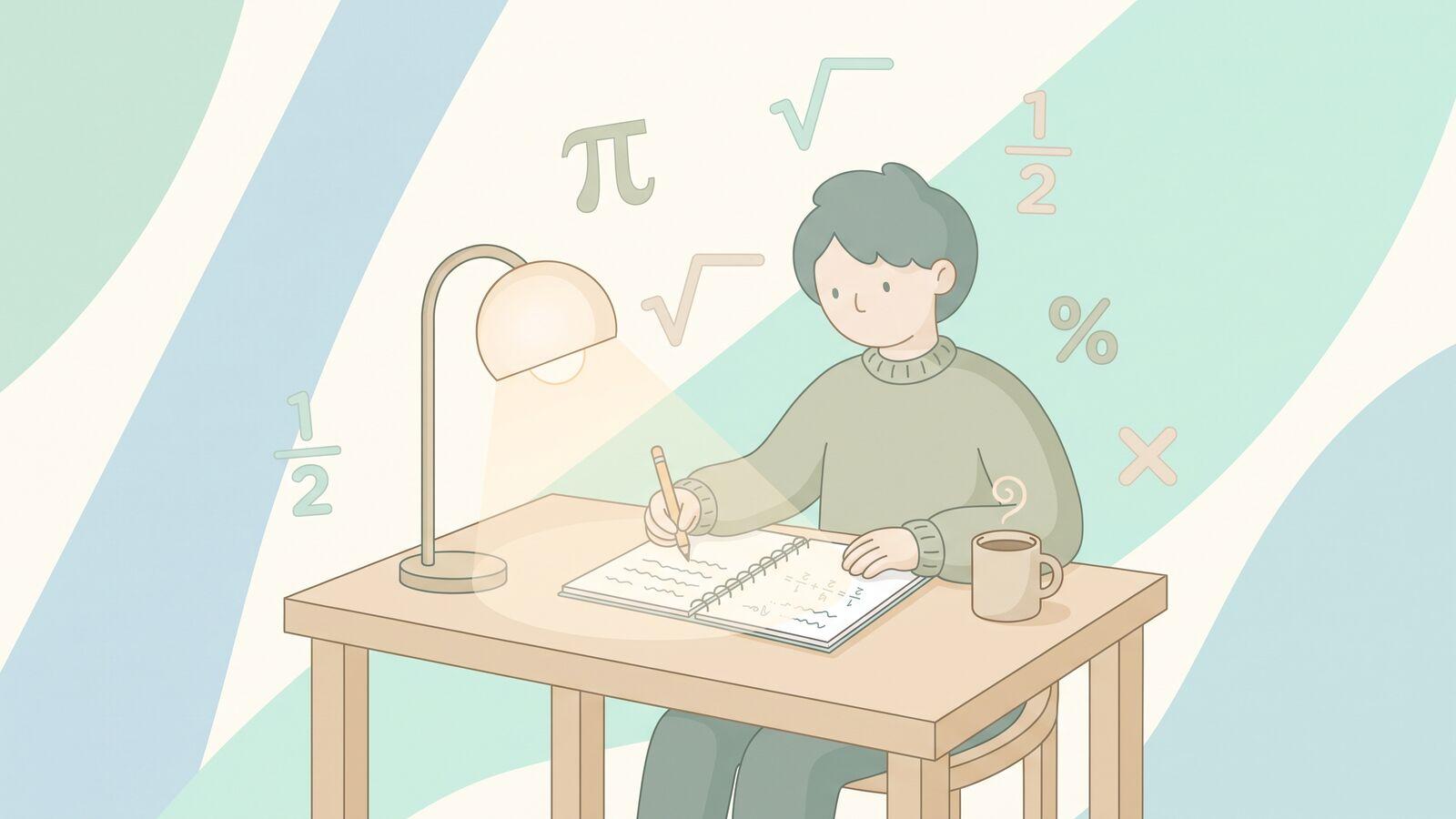
Maybe it was your kid sliding a fractions worksheet across the table. Maybe it was a job posting that said "comfortable with data" and a small knot in your stomach. Maybe it was just the quiet suspicion that a door closed somewhere around ninth grade and you never went back to check if it was locked. Whatever brought you here, the situation is the same: you are an adult, math left your life years ago, and you are wondering whether it can come back.
It can, and more easily than you expect. Not because of motivational-poster optimism, but because adults bring assets to math that no teenager has, and because the things that made math miserable the first time, the pace, the pressure, the grades, are gone. This article is a realistic plan for relearning math as an adult: where to start, how to practice, and what a sensible timeline looks like.
You Are in a Better Position Than You Were at 15
Start with the belief that does the most damage: "I am not a math person." Decades of research on how people learn have failed to find the math gene this phrase assumes. What it usually marks is the moment a class moved on while you still had a gap, and the gap compounded. That is a story about pacing, not about your brain. We take this apart in detail in how to get better at math, but the short version is that math skill is built, not issued at birth.
Now look at what you have that your fifteen-year-old self did not. You chose this, nobody assigned it, and chosen goals survive setbacks far better than imposed ones. You know how you learn, when you are tired, when you are fooling yourself; teenagers are famously bad at all three. And you have decades of real-world material for math to attach to. Compound interest is not an exercise anymore, it is your retirement account. Percentages are the discount you actually paid. Probability is the forecast you checked this morning. Ideas that floated free in a classroom now have somewhere to land.
The one honest disadvantage is time: you have less of it, in smaller pieces. The plan below is built around that constraint instead of pretending it away.
Start Lower Than Your Pride Wants To
Here is the most common way adult math comebacks fail: someone decides to relearn algebra, opens an algebra book, and hits a wall in chapter two. Not because algebra is beyond them, but because algebra assumes fluency with fractions, negative numbers, and percentages, and those are exactly the topics where old gaps hide. The wall was never algebra. It was a fraction wearing algebra's clothes.
So do the unglamorous thing: start one level below where you think you belong. Spend your first week solving problems on fractions, decimals, percentages, and negative numbers. There is no cost to this. If the material is genuinely easy, you will confirm it in days and move up with a verified foundation. If it is not easy, you have just located the real starting line, and every hour you spend there pays interest through everything built on top of it.
If it has been long enough that even those feel foggy, that is fine too. The ideas rebuild quickly when they are taught as meaning instead of rules, which is the approach we take in understanding fractions intuitively and understanding percentages intuitively. You are not re-memorizing procedures; you are seeing, probably for the first time, why the procedures work. Many adults report that this is the point where math starts being interesting rather than threatening.
Fifteen Minutes a Day Beats Three Hours on Sunday
Adult life does not have room for study marathons, and it turns out that is a blessing. The single most robust finding in learning research is that spaced practice beats massed practice: five short sessions across a week build more durable skill than one long session of the same total length, because each return visit after partial forgetting strengthens memory in a way repetition within one sitting cannot. We cover the mechanism in spaced repetition for math practice, but you do not need the theory to use it.
The practical rule: 10 to 20 minutes, every day, ideally attached to an existing habit. Coffee, commute, lunch, the ten minutes after the kids are down. Small enough that you cannot talk yourself out of it, regular enough that spacing happens automatically.
Consistency also solves the motivation problem before it starts. Motivation is unreliable; habits are not. On the days you feel inspired, the session happens. On the days you do not, the session still happens, and those days are where the compounding lives.
Solve Problems, Do Not Collect Explanations
There is a trap built specifically for adult self-learners, and it is called the watching trap. You find a good video on algebra. It is clear, the presenter is engaging, everything makes sense as it goes by, and you finish feeling like you learned something. Then you try a problem and discover that understanding someone else's solution and producing your own are different skills, and you have been training only the first.
Watching feels like learning because recognition is easy and fluent. But math is a performance skill, closer to swimming than to trivia: you learn it by doing it, badly at first, with feedback. The rule that fixes this is simple. For every explanation you consume, solve several problems on it before moving on. Reaching for a half-remembered method, making an error, and seeing why it is wrong does more for your skill than a second viewing ever could. The research behind this, retrieval practice and the testing effect, is laid out in how to study math effectively.
A related note on wrong answers: as an adult you may feel errors as small humiliations, echoes of red ink. Reframe them. An error found in practice is information delivered at zero cost, telling you exactly what to fix while the stakes are nothing. The learners who improve fastest are the ones who make their errors early, in private, on purpose.
Make Peace with the Anxiety That Kept You Away
For many adults the obstacle is not cognitive at all. Math anxiety is a real, measurable phenomenon: the anticipation of doing math triggers a genuine stress response that consumes the very working memory the problem needs. It is also self-reinforcing, because avoidance brings relief, and relief teaches you to keep avoiding. If a school experience left you with that loop, twenty years of avoidance is not a character flaw. It is the loop doing what loops do.
Two things help immediately. First, know that the anxiety is not evidence about your ability; it is a learned response, and learned responses can be unlearned through repeated low-stakes exposure, which is exactly what short private daily sessions provide. No timer, no grade, no one watching. Second, start easy on purpose. Early wins are not cheating, they are the counter-evidence your brain needs to loosen the old association between math and threat. The full set of strategies is in how to overcome math anxiety, and it pairs naturally with everything in this plan.
A Realistic Roadmap and Timeline
Every adult path climbs roughly the same ladder, because math is cumulative. What changes is how far you need to go.
Months one and two: the foundation. Arithmetic fluency, fractions, decimals, percentages, negative numbers, and ratios. This layer runs the practical life of an adult, tips, budgets, interest, cooking, and it is where the old gaps live. Daily practice gets most people comfortable here in four to eight weeks.
Months three to six: algebra. Variables, equations, and lines. This is the layer where math becomes a language rather than a calculator, and it is the prerequisite for nearly everything beyond it. Start with what x actually means and let the rules follow from the meaning.
Beyond six months: choose by goal. Helping your kids through school? Add geometry and word-problem technique. Aiming at data, business, or the sciences? Go toward statistics and probability, the most immediately useful math an adult can own. Curious about the famous stuff? Functions, then limits, then derivatives, and calculus is no longer a rumor.
These timelines assume nothing more than the daily fifteen minutes. Faster is possible; slower is fine. The ladder does not care how quickly you climb, only that you do not skip rungs.
How Math Zen Fits an Adult's Comeback
Math Zen was built around exactly the constraints this article assumes. Sessions are short by design, so the daily-practice habit fits in the gaps of a working life. You learn by solving problems rather than watching explanations, so you are on the right side of the watching trap from the first minute. The adaptive bucket system quietly finds your true level, feeding you problems slightly below your ceiling and resurfacing shaky topics sooner and solid ones later, which is the spaced, diagnosed practice described above with none of the bookkeeping. And it is private. No grades, no timer, no one watching you rebuild. For an adult unlearning old math wounds, that last part matters more than any feature.
The Bottom Line
Relearning math as an adult is not a heroic project. It is a small daily habit pointed in the right order: find your real level by starting lower than pride suggests, practice by solving rather than watching, let short daily sessions do the spacing for you, treat errors as free information, and climb the ladder one rung at a time. The adult advantages, motivation, self-knowledge, and a life full of things math describes, cover everything the years took.
The door you have been wondering about was never locked. Fifteen minutes today is how it opens.
Common Questions
- Is it too late to learn math as an adult?
- No. There is no age window that closes on math. Adults routinely relearn algebra, statistics, and even calculus for career changes, and research on adult learning shows the brain keeps forming new connections throughout life. What adults lack in raw classroom hours they make up in motivation, self-knowledge, and real-world context, three things teenagers rarely have. The only real obstacle is the belief that it is too late, which quietly stops people from starting.
- Where should I start relearning math as an adult?
- Start one level below where you think you should. Most adults who struggle with algebra actually have gaps in fractions, percentages, and negative numbers, so beginning there is not a step backward, it is repairing the foundation everything else stands on. Spend a few days solving problems at that level; if it is genuinely easy you will move up fast and lose nothing, and if it is not, you have found exactly where to work.
- How long does it take to relearn math as an adult?
- With 15 to 20 minutes of daily practice, most adults rebuild comfortable arithmetic and fraction skills in a month or two, and reach solid algebra within six months to a year. The timeline depends more on consistency than intensity: a short session every day beats a three-hour session every other weekend, because spaced practice is what moves math into long-term memory. Rushing the schedule usually means re-learning the same topics twice.
- Can I learn math on my own without a teacher?
- Yes, and most adult learners do. Math is unusually well suited to self-study because problems give instant, objective feedback: your answer is right or it is not, and either way you learn something. What a self-learner must supply is what a classroom normally provides, namely a sensible topic order, regular practice, and honest assessment of gaps. A structured app or curriculum handles the ordering, and solving problems daily handles the rest.
- Why is math easier to learn as an adult?
- Because you now have everything the material was pointing at. Percentages are your mortgage rate, probability is your weather app, and slope is the growth chart in your quarterly report, so abstract ideas land on concrete experience instead of floating free. Adults also know how they learn, notice when they are confused, and choose to study instead of being forced to, which turns out to matter more than a young memory.