How to Prepare for VWO Wiskunde A and B: A 12-Week Study Plan
On the 2026 vwo wiskunde B paper, 11 of the 17 questions, worth 47 of the 75 points, were marked "exact" or "algebraïsch". Both words bar the graphing calculator's solving features, and "exact" also rules out rounded answers. The graphing calculator was allowed for the full three hours, and most of the points still went to work done by hand.
That is what makes wiskunde B unusual. Wiskunde A, sat on the same afternoon, has no such restriction, and its central exam leaves out a large part of the course. Both are national papers set by the College voor Toetsen en Examens (CvTE), and the next sitting is Friday 28 May 2027, 13:30 to 16:30. This guide covers what each paper tests, how points become a grade, the marking rules that cost points, and a 12-week plan for both subjects.
One Name, Two Exams
There is no single vwo math exam. Wiskunde A and wiskunde B share a name and a three-hour slot, but they are separate exams with separate syllabi. Your profile, and sometimes your own choice, decides which one you sit. Wiskunde A is compulsory in Economie en Maatschappij and Natuur en Gezondheid. Wiskunde B is compulsory in Natuur en Techniek and can take the place of A in other profiles.
The central exam (centraal examen, CE) is the national half of the eindexamen, and the two CEs test different mathematics:
- Wiskunde B: functions, graphs and equations; differential and integral calculus; trigonometric functions; and geometry with coordinates, vectors included.
- Wiskunde A: algebra and counting; functions; and change, meaning sequences, slope and the derivative.
How much of the course reaches the paper differs too. Wiskunde B is 600 study-load hours, and the central exam covers about 90 percent of it. Wiskunde A is 520 hours, of which the central exam covers about 60 percent; the rest, statistics and probability included, is graded only in school exams. So the A central exam is a narrower target than the A course, while the B paper can reach almost anything you were taught.
Examenblad keeps an official 2027 page for wiskunde A at vwo and for wiskunde B at vwo, each with its exam schedule. If you are preparing from outside the Dutch system for a "VWO wiskunde A or B level" requirement, the syllabus behind each exam spells out that level topic by topic.
Everything below applies to both subjects, except the two sections marked wiskunde B and the one on wiskunde A. Read the ones that match your subject.
What the Paper Looks Like
Here is the frame for 2027, with the 2026 papers as the latest example.
| Subject | Date 2027 | Time | 2026 paper | Calculator |
|---|---|---|---|---|
| Wiskunde A | Friday 28 May | 13:30 to 16:30 (3 hours) | 20 questions, 75 points | Graphing calculator in Dutch exam mode |
| Wiskunde B | Friday 28 May | 13:30 to 16:30 (3 hours) | 17 questions, 75 points | Graphing calculator in Dutch exam mode; specific options barred on "exact" and "algebraïsch" questions |
The question counts change from year to year, so treat the 2026 figures as a sample, not a rule.
Each paper is a series of opgaven. An opgave opens with a title and a context, then asks one or more questions about it. The cover carries a warning worth taking literally: when a question requires an explanation or a calculation, an answer without it usually scores no points.
Page 2 of each paper is a formula list, and it is short. Wiskunde B gets the trigonometric sum and difference formulas and the double-angle formulas, nothing else. Wiskunde A gets the differentiation rules (sum, difference, product, quotient and chain rule) and the rules for logarithms. Any other formula has to come from memory.
Approved calculators for 2027 include the Casio fx-CG50, HP Prime G2, TI-84 Plus CE-T, TI-Nspire CX II-T and NumWorks N0110 or later, each in the Dutch exam mode. Practice in that mode from week 1 so nothing on the day looks unfamiliar.
If the May paper goes badly, there is a second sitting in June: each candidate may resit the central exam in one subject. In 2026 the wiskunde resits fell on 17 June (A) and 18 June (B).
How a Score Becomes a Grade
Points do not convert to a grade by a fixed percentage. The conversion includes an N-term that differs per exam and per year. The CvTE says it normally lies between 0 and 2, and a harder exam gets a higher one, so fewer points are needed for a pass.
In 2026, wiskunde A and wiskunde B were both scored out of 75 with an N-term of 1.7, and 32 points gave a 5.5. Earlier years looked different:
- Wiskunde B: N-term 1.6 on a 77-point paper in 2025, and 2.1 on 76 points in 2024.
- Wiskunde A: N-term 1.8 on 78 points in 2025, and 2.1 on 77 points in 2024.
You cannot know your year's N-term while you prepare, so do not train for 32. It was the pass line of one year. Aim well above it.
Your final grade in the subject is the average of your school exam grade and your central exam grade, rounded to a whole number. The pass rules for havo and vwo then apply across all subjects, and three of them matter here:
- The average of all your central exam grades, unrounded, must be 5.5 or higher.
- Among Dutch, English and mathematics, at most one final grade may be a 5; the other two need a 6 or higher.
- No final grade may be lower than 4.
So can you pass vwo with a 4 for mathematics? Under these rules, no. Mathematics is one of the three core subjects, where a single 5 is the lowest grade allowed, and only if the other two are 6 or higher.
Exact Means No Calculator Shortcuts (wiskunde B)
Two words in a wiskunde B question change what counts as an answer. The wiskunde B syllabus for 2027 defines them and states that they apply only to wiskunde B:
- Algebraïsch: answer without the graphing calculator's specific options. Rounded answers are allowed.
- Exact: the same restriction, and no approximations either, in intermediate steps or in the final answer.
So if an exact question leads to x = ln(3)/2, that expression is the answer, and 0.549 is not.
On the 2026 paper, seven questions said "Bereken exact" (32 points) and four were algebraïsch (15 points). Two more, questions 14 and 16, were proofs ("Bewijs dat...") worth 12 points together. Restricted questions and proofs carried 59 of the 75 points between them.
These are the hand skills that carry those points:
- Exponential and logarithmic equations, solved all the way to an exact form. The B formula page has no logarithm rules, so those must be automatic.
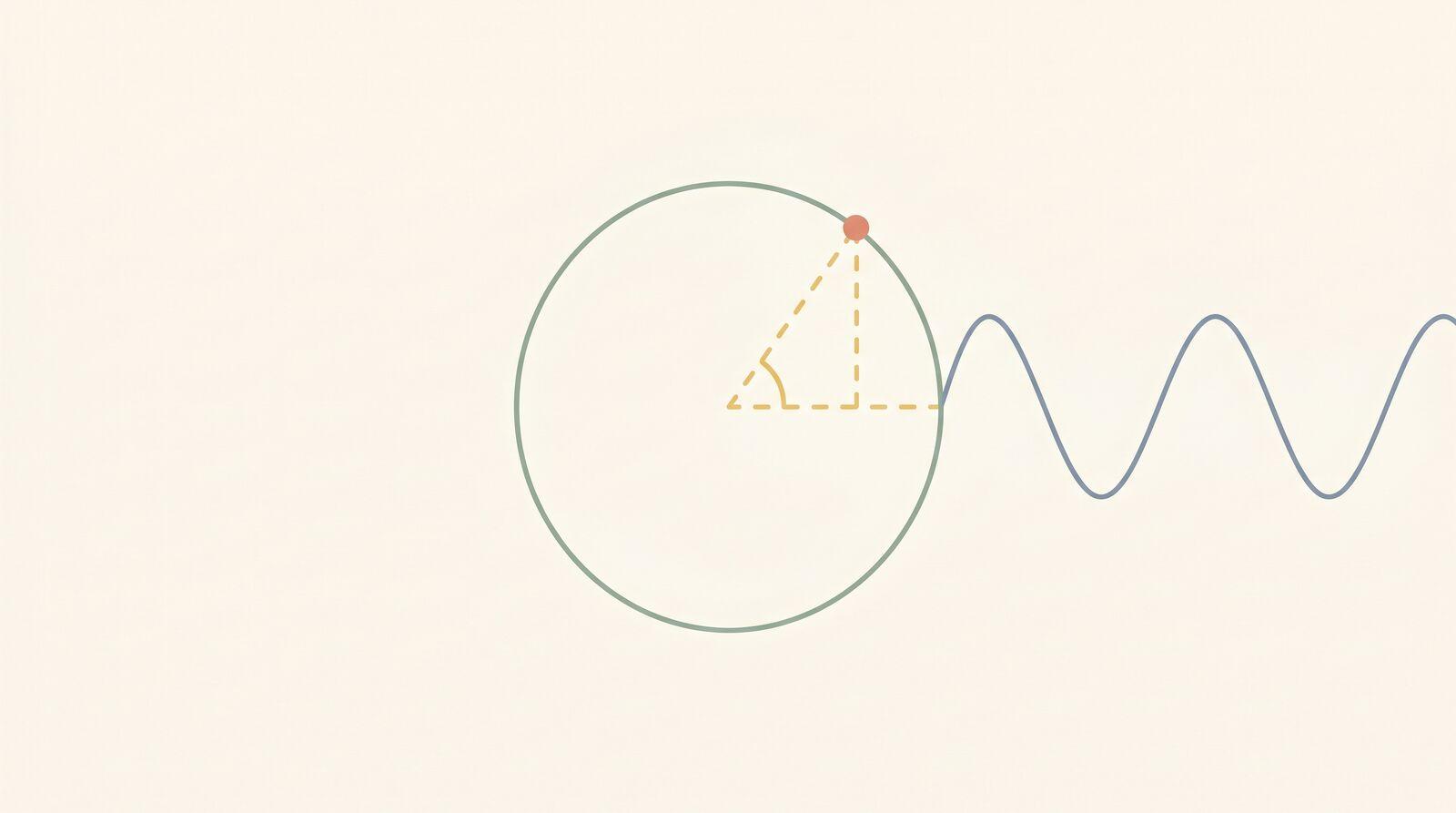
- Trigonometric equations. Know the exact values of sin, cos and tan at multiples of π/6 and π/4, and use periodicity and symmetry to find every solution in the interval. The trigonometry guide shows those values as coordinates on the unit circle.
- Derivatives with the sum, difference, product, quotient and chain rules, simplified without help. The derivatives guide explains what each rule is saying.
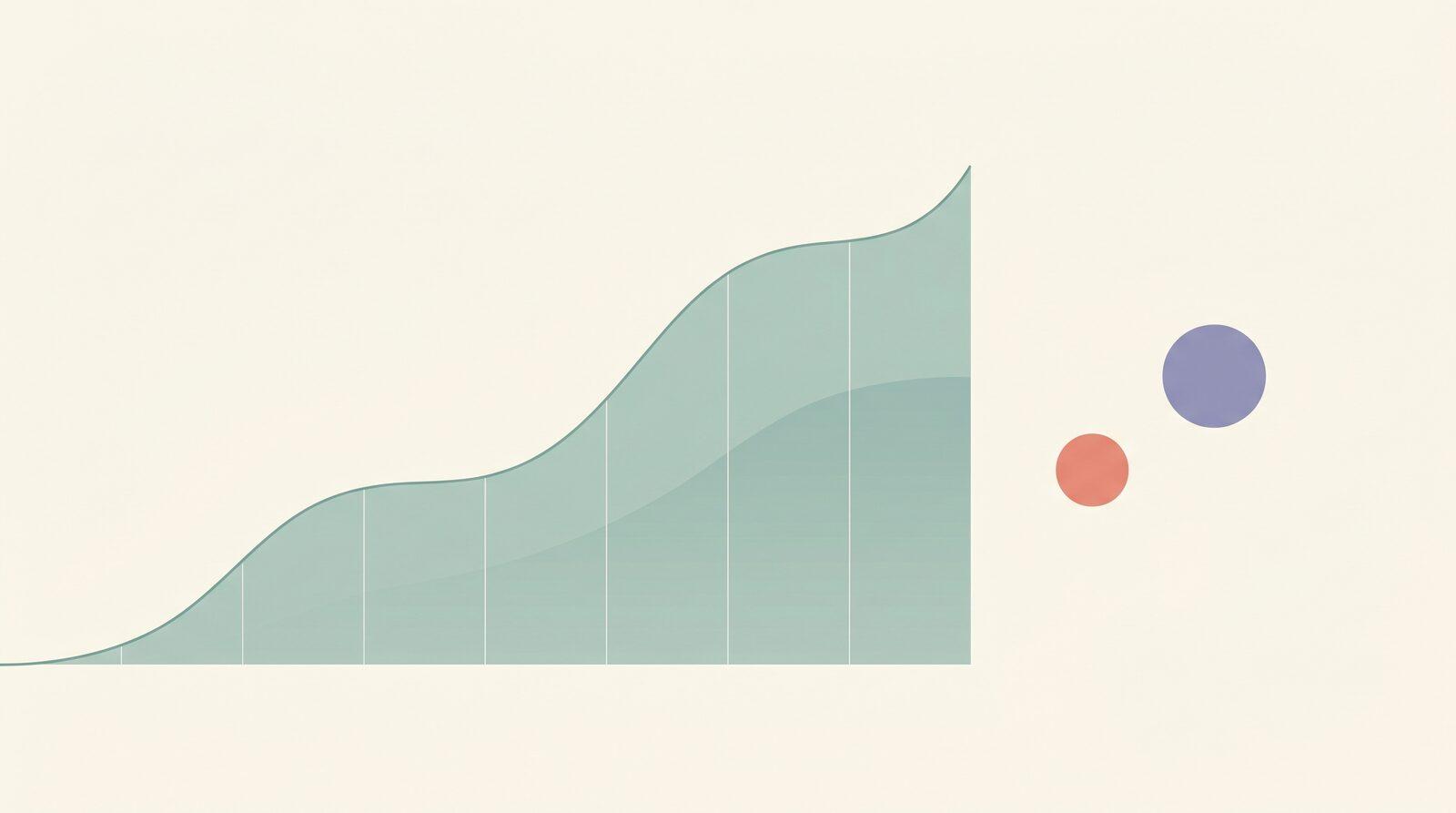
- Integrals for areas and for volumes of revolution about the x-axis or y-axis, evaluated exactly, with the slicing picture from the integrals guide.
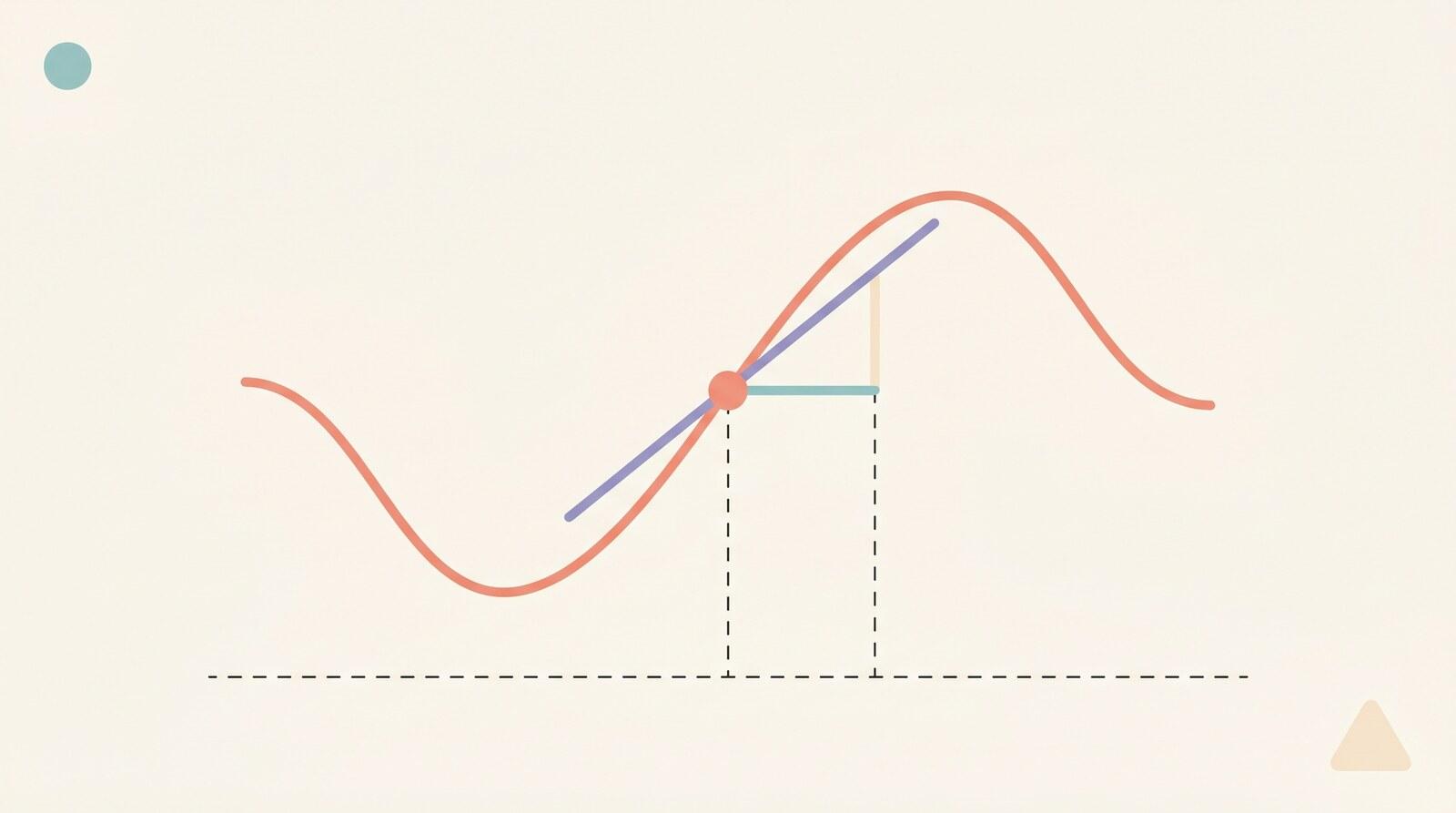
- Limits for horizontal, vertical and oblique asymptotes and for holes in a graph, as in the limits guide.
The restriction is on how you answer, not on what you look at. After the hand work, a ten-second numerical check on the calculator still catches a dropped sign.
Geometry and Vectors Are a Craft of Their Own (wiskunde B)
The last domain on the B central exam is geometry with coordinates. It asks for a different habit: turning a figure into equations before any algebra starts.
- Lines and circles. Equations of lines and circles, and the tangent line to a circle through a given point, both when the point lies on the circle and when it lies outside it.
- Vectors and the inner product. The inner product gets angles and perpendicularity out of coordinates; the vectors guide shows it as a measure of how much two directions agree.
- Moving points. When a point's position is a vector that depends on time, the syllabus expects you to compute its velocity vector, speed and acceleration. The parametric equations guide treats such a curve as a path with a clock, which is the picture you need.
Proof questions ("Bewijs dat", "Toon aan") draw on the same craft. A proof earns its points through the written chain: what is given, each step with its reason, and a last line that states exactly what had to be shown. The cover warning applies with full force here, since a proof without its reasoning is just a claim.
What Wiskunde A Actually Tests
If you take wiskunde A, this section replaces the two before it. Your central exam draws on three syllabus domains:
- Algebra and counting. Counting means permutations and combinations, with tree diagrams and grids as tools. The permutations and combinations guide shows how to tell the two apart.
- Functions. The syllabus explicitly allows equations and inequalities to be solved numerically or graphically, so the calculator is a legitimate method here, not a shortcut.
- Change. Arithmetic and geometric sequences with direct and recursive formulas, covered in the sequences guide, plus slope and the derivatives of the standard functions (the syllabus leaves out the derivative of sin(x)). The formula page supplies the differentiation and logarithm rules, so spend your effort on using them; the logarithms guide helps when those rules feel arbitrary.
Statistics and probability are not on the list. They are a compulsory part of the course, but the syllabus assigns them to the school exam, so leave them out of your central exam plan.
The 2026 A paper had 20 questions for the same 75 points that B spread over 17, so expect more questions, each worth a little less. The skill A rewards is translation: read the context, decide which quantity is asked for, write the formula, and give the answer in the units and precision the question requests. The calculator does most of the computing, but it will not choose the equation, and the cover warning still holds. Write the equation you solved and the option you used, then the result.
Marking Rules That Cost Points
The correction rules (correctievoorschrift) for the 2026 wiskunde B paper list three deductions that have nothing to do with understanding the mathematics:
- Each arithmetic error costs 1 point.
- Rounding an intermediate result costs 1 point if it changes the final answer.
- Where you use the graphing calculator, you must explain how you used it.
Those rules are written for B, but the habits that avoid them pay in A as well. Keep full precision until the end by storing intermediate results in the calculator instead of retyping rounded values. Write down the equation you solved and the calculator option you used before the result. And answer exactly what is asked, in the requested unit and rounding: a correct number for a different question earns nothing.
Diagnose Before You Plan
Before week 1, sit the 2026 first-sitting paper (tijdvak 1) for your subject cold: three hours, calculator in exam mode, no notes. It is a fair preview, since the 2027 syllabi are unchanged from 2026. The syllabus also counts every central exam from 2018 onward as example material, so plenty of papers remain for later.
Mark it with the official correction rules, then sort every lost point into five bins: exact algebra, a topic gap, setting up a model from the context, calculator method or a missing explanation, and arithmetic or rounding.
Each bin needs its own medicine. Exact algebra needs short daily work by hand. A topic gap needs explanation and simple examples before any exam questions. Modelling errors need practice writing the formula before computing anything. Calculator losses need a fixed write-up for every calculator step, and arithmetic and rounding need the precision habits above. More full papers fix none of these on their own: papers show where the points went, and focused sessions win them back.
The 12-Week Study Plan
For a 28 May exam, week 1 starts in early March; if you start earlier, stretch the blocks. There are six two-week blocks, and where A and B differ, each gets its own line. End every session with ten minutes of mixed questions from earlier blocks so nothing fades.
Weeks 1 and 2: functions and equations.
- Both: functions and graphs, exponentials and logarithms, equations and inequalities.
- B: add limits, asymptotes and holes, all by hand.
- A: solve the same kinds of equations graphically and numerically on the calculator, and write down each step.
Weeks 3 and 4: derivatives.
- Both: differentiation and optimization.
- B: the product, quotient and chain rules until they run without notes, then the second derivative and points of inflection.
- A: derivatives of the standard functions using the formula-page rules, plus arithmetic and geometric sequences with direct and recursive formulas.
Weeks 5 and 6: the subject core.
- B: integrals for areas and volumes of revolution, and trigonometric equations with exact values.
- A: counting with permutations, combinations, tree diagrams and grids, and turning contexts into formulas.
Weeks 7 and 8: geometry or full contexts.
- B: lines, circles and tangent lines, then vectors, the inner product and moving points.
- A: complete past-paper contexts that mix functions, derivatives and sequences.
Weeks 9 and 10: exact work and the formula page.
- Both: practice with nothing but the printed formula page, and write out every calculator step.
- B: exact-only sessions with the calculator in a drawer.
Weeks 11 and 12: full papers. Sit complete papers under real timing, starting at 13:30 like the exam. Review each one for as long as the sitting took, and redo every lost question from a blank page a day later. Then freeze the routine: no new topics in the final days.
For the short daily drills, the guide to spaced repetition for math practice explains how to schedule them.
Exam-Day Pacing for a Three-Hour Paper
The arithmetic is simple: 180 minutes for 75 points is 2.4 minutes per point. A 6-point question is worth about 14 minutes, a 3-point question about 7, and the point value stands next to each question number, so you can budget as you go.
When a question runs well past its budget, mark it, move on, and come back once the accessible points are banked. When a question asks you to show a result ("Toon aan"), the result is printed in the question, so you can use it in the next question even if your own derivation stalled.
Keep the last 15 minutes for checks: rounding instructions followed, exact answers still exact, every calculator step written down with its equation. Those are the cheapest points on the paper.
The Bottom Line
VWO wiskunde is two exams under one name. Wiskunde B is a graphing-calculator paper that, in 2026, paid most of its points for exact work done by hand. Wiskunde A lets the calculator solve but tests a narrower slice of its course, with statistics left to the school exam. Both convert points through an N-term you cannot predict, and both punish missing explanations. Diagnose with the 2026 paper, work the blocks for your subject, build the habits the marking rules reward, and finish with full papers at the real start time. Twelve focused weeks is enough to walk in on 28 May knowing what the paper will ask of you.
Common Questions
- When is the VWO wiskunde exam in 2027?
- The 2027 central exams for wiskunde A and wiskunde B are on the same afternoon: Friday 28 May 2027, from 13:30 to 16:30, in the first exam period (eerste tijdvak). If that sitting goes badly, each candidate may resit the central exam in one subject during the second period in June. In 2026 the wiskunde resits were on 17 June for A and 18 June for B.
- What is the difference between wiskunde A and wiskunde B on the central exam?
- They are separate exams with separate syllabi. Wiskunde B, compulsory in Natuur en Techniek, tests functions and equations, differential and integral calculus, trigonometry, and coordinate geometry with vectors; its central exam covers about 90 percent of a 600-hour course. Wiskunde A, compulsory in Economie en Maatschappij and Natuur en Gezondheid, tests algebra and counting, functions, and change through sequences and derivatives; its central exam covers about 60 percent of 520 hours, and statistics is left to the school exam.
- Can you use a calculator on the VWO wiskunde exam?
- Yes. A graphing calculator is allowed at the central exams for wiskunde A, B and C, and it must be in the Dutch exam mode. Approved models for 2027 include the Casio fx-CG50, HP Prime G2, TI-84 Plus CE-T, TI-Nspire CX II-T and NumWorks N0110 or later. In wiskunde B, questions marked "exact" or "algebraïsch" forbid the specific options of the calculator, and "exact" also forbids rounded answers.
- How many points do you need for a 5.5 on VWO wiskunde?
- It changes every year, because points are converted to a grade with an N-term set for each exam. In 2026, wiskunde A and wiskunde B were both scored out of 75 with an N-term of 1.7, and 32 points gave a 5.5. In 2025 the N-terms were 1.6 for B and 1.8 for A, and in 2024 both were 2.1. A harder paper gets a higher N-term, so fewer points are needed for a pass.
- Can you pass VWO with a 4 or a 5 for mathematics?
- Under the pass rules, a 5 for mathematics can still let you pass, but a 4 cannot. Mathematics is a core subject together with Dutch and English: among those three, at most one final grade may be a 5, and the other two need a 6 or higher. No final grade may be below 4, and the unrounded average of your central exam grades must be at least 5.5. Your final grade for mathematics is the rounded average of your school exam and central exam grades.
- Is statistics on the wiskunde A central exam?
- No. Statistics and probability are a compulsory part of the vwo wiskunde A course, but the syllabus assigns them to the school exam, not the central exam. The central exam covers algebra and counting, functions, and change: sequences, slope and the derivative. Counting is on it, so expect permutations and combinations, with tree diagrams and grids as tools. Revise statistics for your school exams and keep it out of your central exam plan.