study-tips

How to Help Your Child with Math Homework (Without Fighting)

July 26, 202610 min read
How to Help Your Child with Math Homework (Without Fighting)

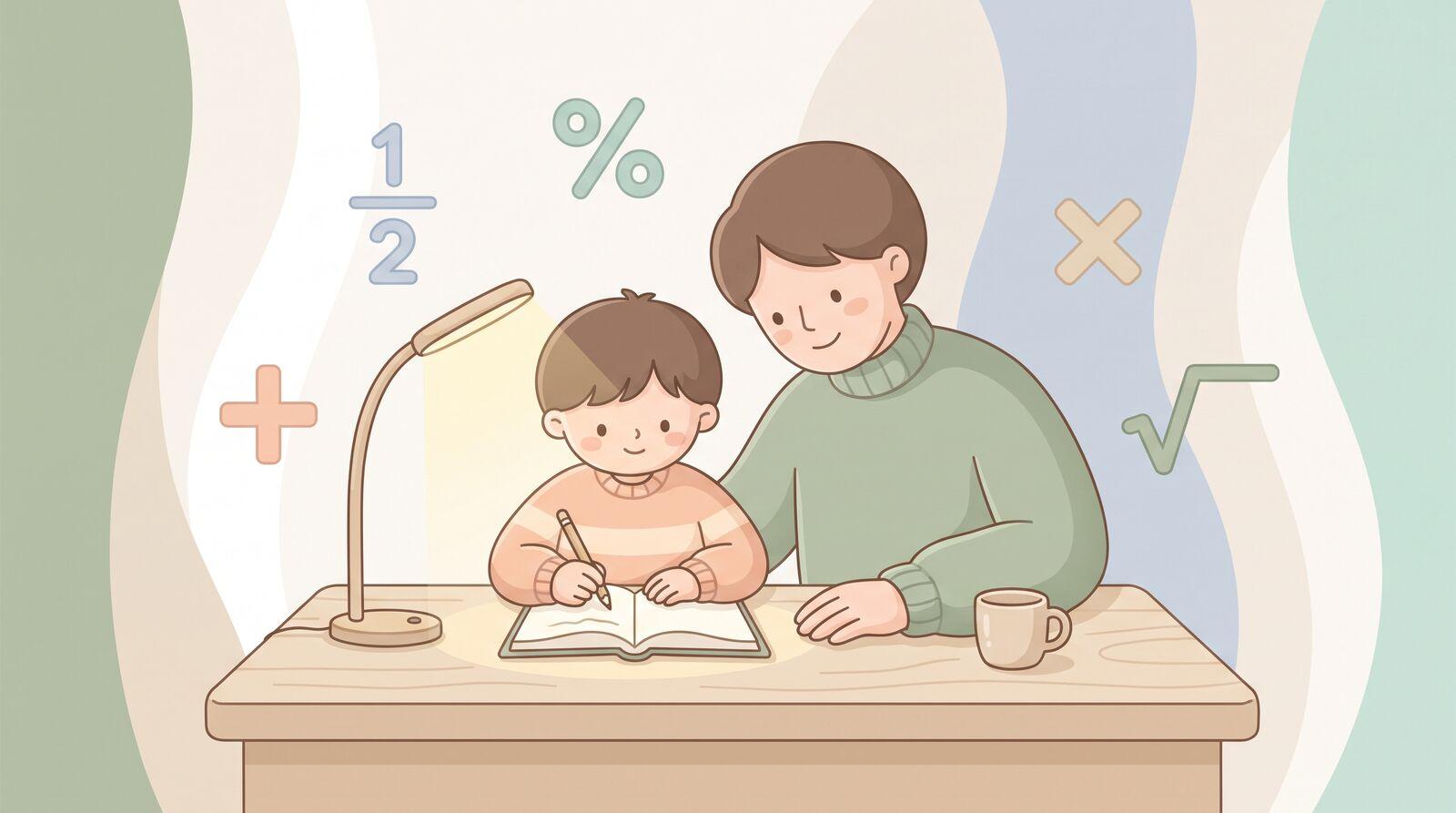
It is 7:40 on a Tuesday. Four problems left on the worksheet. Your child is crying, or has gone silent, or is insisting that the teacher does it a completely different way, and you are somewhere between patient and finished. You sit down to help. Twenty minutes later the homework is not done, the mood is worse, and you have both quietly agreed that math is the enemy.

Nearly every parent has had that evening. What follows is not a set of teaching tips, because you are not the teacher and should not have to be. It is a short list of the things that actually change how those evenings go, and most of them are about what you say rather than what you know.

The Finding Every Parent Should Know First

In 2015, researchers at the University of Chicago published a study in Psychological Science tracking first and second graders across a school year. They measured how much math the children learned, how anxious they felt about it, how math-anxious their parents were, and how often those parents helped with math homework.

The result was uncomfortable and specific. Children of math-anxious parents learned less math over the year and became more math-anxious themselves. But that effect appeared almost entirely among the children whose parents helped with math homework frequently. When math-anxious parents rarely helped, their children were largely unaffected.

The natural conclusion, that anxious parents should back away from the kitchen table, is the wrong one. What the study points at is not the helping. It is what leaks through it: the sigh before the worksheet comes out, the shared joke about hating math, the visible tension when a question cannot be answered, the tone that says this is a chore we survive together. Children read all of it fluently, and they are learning what math is from you long before they learn any particular topic.

So the goal is not to help less. It is to change what gets transmitted while you help.

Start with What You Say About Yourself

The single most common thing parents say at that table is a kindness: "Do not worry, I was terrible at math too."

It is meant as solidarity, and it lands as inheritance. It tells a struggling child that this is genetic, that the family does not do math, and that giving up is not only allowed but expected. The belief that math ability is something you either got or did not is the most durable myth in the subject, and we take it apart in how to get better at math. Your child will meet that myth eventually. They should not first meet it from you.

There is a related finding worth knowing. Research by Haimovitz and Dweck found that what children absorb is less about their parents' stated beliefs on intelligence and more about how their parents react to failure. Parents who treat a wrong answer as damaging produce children who see ability as fixed. Parents who treat it as informative produce children who do not. The moment your child gets a problem wrong in front of you is a bigger teaching moment than anything you say about effort afterward.

A few swaps that cost nothing:

  • Instead of "I was never a math person," try "I have not done this in years, let us work it out."
  • Instead of "It is easy, you just...," try "This one is tricky. Where does it stop making sense?"
  • Instead of "You are so smart," try "That is a good method. Tell me why it works."
  • Instead of "We are almost done," try nothing at all, and let them finish the thought.

If your own math really is rusty and you would rather it were not, that is a fixable problem and a good one to let your child watch you fix. How to relearn math as an adult is written for exactly that, and a parent visibly relearning fractions is worth more than any lecture about persistence.

Help by Asking, Not by Showing

The fastest way to end a homework standoff is to show the steps. It is also the way that teaches the least, because it resolves the discomfort for both of you, and the discomfort was the part doing the work. Effortful retrieval, the struggle to reach for something half-remembered, is what builds durable skill, which is the core of how to study math effectively.

So use a fixed ladder of questions instead. It works even when you have no idea how to solve the problem yourself:

  1. Read it to me out loud. A surprising share of stuck problems unstick here, because the child has been staring at the numbers and skipping the sentence.
  2. What is it actually asking for? Not the topic, the specific quantity. Many wrong answers are correct answers to a question that was not asked.
  3. What do you already know? List the given information out loud.
  4. What have you tried? This separates "I do not know how" from "I did not start."
  5. Where did it stop making sense? The most valuable question in the set, and the one that tells you whether tonight is a homework problem or a foundations problem.

Then stop talking. The silence will feel long, and the urge to fill it is the urge that ends the learning. Wait.

For word problems in particular, which cause more kitchen table conflict than any other question type, the translation method in how to solve math word problems gives you and your child a shared vocabulary that is more useful than any individual answer.

Do Not Fight the Method

"That is not how we do it" ends more homework sessions than any actual mathematics.

Modern curricula often teach place-value strategies and visual models before the standard algorithm you grew up with. Parents frequently find this baffling, and the instinct is to override it with the faster method you already trust. Both approaches produce correct answers, and yours may well be quicker. The problem is not which method is better. The problem is that switching methods halfway through a worksheet asks a struggling child to hold two systems in working memory at once, at the exact moment they have none to spare.

So ask first: "Show me how your teacher does it." If your child can, follow their method even if it feels roundabout. If your child genuinely cannot, you have found the real issue, and it is worth a note to the teacher. Teaching them your method for the night is a reasonable fallback, but say plainly that it is one of several valid routes, not a correction of what school got wrong.

Put a Clock on It, and Mean It

A widely used guideline puts total homework at roughly 10 minutes per grade level per night, so about half an hour in third grade and an hour in sixth, across all subjects. Math is a slice of that. If one math assignment routinely consumes the entire evening, the assignment is not the only thing that is broken.

Agree on a stopping time before you start, and honor it. When the time is up, stop, even mid-problem, and send the teacher a short note: how far your child got, which question stalled them, how long it took. Three things happen. The nightly escalation never starts. The teacher gets accurate information instead of a worksheet quietly finished by a parent at 9pm. And your child learns that effort is bounded, that stopping is allowed, and that they will not be held at a table until they break.

Move Math Off the Worksheet

There is an encouraging counterpart to the anxiety study. Also in 2015, researchers published work in Science on families using a short math-story app a few nights a week, doing brief math reading together at bedtime. Across a school year, children in those families showed higher math achievement, and the effect was strongest for children whose parents were the most math-anxious.

The contrast is the useful part. The same anxious parents whose homework help correlated with harm produced measurable gains through short, positive, low-pressure math contact. Math anxiety is not a disqualification from helping your child. It is a reason to change the format.

The everyday version costs nothing:

  • Doubling a recipe is fractions and ratios, with an outcome you can eat.
  • A 30 percent sale sign is percentages, and estimating it in the aisle beats a worksheet.
  • A thermometer at minus four is negative numbers doing something visible.
  • Sports statistics, tip splitting, road trip arrival times, board game scoring, all of it counts.

Keep it brief and drop it before it becomes a quiz. The goal is repeated evidence that math is a normal part of life rather than a subject that happens at night under duress.

Where a Practice App Fits

Most of the strain in math homework comes from parents being pushed into a role they never asked for: second teacher, at night, without the curriculum, with a tired child. The most reliable way to fix those evenings is to move the teaching somewhere else so you can go back to being the ally.

That is the role Math Zen plays for families. Sessions are short enough to fit before dinner, the adaptive bucket system starts at the level your child can actually handle rather than the level the worksheet assumes, and it resurfaces shaky topics on the spaced schedule that makes skills stick. Because it is private, with no grades and no audience, it is a place to be wrong without anyone watching, which is exactly what a child who has started to dread math needs. It will not do tonight's assignment, and it is not meant to. It quietly closes the gaps that make tonight's assignment feel impossible.

If your child's frustration is more fear than confusion, and especially if the tears arrive before the worksheet does, read how to overcome math anxiety as well. Much of it applies directly to children, and the section on low-stakes repeated exposure is the mechanism behind everything above.

The Bottom Line

You do not need to remember how to divide fractions to be enormously helpful. You need to watch what you say about math and about failure, ask questions instead of demonstrating steps, follow your child's method rather than defending your own, stop at an agreed time, and let some math happen away from the worksheet where nobody is being graded.

The research is genuinely encouraging on this point. Parents who feel least equipped to help are not doomed to pass that on. What gets transmitted is the attitude, not the algebra, and the attitude is the part you can choose tonight.

Common Questions

How can I help my child with math homework if I am bad at math myself?
By helping with the process instead of the math. You do not need to know how to solve the problem to ask your child to read it out loud, say what it is asking for, and point to where it stopped making sense. Those questions do most of the work. What matters more is how you talk about your own math history, because research has found that math-anxious parents who help frequently can pass that anxiety along. Saying you have not done this in years and are curious how their teacher does it works far better than saying you were never a math person.
Why does my child get so frustrated with math homework?
Usually because of a gap further back, not the topic on the page. Math is cumulative, so a child who is shaky on fractions will look like they cannot do algebra, and the frustration is a reasonable response to being asked to build on something that is not there. Time pressure and an audience make it worse, since anxiety consumes the working memory the problem needs. If frustration shows up every night rather than occasionally, treat it as a signal about foundations rather than about attitude.
Should I teach my child the method I learned in school?
Only if they cannot produce any method of their own. Modern curricula often teach place-value strategies before the standard algorithm you probably learned, and both get correct answers. The problem is switching methods halfway through a worksheet, which doubles the mental load at exactly the wrong moment. Ask your child to show you how their teacher does it first. If they genuinely cannot, that is useful information for the teacher, and your method is a reasonable fallback for that night.
How long should math homework take?
A widely used guideline is about 10 minutes per grade level per night across all subjects, so roughly 30 minutes total in third grade and an hour in sixth. Math is only part of that. If a single math assignment routinely runs far past its share, the useful response is to stop at a set time and send the teacher a short note saying how far your child got and where it broke down. That is better data for the teacher than a completed worksheet finished by an exhausted parent.
How do I know if my child needs a tutor?
Consider one when the gap is in prerequisites rather than the current topic, when nightly homework has become a reliable source of conflict, or when your child can follow an explanation but cannot start a problem alone. A tutor is also worth it purely to remove you from the teaching role, since the parent relationship often works better as support than as instruction. Before hiring anyone, a few weeks of short daily practice aimed at the missing foundation solves a surprising number of cases on its own.