How to Overcome Math Anxiety: Evidence-Based Strategies

Math anxiety is a specific feeling of tension or fear that interferes with math performance, even in students whose underlying ability is fine. It is one of the most well-documented performance killers in education, and one of the most treatable. This article covers what the research says, why anxiety and ability are surprisingly independent, and the evidence-based techniques (breathing, reframing, exposure practice) that quietly fix it.
Your heart rate picks up. Your palms get damp. You stare at the first problem and your mind goes completely blank, even though you studied the material last night. By the time you remember how to factor the expression, you have already lost five minutes and most of your confidence.
If that sounds familiar, you are not lazy, and you are not bad at math. You have math anxiety, and it is one of the most well-documented performance killers in education. The good news: it is also one of the most treatable.
What Math Anxiety Actually Is
Math anxiety is not the same thing as not understanding math. Researchers define it as a specific feeling of tension, apprehension, or fear that interferes with math performance. It can strike during homework, on exams, or even when someone mentions numbers in casual conversation.
The critical finding from decades of research is that math anxiety and math ability are surprisingly independent. Many students with strong underlying skills perform far below their potential because anxiety hijacks their working memory during the test. Others who are calm but underprepared still outperform them.
This matters because it reframes the problem. If you believe "I am just bad at math," you are stuck. If you understand "my brain is going offline under pressure," there is a clear path forward.
The Cognitive Load Cost
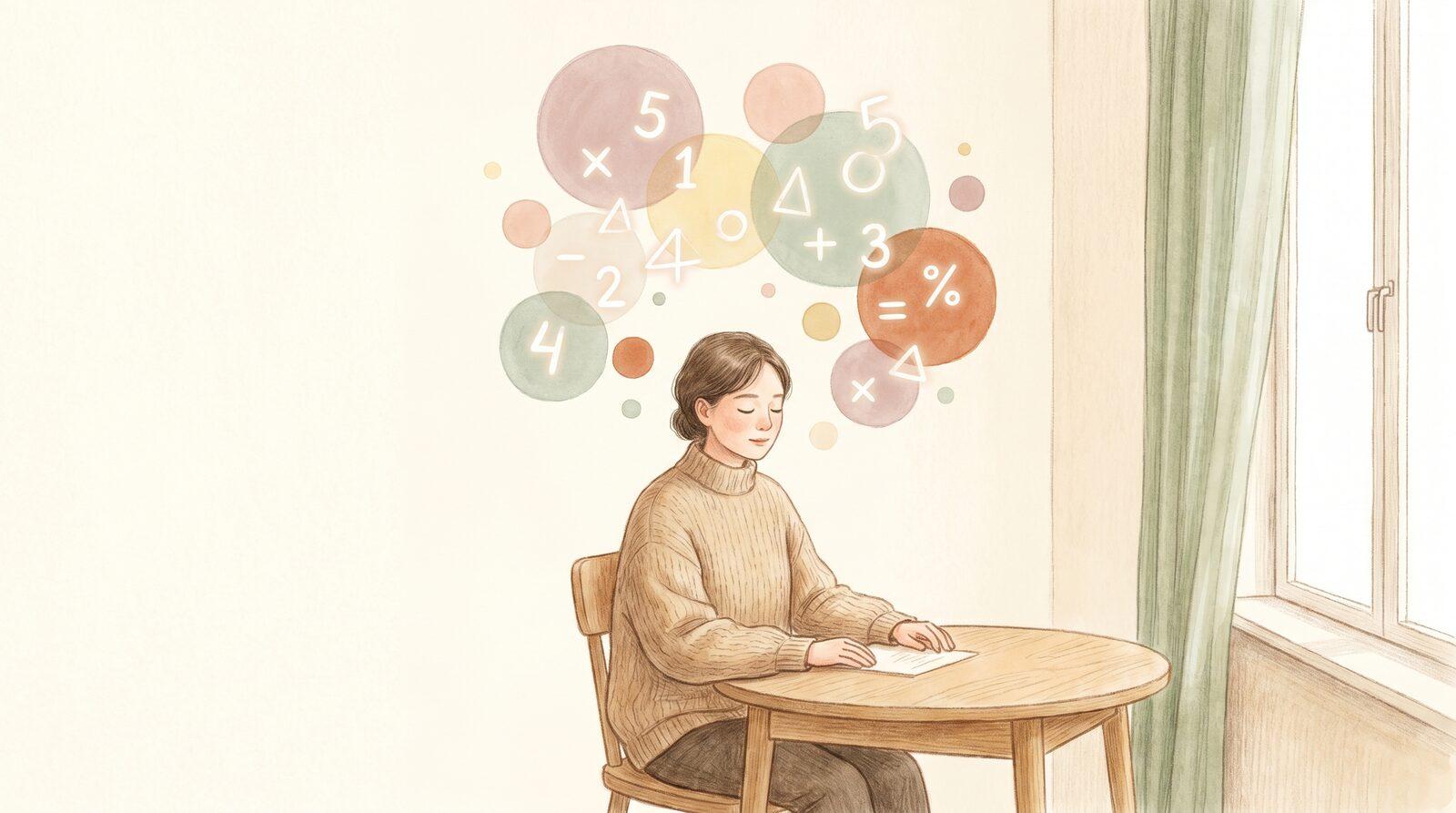
To see why anxiety hurts so much, you need to understand working memory. Working memory is the mental scratchpad where you hold intermediate steps of a problem: the carrying digit, the substituted value, the next operation. It is small. Most adults can only juggle about four items at once.
Anxiety fills that scratchpad with noise. Intrusive thoughts like "I cannot do this" or "everyone else is already on question three" consume the same slots that should be holding the math. A 2005 study by Ashcraft and Krause showed that students with high math anxiety performed similarly to non-anxious students on easy arithmetic but dropped dramatically on problems that required multi-step working memory. The harder the problem, the more room anxiety has to crowd out the math.
This is why math anxiety feels like a sudden blank rather than a slow struggle. You have not forgotten how to solve the equation. The steps are still there. They just cannot reach the surface through the static.
Separating Anxiety from Ability
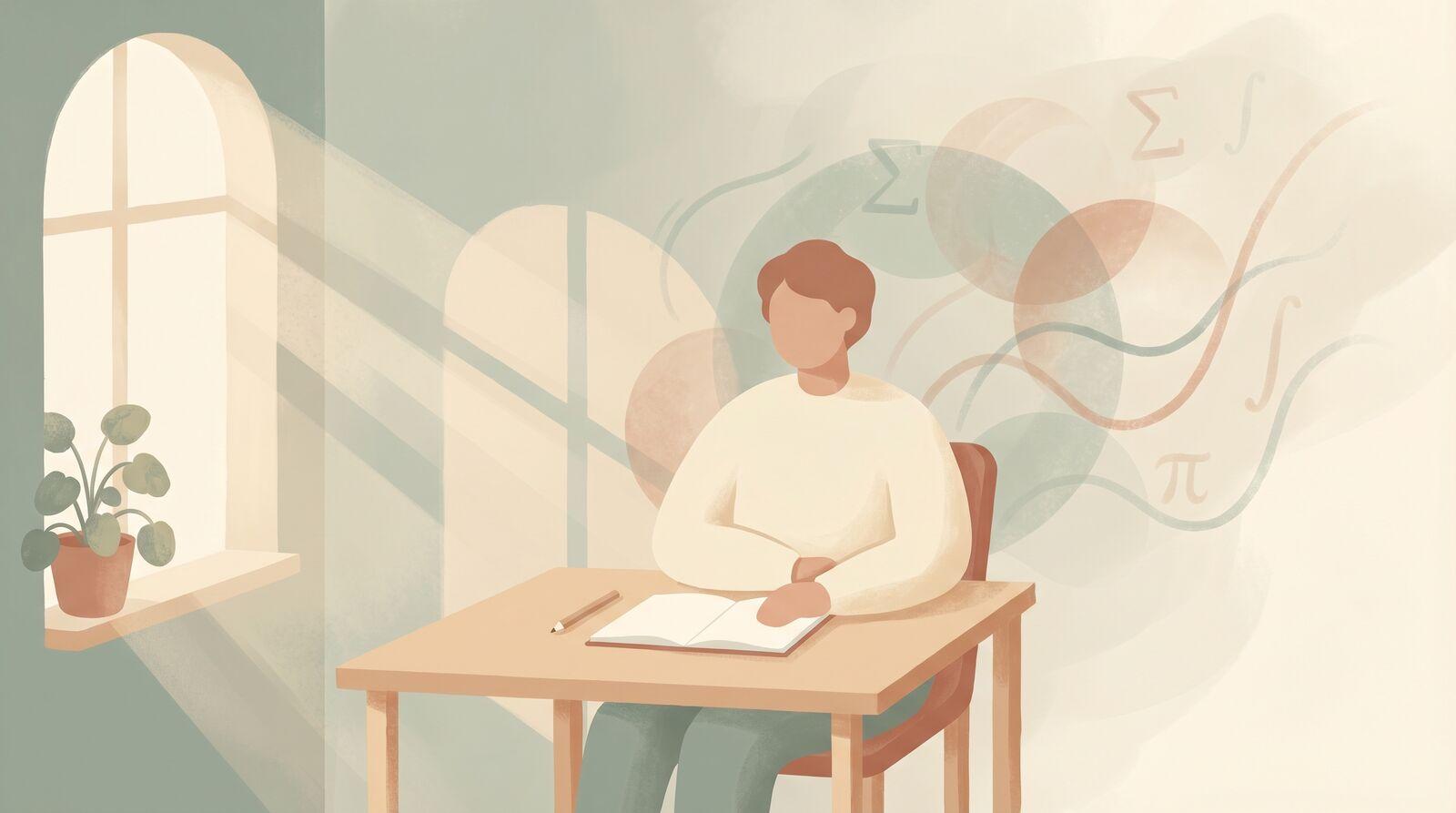
The first practical step is to stop treating anxiety as evidence about your intelligence. It is not. It is a signal that your nervous system has learned to associate math with threat, usually because of a specific past experience: a humiliating moment at the blackboard, a teacher who mocked wrong answers, a timed test that went badly in third grade.
Your brain is doing what brains are designed to do. It is protecting you from a pattern it has flagged as dangerous. The problem is that the pattern it learned is broken, because the consequence of a wrong math answer as an adult is almost always nothing. No predator, no public shame, no real loss. Your job is to teach your nervous system the new truth.
Five Evidence-Based Techniques
Here is what actually works, based on peer-reviewed research in educational psychology.
1. Expressive Writing Before the Test
In a 2011 study published in Science, Ramirez and Beilock found that students who spent 10 minutes writing about their anxieties immediately before a math exam performed significantly better than students who sat quietly or wrote about an unrelated topic. The act of naming the fear on paper appears to free up working memory that was being consumed by suppressing it.
How to apply it: Before your next high-stakes practice session or exam, spend 10 minutes writing freely about how you feel. Do not edit. Do not try to reassure yourself. Just describe what you are afraid of. Then set the paper aside and start the work.
2. Reframe Arousal as Excitement
Racing heart and shallow breathing are also the symptoms of excitement. Research by Alison Wood Brooks at Harvard showed that people who said "I am excited" before a stressful task outperformed those who said "I am calm." The physical state is nearly identical, but the label you put on it changes how your brain interprets the signal.
How to apply it: When you notice the physical symptoms of anxiety, silently say "I am excited, I am ready." It sounds absurd. It works anyway.
3. Build Tolerance Through Low-Stakes Exposure
Anxiety shrinks when you expose yourself to the feared situation in conditions where the stakes are low enough that your nervous system can learn it is safe. This is the same mechanism behind treating phobias.
For math, low-stakes means short sessions with no grade, no timer, no audience. The goal is not to practice the math. The goal is to practice sitting with the discomfort while doing math, and watching nothing bad happen.
How to apply it: Schedule 10 minutes of math practice per day in a setting that feels safe, ideally alone. Pick problems slightly below your edge so that you can solve most of them. The point is not growth. The point is repetition of the neutral experience.
4. Use a Pre-Problem Ritual
A ritual is a fixed, repeatable sequence you perform before engaging with a task. Rituals work because they give your brain a reliable transition from regular mode to work mode. Athletes, musicians, and surgeons use them because the evidence is strong.
How to apply it: Create a 30-second ritual before every practice session. For example: three slow breaths, a specific phrase you say to yourself, a pencil tap, then the first problem. Keep it the same every time. After a few weeks, the ritual itself will start to calm your nervous system before you even start.
5. Swap Performance Goals for Process Goals
A performance goal is an outcome: "I want to get 90% right." A process goal is a behavior: "I will work through 15 problems with full attention." Research on motivation consistently shows that process goals produce better outcomes and lower anxiety, because you control whether you met them.
How to apply it: Before a session, write down the process goal, not the score. At the end, evaluate yourself only on whether you showed up and did the work, not on how many you got right.
Building a Low-Stakes Practice Habit
Techniques work best when they are embedded in a sustainable routine. Here is a simple one to start with.
Daily: 10 to 20 minutes of practice at a comfortable difficulty. No timer. No audience. Expressive writing first if you are feeling tense.
Weekly: One slightly harder session where you push into unfamiliar material. Treat every wrong answer as information, not failure. Note the problem, the mistake, and what you will try next time.
Monthly: One longer session under more realistic test conditions. This is where you practice your ritual, reframe arousal, and prove to your nervous system that it can handle the pressure.
The spaced repetition structure we have written about pairs naturally with this routine because it removes a common anxiety trigger: not knowing what to work on. When the app tells you what to practice next, you save the decision fatigue and emotional wobble of choosing.
How Math Zen Fits In
One reason apps can help with math anxiety specifically is that they remove the audience. No teacher waiting. No classmates watching. No red pen. When you get a problem wrong in Math Zen, the app simply adjusts and moves on. The bucket progression system keeps problems at a level where you are likely to succeed, which gives your nervous system the repeated experience of "doing math and being fine" that underlies all exposure-based treatment.
If timed practice is a specific trigger for you, start with Zen Mode, where there is no timer at all. Only introduce Timed Mode after you have built a base of calm sessions, and even then, keep the early timed sessions short. The goal is to expand your comfort zone gradually, not to blow past it.
When to Seek More Help
The strategies above work well for the ordinary math anxiety that most students experience. If your anxiety is severe enough to cause panic attacks, physical illness before tests, or persistent avoidance that is hurting your life outside of math, talk to a counselor or therapist. Cognitive behavioral therapy has a strong evidence base for anxiety disorders, including math-specific anxiety, and you do not have to white-knuckle it alone.
The Bottom Line
Math anxiety is not a verdict on your ability. It is a learned nervous system response, and like any learned response, it can be unlearned. The path forward is not to push harder through the fear. It is to create enough low-stakes, quiet, repeated experiences of doing math without catastrophe that your brain finally updates its threat model.
Start small. Ten minutes tomorrow. A short expressive writing session if you feel tense. A simple ritual before you begin. Then the first problem. That is all it takes to start the process, and the process is the whole thing.
Common Questions
- Is math anxiety the same as being bad at math?
- No. Researchers consistently find that math anxiety and math ability are surprisingly independent. Many students with strong skills underperform because anxiety hijacks their working memory during tests, while calmer but less-prepared students sometimes outperform them.
- What is the fastest way to reduce math anxiety during a test?
- Slow nasal breathing for 60 to 90 seconds before starting. This lowers heart rate, frees up working memory, and reliably reduces the felt intensity of anxiety. Pair it with writing your worries on paper for five minutes before the test, a technique shown in randomized studies to raise scores.
- Why do I forget math the moment I sit down for a test?
- Anxiety consumes working memory, leaving less capacity for problem solving. The information is still in long-term storage; you just cannot access it under pressure. Reducing physiological arousal through breathing or brief journaling restores access without requiring more study.
- Can math anxiety be cured?
- It can be reduced substantially. The combination of paced breathing, cognitive reframing, low-stakes exposure practice, and mastery-based study works for the majority of students within a few weeks. Severe cases can benefit from cognitive-behavioral therapy.
- Does telling someone you can do math actually help?
- Only when the reframing is specific. Generic encouragement does not move the needle. Saying something like your brain is fine, what is happening is that anxiety is making it feel harder works, because it points at the right cause instead of the wrong one.